
- Home
- Services
- Locations
Amesbury, MA
Boxford, MA
Chelmsford, MA
Danvers, MA
Dracut, MA
Essex, MA
Georgetown, MA
Groveland, MA
Hamilton, MA
Haverhill, MA
Ipswich, MA
Merrimac, MA
Methuen, MA
Middleton, MA
Newbury, MA
Newburyport, MA
North Andover, MA
North Reading, MA
Peabody, MA
Rowley, MA
Salem, MA
Salisbury, MA
Tewksbury, MA
Topsfield, MA
Topsfield, MA
West Newbury, MA
Atkinson, MA
Derry, NH
East Kingston, NH
Kensington, NH
Kingston, NH
Londonderry, NH
Plaistow, NH
Salem, NH
- Company
- Contact
- Home
- Services
- Locations
Amesbury, MA
Boxford, MA
Chelmsford, MA
Danvers, MA
Dracut, MA
Essex, MA
Georgetown, MA
Groveland, MA
Hamilton, MA
Haverhill, MA
Ipswich, MA
Merrimac, MA
Methuen, MA
Middleton, MA
Newbury, MA
Newburyport, MA
North Andover, MA
North Reading, MA
Peabody, MA
Rowley, MA
Salem, MA
Salisbury, MA
Tewksbury, MA
Topsfield, MA
Topsfield, MA
West Newbury, MA
Atkinson, MA
Derry, NH
East Kingston, NH
Kensington, NH
Kingston, NH
Londonderry, NH
Plaistow, NH
Salem, NH
- Company
- Contact
Roof Replacement in Kensington, NH
Kensington is still mostly large lots, older farmhouses, and a good number of homes tucked back under mature oak and pine cover, with newer construction filled in along Amesbury Road and toward the Exeter line. That mix means we see a wider spread of roof problems here than in a typical subdivision town – a hundred-year-old farmhouse roof with three layers of shingles on it sitting a mile from a 1990s colonial that’s due for its first tear-off. There isn’t one Kensington roof problem. There are three or four, depending on which part of town you’re in.
Roof Replacement in Kensington
If you’re standing in your driveway looking up at shingles that are cupping, losing granules, or showing daylight at a valley, you’re probably past the point where a repair buys you much time. We do full tear-offs and re-roofs for Kensington homeowners – architectural asphalt shingle systems mostly, with proper ice and water shield, ridge and soffit ventilation, and flashing done right at every chimney, valley, and sidewall, not just caulked and left. We also handle the low-slope rear additions and porch roofs that a lot of the older Kensington farmhouses have added on over the years, which need a different approach than the main roof.
We’re a Methuen, Massachusetts company, and we work both sides of the state line every week. A homeowner in Kensington has no reason to assume a Massachusetts contractor bothers with the drive out here, so we’ll say it plainly – we do. We’re already covering Salem, Derry, and Windham on this side of the border, and Kensington sits right in that same service radius.
What Kensington roofs are up against
The biggest single factor in Kensington is tree cover. A lot of these lots back up to woods or run along stone-wall tree lines that have been there since the property was farmland, and that means valleys fill with leaves and pine needles every fall. When a valley can’t shed water because it’s packed with debris, water backs up under the shingle edge, and that’s where you start seeing stains on the ceiling below even though the shingles themselves still look fine from the ground. It’s a slower failure than wind damage, but it’s just as real, and it’s specific to towns like this one where the tree canopy is heavy and close to the house.
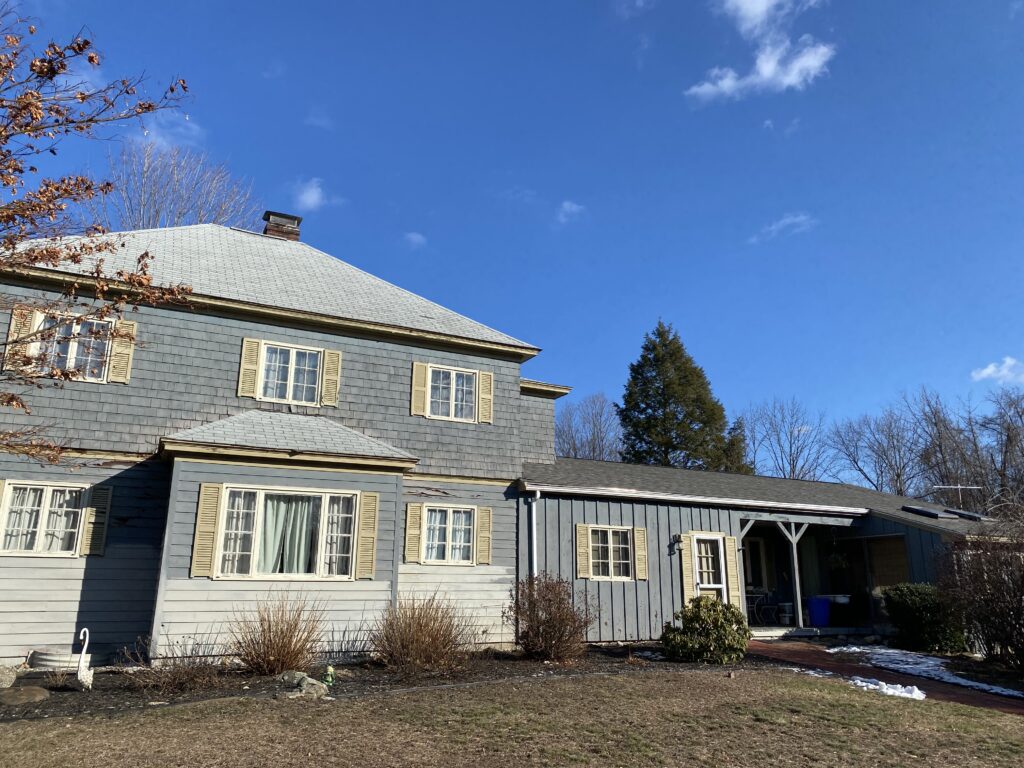
The second issue is age clustering by build era. The older farmhouses in town, some going back well over a century with additions bolted on over the decades, tend to have decking that was never meant to carry today’s shingle weight or ice and water shield requirements, and some still have skip sheathing under the existing roof, which changes what we can put back on it. The newer homes built through the 80s and 90s are now hitting the age where their original roofs are simply worn out on schedule – granule loss, brittle shingles, nail pops along the ridge. North-facing slopes on both types of homes are where we see the worst ice dam damage every winter, because that side of the roof holds snow longest and refreezes overnight, and it’s usually where ventilation was skipped or done wrong the first time.
How we assess it
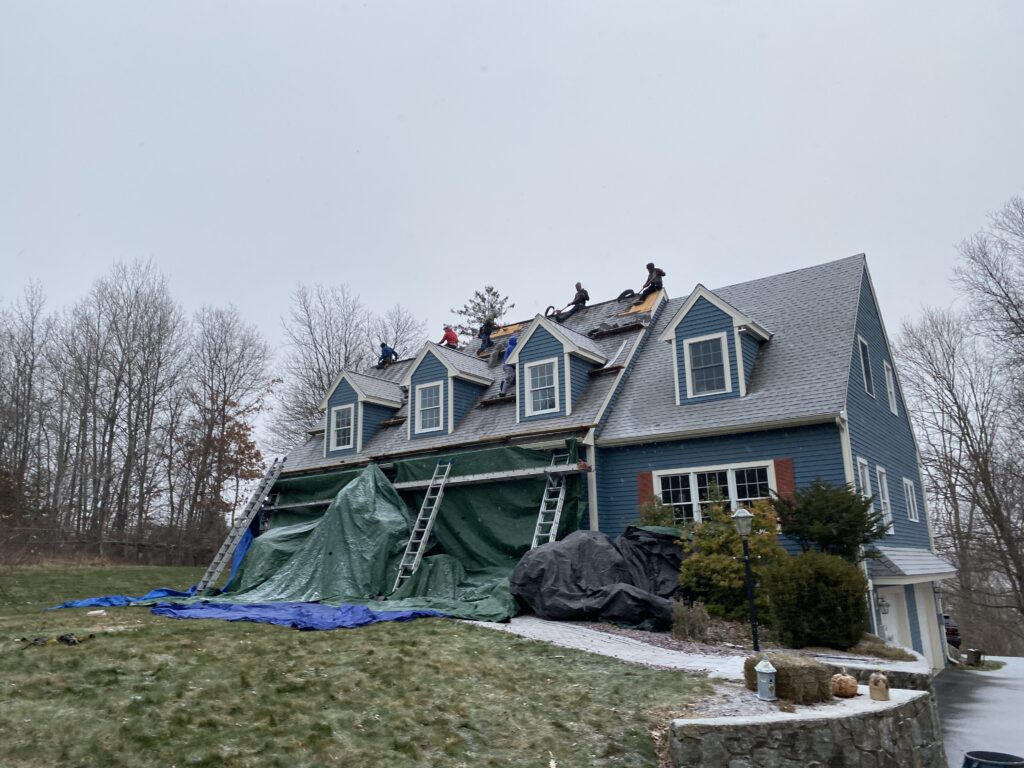
Derek doesn’t quote a roof replacement from the driveway. Before we give you a number, someone gets on the roof and looks at the actual condition of the decking, checks the flashing at every penetration, and looks at how the ridge and soffit vents are working, or not working. Then we go into the attic, because that’s where a roof problem actually shows itself first – staining on the underside of the decking, frost buildup in winter, insulation that’s been compressed or blocking the soffit vents. That combination tells us whether you’re looking at a straightforward reroof or whether there’s decking to replace and ventilation to correct along the way.
Sometimes what looks like a roof problem from inside the house is actually a repair, not a replacement, and we’ll tell you that. A single cracked pipe boot, one storm-damaged section of ridge cap, a flashing detail at a chimney that was never sealed right – those get fixed, not replaced, if the rest of the roof still has years left in it. We’re not going to sell a full tear-off to a roof that needs a $400 repair.
What the job involves
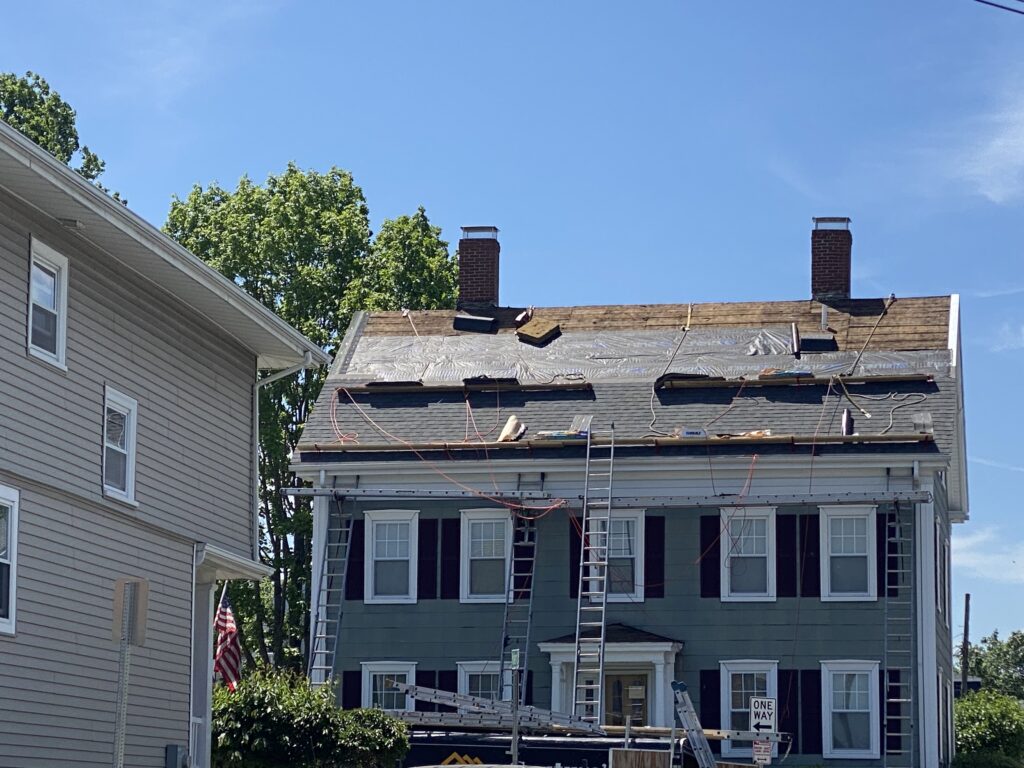
A full tear-off starts with stripping the existing roofing down to the decking, and that’s the point where we find out what’s actually underneath – sometimes that’s clean plywood in good shape, sometimes it’s original board sheathing with soft spots that need to be cut out and replaced before anything else happens. From there we install ice and water shield along the eaves, valleys, and any low-slope sections, felt or synthetic underlayment across the rest of the field, new flashing at every chimney, skylight, and sidewall, and the shingle system itself, matched to the wind exposure and pitch of your particular roof. We finish with ridge venting tied into functioning soffit intake, because one without the other doesn’t move air the way it’s supposed to. Cleanup includes a magnetic sweep for nails, every day, not just at the end of the job.
What it costs
Most Kensington roof replacements run between {PRICE_LOW} and {PRICE_HIGH}, and the honest answer to what moves that number is size, pitch, and what we find once the old roofing comes off. A simple ranch with one layer of shingles and easy ground access costs less than a steep colonial with multiple valleys, dormers, and two layers to strip. Rotted decking, if we find it, gets priced separately once we can see how much there is – we don’t guess at that number before the tear-off, and we won’t pad it in either. Access matters too – a roof we can drive equipment right up to costs less in labor than one boxed in by trees or a tight driveway, which is worth knowing given how many wooded lots there are in this town.
How long it takes
Most single-family roof replacements in Kensington take one to two days once material is on site, weather permitting. Homes with steeper pitches, more roof planes, or decking repairs run longer. New Hampshire’s permitting process is different from what we deal with on the Massachusetts side, and the town has its own building permit requirements for full reroofs – we handle that paperwork as part of the job so you’re not the one tracking it down.
How do I know if I need a roof replacement instead of a repair?
Widespread granule loss, shingles that are curling or cupping across most of the roof, soft spots in the decking, or ceiling stains that keep reappearing after repairs are all signs the roof is past patching. A single damaged spot on an otherwise sound roof is usually a repair, not a replacement, and we'll tell you which one you're actually looking at after we get on the roof.
Do you work on both sides of the Massachusetts and New Hampshire line?
Yes. We're based in Methuen, Massachusetts, but Kensington is well within our regular service area alongside Salem, Derry, and Windham on the New Hampshire side. Crossing the state line doesn't change how we price or schedule a job.
What causes ice dams on Kensington roofs?
Ice dams form when heat escaping from the attic melts snow on the roof, which then refreezes at the colder eaves and backs water up under the shingles. It's most common on north-facing slopes and roofs where ridge and soffit ventilation isn't balanced, which is something we check specifically during an assessment.
Does a roof replacement include work in the attic?
We don't touch attic insulation or structural framing as a default, but our assessment always includes a look at the underside of the decking and the ventilation setup, because that's often where a roofing problem starts. If we see something that needs attention beyond the roof itself, we'll point it out before work begins, not after.
Do you handle the building permit for a Kensington roof replacement?
Yes. New Hampshire's permitting requirements are different from Massachusetts, and we take care of pulling the permit for the town as part of the job.
Get an estimate
If you’ve got shingles that are curling, granules collecting in the gutters, or a ceiling stain that showed up after last winter’s ice, call {PHONE} and we’ll get someone out to look at it. Derek quotes the jobs himself, so what you’re told on the roof is what shows up on the estimate.