
- Home
- Services
- Locations
Amesbury, MA
Boxford, MA
Chelmsford, MA
Danvers, MA
Dracut, MA
Essex, MA
Georgetown, MA
Groveland, MA
Hamilton, MA
Haverhill, MA
Ipswich, MA
Merrimac, MA
Methuen, MA
Middleton, MA
Newbury, MA
Newburyport, MA
North Andover, MA
North Reading, MA
Peabody, MA
Rowley, MA
Salem, MA
Salisbury, MA
Tewksbury, MA
Topsfield, MA
Topsfield, MA
West Newbury, MA
Atkinson, MA
Derry, NH
East Kingston, NH
Kensington, NH
Kingston, NH
Londonderry, NH
Plaistow, NH
Salem, NH
- Company
- Contact
- Home
- Services
- Locations
Amesbury, MA
Boxford, MA
Chelmsford, MA
Danvers, MA
Dracut, MA
Essex, MA
Georgetown, MA
Groveland, MA
Hamilton, MA
Haverhill, MA
Ipswich, MA
Merrimac, MA
Methuen, MA
Middleton, MA
Newbury, MA
Newburyport, MA
North Andover, MA
North Reading, MA
Peabody, MA
Rowley, MA
Salem, MA
Salisbury, MA
Tewksbury, MA
Topsfield, MA
Topsfield, MA
West Newbury, MA
Atkinson, MA
Derry, NH
East Kingston, NH
Kensington, NH
Kingston, NH
Londonderry, NH
Plaistow, NH
Salem, NH
- Company
- Contact
Roof Repair in Newburyport, MA
Walk through downtown Newburyport and you’ll see slate-look and slope-heavy roofs on federal-era homes packed tight against each other, with barely enough side yard to set a ladder. A few blocks out, toward the Merrimack and the marshes, the houses open up but the wind off the water doesn’t let up. Those two conditions – dense historic construction and coastal exposure – drive most of the repair calls we get in this city.
Roof Repair in Newburyport
Most homeowners who call us about roof repair in Newburyport aren’t sure yet whether they need a repair or something bigger. That’s fine. That’s the point of the call. A stain on a bedroom ceiling, a shingle in the yard after a nor’easter, a soft spot near the chimney – these are symptoms, and the right fix depends on what’s actually happening under the surface, not on what the roof looks like from the street.
We’re not going to tell you every roof needs to be replaced. Plenty of the roofs we work on in this city get another five, ten, sometimes fifteen years out of a targeted repair. Our job is to find out which category yours is in before we quote anything.
What Newburyport roofs are up against
This close to the water, wind uplift is not a theoretical concern. Shingles rated for standard wind exposure can start lifting at the tab line in a sustained coastal blow, especially on roofs with wide open faces toward the river or the marsh. Salt-laden air also accelerates the breakdown of exposed fasteners and flashing metal faster than it would twenty miles inland. If you’re seeing granule loss concentrated on one side of the roof, or lifted tabs after every big storm, that’s usually wind exposure catching up with an older shingle, not a defect.
The downtown housing stock adds a second layer of difficulty. A lot of these federal and Greek Revival homes have low-slope additions tacked onto the rear, tight valleys where two roof planes meet, and chimneys built into the roof plane rather than at a gable end – all classic spots for flashing failure. Some of these homes also sit in or near a local historic district, which can affect what materials and roof lines are allowed on street-facing slopes. And because many of these houses are built shoulder to shoulder, access for a repair crew is often limited to what can go over the front or come off a narrow driveway, which changes how we stage the job.
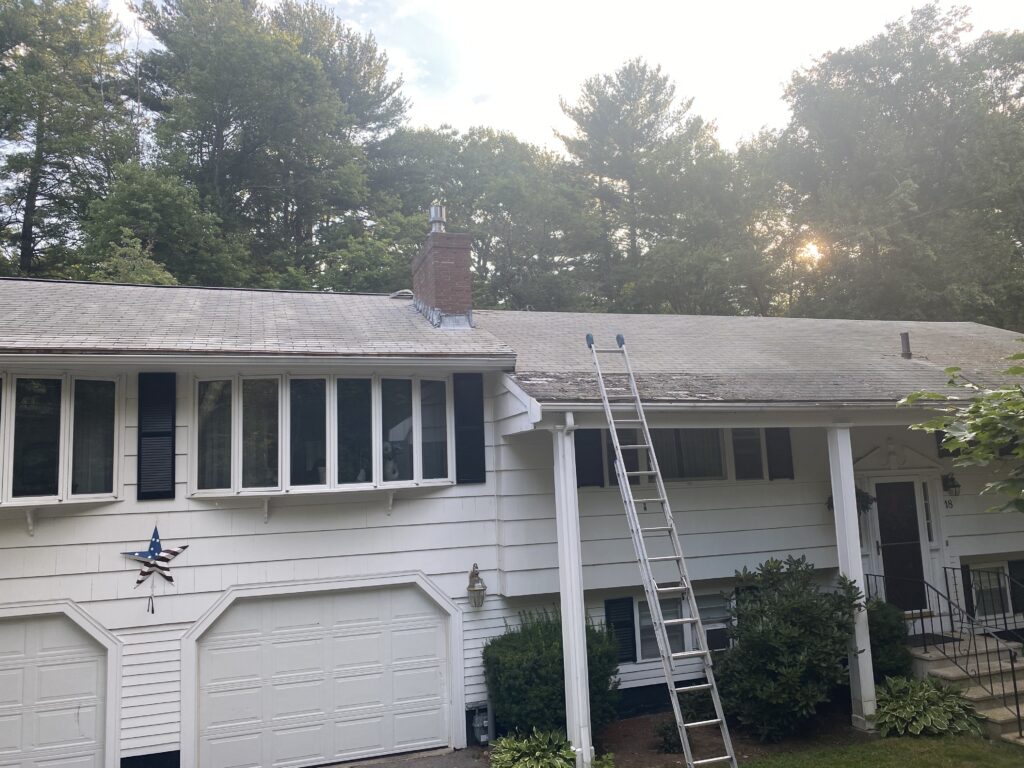
How we assess it
Before Derek or one of our crew leads tells you anything about cost or scope, we get on the roof and, if possible, into the attic. On the roof, we’re checking the decking for soft spots underfoot, the condition and age of the shingle field, the flashing at every chimney, sidewall, and valley, and whether the ridge and any soffit vents are actually doing their job or just installed for looks. From inside the attic we look at the underside of the decking for water staining, check insulation for compression or gaps, and look for daylight where there shouldn’t be any.
A proper assessment happens before a recommendation, not after. If a repair solves the problem, we say so. If the decking is soft in more than a spot or two, or the shingle is failing across the whole field rather than in one localized area, we’ll tell you that too, and explain why patching it would just be spending money to delay the same conversation.
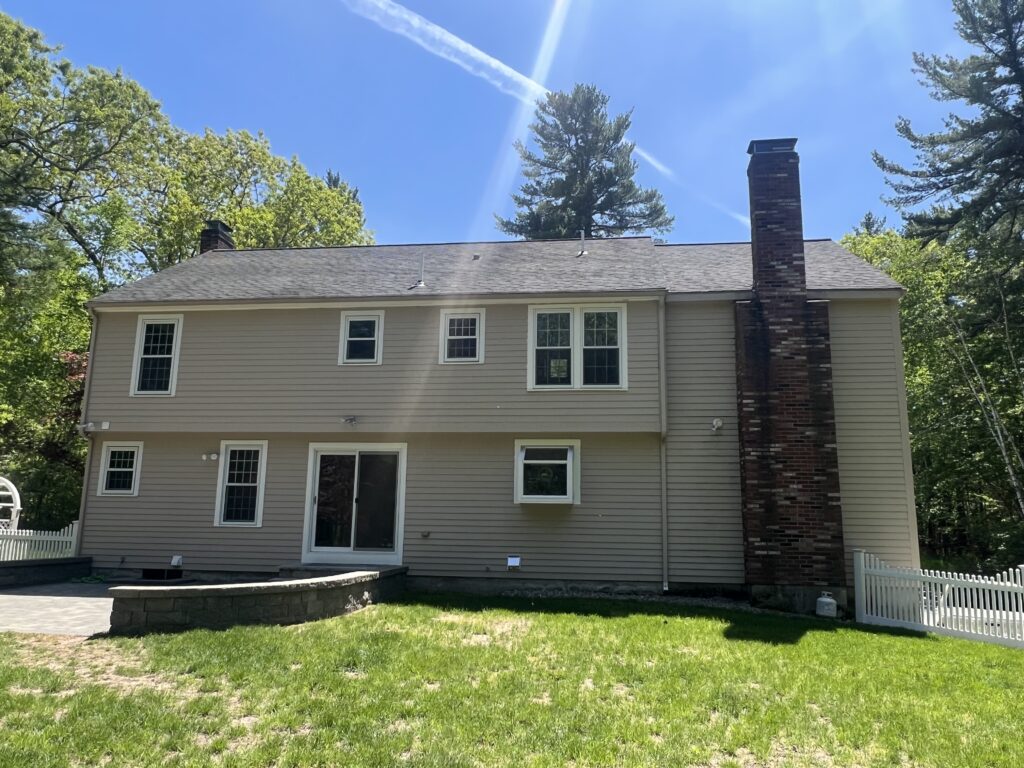
What the job involves
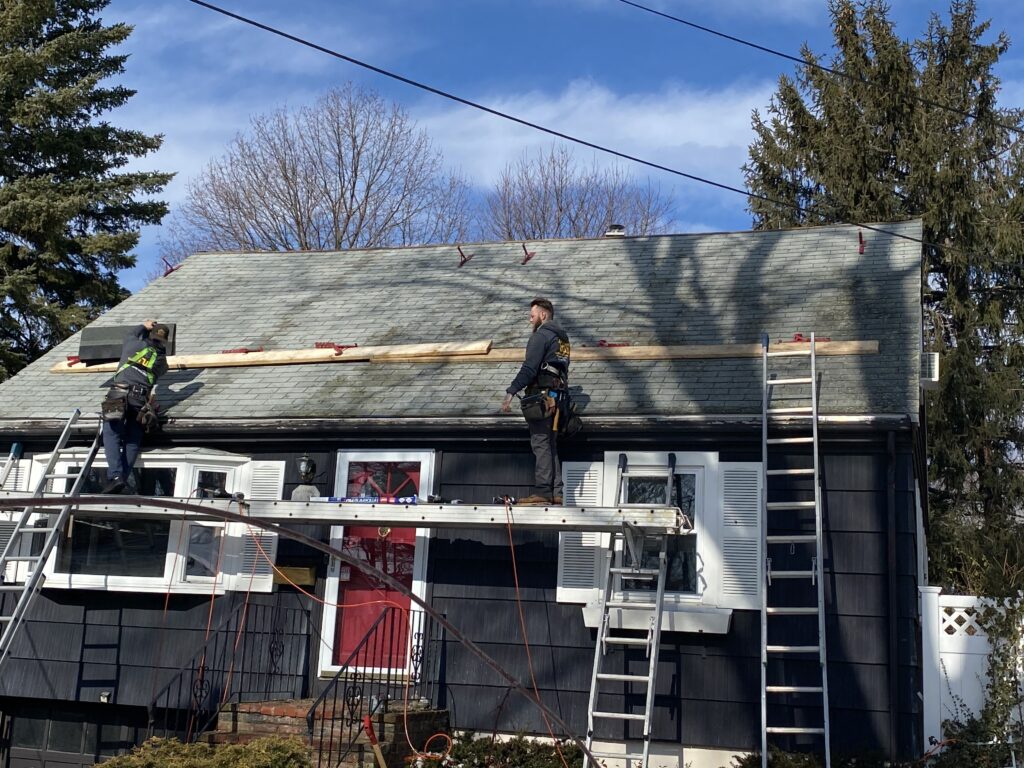
A straightforward repair – a section of storm-damaged shingles, a flashing failure at a chimney or valley, a vent boot that’s cracked and letting water in – typically means stripping the affected area down to the decking, checking the decking underneath for rot before anything goes back down, and rebuilding the flashing and ice and water shield in that section to current standards even if the surrounding roof is older. We match shingle as closely as we can to what’s already up there, though on an older roof an exact match isn’t always possible.
If the problem is ice damming on a north-facing slope, the repair usually isn’t just patching the leak point. It’s adding or extending ice and water shield along the eaves and improving attic ventilation so the roof deck stays cold and even, which is what actually stops the dam from forming in the first place.
What it costs
Most roof repairs we do in Newburyport run in the range of {PRICE_LOW} to {PRICE_HIGH}, and where a job lands in that range depends on a handful of specific things: how much of the roof is affected, the pitch and how safely we can work it, whether there are one or two layers of old shingle to deal with in that section, and what we find once decking is exposed. Chimney and valley flashing repairs tend to run toward the lower end unless the surrounding decking is compromised. Ice dam damage that requires deck repair and added ventilation runs higher. We won’t give you a number over the phone that means anything – we’ll give you one after we’ve actually seen the roof.
How long it takes
A single-area repair – one valley, one chimney, one section of storm damage – is usually a one-day job for our crew, weather permitting. Repairs that involve deck replacement or a full ice-and-water rebuild along an eave can run into a second day. Coastal weather in this area doesn’t always cooperate, so we build a little flexibility into the schedule rather than promising a date we can’t guarantee.
Can my roof actually be repaired instead of replaced?
Often, yes. If the issue is localized – a valley, a chimney flashing failure, storm damage to one section – and the decking and shingle field elsewhere are sound, a repair is the right call. We only recommend replacement when the damage or wear is spread across the whole roof, or the decking underneath is failing in multiple areas.
Why does wind damage seem worse here than it does further inland?
Newburyport sits close enough to open water that sustained coastal wind puts more uplift force on a shingle edge than the same storm would produce twenty miles inland. Older shingles rated for standard exposure are more prone to tab lift in that kind of wind, which is why we look at wind rating when matching or replacing shingle in a repair.
Will historic district rules affect my repair?
If your home is in or near Newburyport's local historic district, street-facing roof work can be subject to review, particularly around visible material changes. We'll flag this during the assessment if it applies to your property so there are no surprises.
Do you check the attic as part of the assessment?
Yes, whenever we can get access. The underside of the decking tells us things the topside can't – water staining, past leak paths, ventilation problems – and it's a key part of giving you an honest recommendation rather than a guess.
What causes ice dams on Newburyport roofs?
Ice dams form when heat escaping from the living space warms the roof deck unevenly, melting snow that refreezes at the colder eave. It's most common on north-facing slopes with poor attic ventilation. The fix usually involves both ice and water shield at the eaves and improving airflow through the attic, not just patching the leak point.
Get an estimate
If you’ve got a leak, a shingle problem, or a spot that’s been bothering you since the last storm, call Couture’s Construction at {PHONE}. We’ll set up a time to get on the roof, tell you plainly what we find, and give you an honest answer on whether a repair is the right move. We’re a family-owned crew based in Methuen and BBB accredited with an A+ rating, and we’d rather fix what can be fixed than sell you more than you need.