
- Home
- Services
- Locations
Amesbury, MA
Boxford, MA
Chelmsford, MA
Danvers, MA
Dracut, MA
Essex, MA
Georgetown, MA
Groveland, MA
Hamilton, MA
Haverhill, MA
Ipswich, MA
Merrimac, MA
Methuen, MA
Middleton, MA
Newbury, MA
Newburyport, MA
North Andover, MA
North Reading, MA
Peabody, MA
Rowley, MA
Salem, MA
Salisbury, MA
Tewksbury, MA
Topsfield, MA
Topsfield, MA
West Newbury, MA
Atkinson, MA
Derry, NH
East Kingston, NH
Kensington, NH
Kingston, NH
Londonderry, NH
Plaistow, NH
Salem, NH
- Company
- Contact
- Home
- Services
- Locations
Amesbury, MA
Boxford, MA
Chelmsford, MA
Danvers, MA
Dracut, MA
Essex, MA
Georgetown, MA
Groveland, MA
Hamilton, MA
Haverhill, MA
Ipswich, MA
Merrimac, MA
Methuen, MA
Middleton, MA
Newbury, MA
Newburyport, MA
North Andover, MA
North Reading, MA
Peabody, MA
Rowley, MA
Salem, MA
Salisbury, MA
Tewksbury, MA
Topsfield, MA
Topsfield, MA
West Newbury, MA
Atkinson, MA
Derry, NH
East Kingston, NH
Kensington, NH
Kingston, NH
Londonderry, NH
Plaistow, NH
Salem, NH
- Company
- Contact
Roof Repair in Andover, MA
Andover’s residential roofs fall into two groups. Near the center of town, older colonials and capes have steep pitches, dormers, and valleys that were built before modern flashing standards. Out toward Route 133 and North Main, the newer subdivisions are running standard architectural shingle roofs that are now closing in on the 15 to 20 year mark, right when nail pops and granule loss start showing up.
Professional Roof Repair Solutions for Andover Homes
We fix what’s actually broken. That’s flashing repair around chimneys and valleys, isolated shingle replacement after wind or storm damage, pipe boot and vent flashing replacement, ridge cap repair, valley debris clearing, and leak diagnosis when water’s showing up inside but nobody can tell where it’s coming from. A repair is a legitimate job on its own, not a stop on the way to selling you a new roof. If a handful of shingles took wind damage or a valley’s flashing has come loose, that’s the whole job, start to finish. Where a leak is tied to poor attic ventilation rather than a roofing defect, we’ll say so and point you to the actual cause instead of replacing shingles that were never the problem.
What Andover roofs are up against
The Merrimack Valley gets ice dams every winter on north-facing slopes, where snow melts from attic heat loss and refreezes at the eave, backing water up under the shingles. It’s one of the most common calls we get from January through March, and it’s often mistaken for a roofing defect when the real cause is poor attic ventilation or insulation letting heat escape upward. Heavy tree cover across most of Andover means valleys collect leaves and pine debris that hold moisture against the shingle longer than it should sit, and you’ll see moss or dark streaking on the shaded side of a roof well before it shows up anywhere sunnier. South-facing slopes with more direct sun tend to shed debris and dry out faster, which is part of why two sides of the same roof can be in noticeably different condition.
The town’s two building eras fail differently. The older homes near downtown and the historic district have steep rooflines with multiple valleys and dormer flashing, which is where most of the leaks we get called for actually start. Complex rooflines mean more transitions, and every transition is a place water can find its way in if the flashing wasn’t detailed correctly the first time. The subdivisions off Route 133 are simpler roof geometry, but a lot of them are hitting the age where the original nailing pattern starts working loose and shingles lift in wind before they visibly fail. On these roofs, the first sign is often a missing shingle after a windstorm rather than a slow leak.
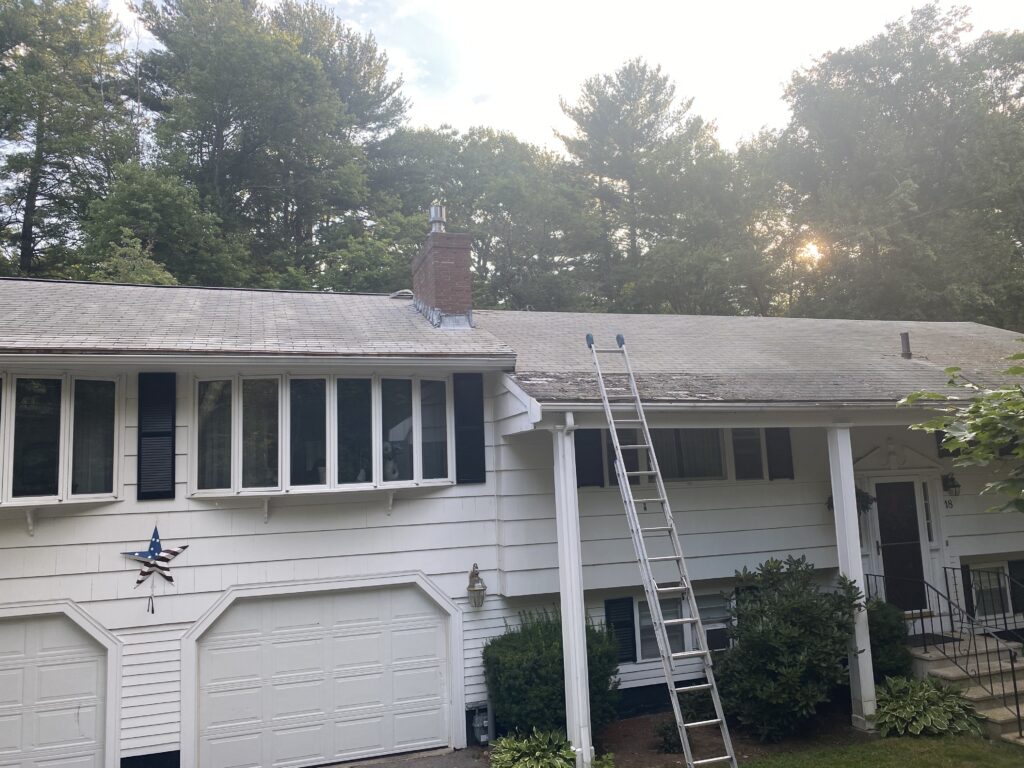
How we assess it
Derek gets on the roof and finds the actual entry point before anyone talks about fixing anything. That means checking flashing at every valley, chimney, and dormer, checking the shingle field for granule loss and lifted tabs, checking pipe boots and vent flashing for cracking, and checking the attic underside for staining or damp decking, because a leak often shows up inside several feet from where the water actually got in. On steeper or more complex roofs we’ll also check ridge and soffit ventilation, since poor airflow is what drives a lot of the ice dam problems we see here. You get a real diagnosis before a recommendation, not a guess based on where the ceiling stain happens to be.
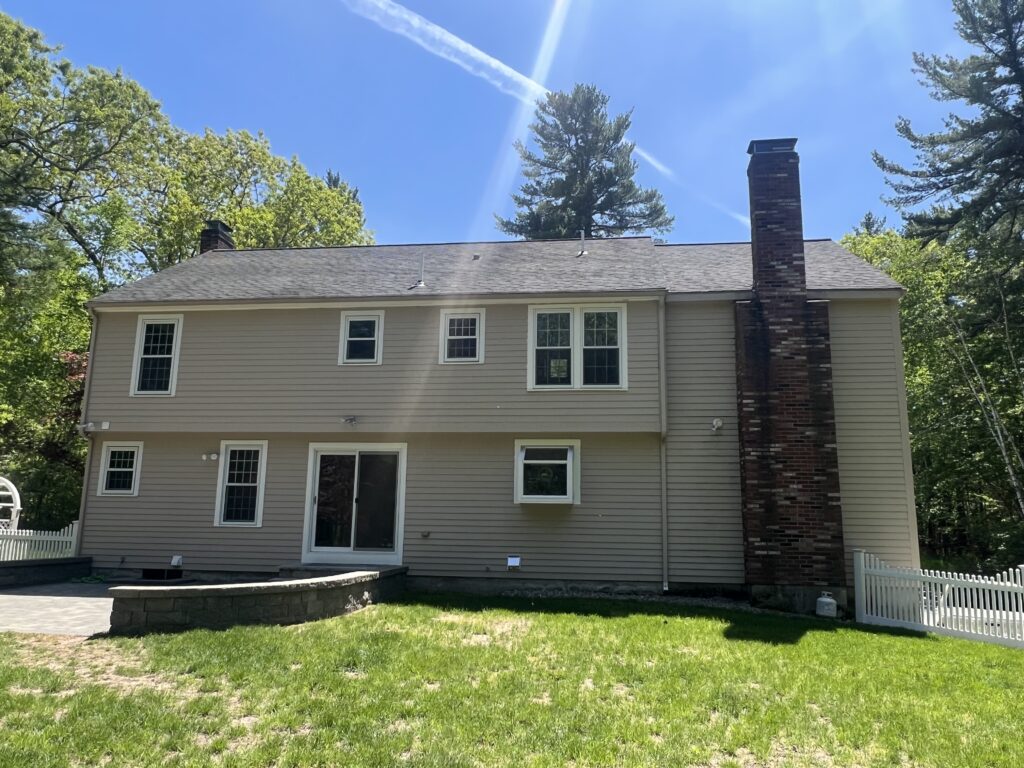
What the job involves
Most of what we do here is targeted. If the deck is sound and the issue is a failed flashing seam, a damaged valley, a cracked pipe boot, or a section of shingles that took wind or hail damage, a repair fixes it and there’s no reason to talk about anything bigger. We’ll say so plainly. Matching your existing shingle color and profile is part of doing a repair properly, and on an open valley we’ll re-flash with new valley metal rather than just patching over what’s there, because a patched valley is one of the more common places a repair fails again within a year or two. On a closed-cut valley, the fix is usually replacing the shingles that form the valley line itself rather than the metal underneath, and knowing which type you have changes how the repair gets done.
A repair isn’t the right answer everywhere, and we’ll tell you that too. If the shingle field is showing granule loss across the whole roof, if there are already two layers down and the deck’s starting to sag, or if the leak keeps coming back in a new spot after repairs, patching it again just delays a job that needs to happen anyway. We’d rather tell you that up front than have you pay for a repair twice.
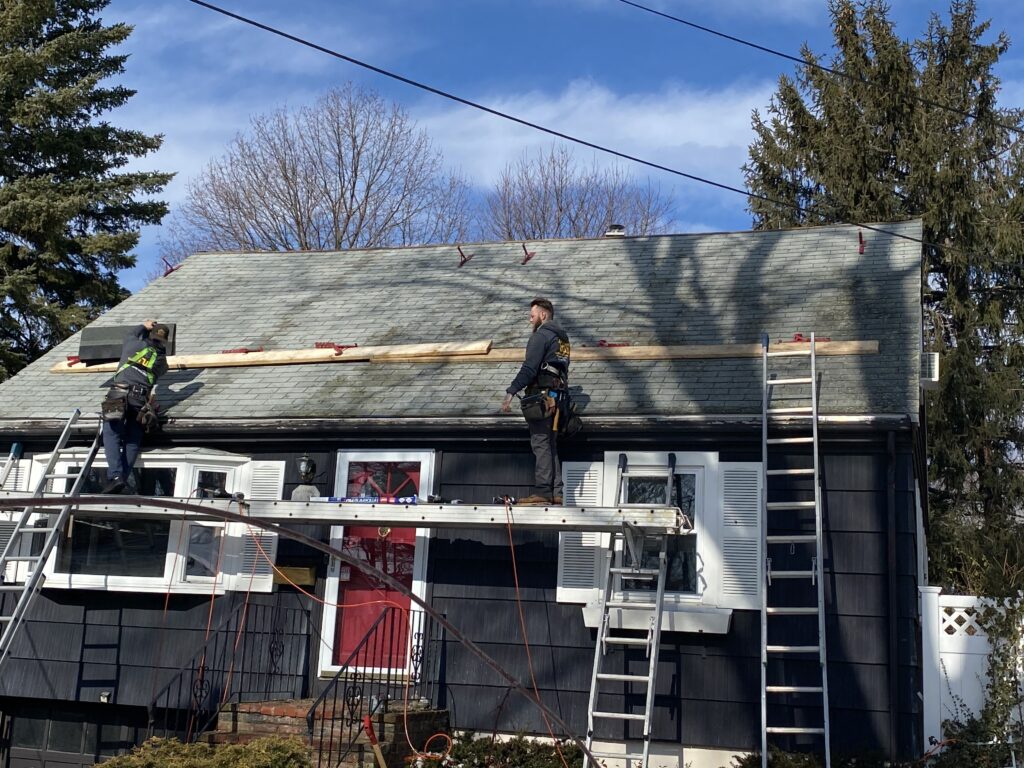
How long it takes
Most repairs are a single day. A larger job with more than one problem area, or one that turns up decking damage once we’re into it, can run two days. Weather is the main thing that moves this. We don’t put a crew on a wet or icy roof, and steep-pitch work in particular waits for dry, stable conditions.
Common questions
Please reach us at [email protected] if you cannot find an answer to your question.
Do I need a full replacement, or will a repair actually fix this?
Depends what we find. If the roof’s otherwise sound and the problem is localized, a repair is the right call and that’s what we’ll recommend. We’ll tell you honestly if it isn’t enough.
How do I know if I actually have a roof leak?
Ceiling stains, damp spots in the attic after rain or snowmelt, and daylight visible through the roof deck from inside are the clearest signs. A stain doesn’t always mean the leak is directly above it, which is part of why the assessment matters.
Can you match my existing shingles?
In most cases, yes, especially on common architectural shingle profiles. Exact color match gets harder on an older roof where the existing shingles have weathered and faded.
Do you handle storm or insurance-related repairs?
Yes. We’ll document the damage clearly enough to support a claim, and we’ll tell you honestly whether what you’re looking at is storm damage or normal wear.
Should I fix a small leak now or wait until spring?
Fix it now if you can. A small leak in winter tends to get worse, not better, especially with ice dams adding pressure at the eaves. Waiting usually turns a contained repair into a bigger one by the time the snow melts.
What's the difference between an open and closed valley, and does it matter for a repair?
An open valley has exposed metal running down the center where two roof planes meet. A closed-cut valley has shingles woven over it with no metal visible. Both fail differently, so knowing which one you have changes whether the fix is new valley metal or new shingles along that line.
Get an estimate
Couture’s Construction is based in Methuen and repairs roofs across Andover and the rest of the Merrimack Valley. We’re BBB accredited with an A+ rating. Call 978-778-2856 for an honest look at what’s actually wrong.