
- Home
- Services
- Locations
Amesbury, MA
Boxford, MA
Chelmsford, MA
Danvers, MA
Dracut, MA
Essex, MA
Georgetown, MA
Groveland, MA
Hamilton, MA
Haverhill, MA
Ipswich, MA
Merrimac, MA
Methuen, MA
Middleton, MA
Newbury, MA
Newburyport, MA
North Andover, MA
North Reading, MA
Peabody, MA
Rowley, MA
Salem, MA
Salisbury, MA
Tewksbury, MA
Topsfield, MA
Topsfield, MA
West Newbury, MA
Atkinson, MA
Derry, NH
East Kingston, NH
Kensington, NH
Kingston, NH
Londonderry, NH
Plaistow, NH
Salem, NH
- Company
- Contact
- Home
- Services
- Locations
Amesbury, MA
Boxford, MA
Chelmsford, MA
Danvers, MA
Dracut, MA
Essex, MA
Georgetown, MA
Groveland, MA
Hamilton, MA
Haverhill, MA
Ipswich, MA
Merrimac, MA
Methuen, MA
Middleton, MA
Newbury, MA
Newburyport, MA
North Andover, MA
North Reading, MA
Peabody, MA
Rowley, MA
Salem, MA
Salisbury, MA
Tewksbury, MA
Topsfield, MA
Topsfield, MA
West Newbury, MA
Atkinson, MA
Derry, NH
East Kingston, NH
Kensington, NH
Kingston, NH
Londonderry, NH
Plaistow, NH
Salem, NH
- Company
- Contact
Commercial Roofing in Hamilton, MA
Hamilton doesn’t have a business park or a strip of office buildings. What it has is a handful of buildings above retail on Bay Road, a few municipal and church roofs, and a lot of large private properties with barns, garages, and outbuildings that carry a low-slope roof section somewhere on them. That’s the commercial roofing work here, and it’s real work, it’s just not the kind of volume you’d find in Peabody or Danvers.
Commercial Roofing in Hamilton
If you own or manage a building in Hamilton with a flat or low-slope roof section, you’re dealing with a different set of problems than a homeowner two doors down with a gable roof. Membrane roofing doesn’t fail the way shingles do. It fails at seams, at penetrations, at drains that were never sized right to begin with, and it usually fails slow, as a stain on a ceiling tile long before it’s a leak you can see from outside. We work on these roofs, and we work around the fact that most of them sit over a business or a building that can’t just shut down for two weeks.
Flat and Low-Slope Systems We Install
Most of what we put on commercial and mixed-use buildings in this part of Massachusetts is EPDM (rubber membrane), TPO, or modified bitumen, depending on the roof’s slope, its exposure, and what’s already up there. EPDM is the workhorse for a lot of these smaller flat sections because it’s forgiving to install and repair. TPO gives you a reflective white surface that helps with heat load on a roof over occupied space. Modified bitumen still shows up on older barn and outbuilding conversions where a torch-down or self-adhered system fits the existing structure without a full tear-off. We’ll tell you which one fits your building instead of selling you whichever one we happen to have on the truck.
What Hamilton roofs are up against
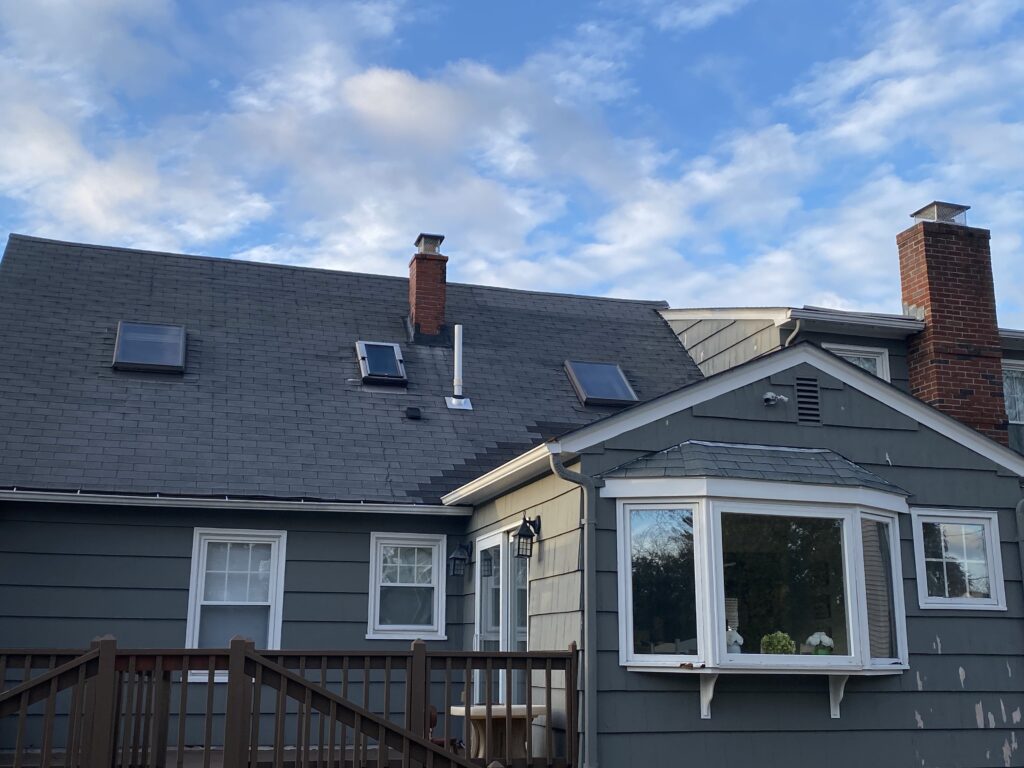
The commercial and mixed-use buildings here that do have flat or low-slope sections are almost always tucked behind or under a steeper pitched roof, an addition off the back of a colonial storefront, a shed roof over an old barn bay that’s now storage or workshop space. That transition point, where low-slope meets steep-slope, is where these roofs actually fail. Water backs up against the step flashing, debris collects in the valley formed by the two planes, and if nobody’s looked at it in a few years, the membrane underneath has usually been sitting in standing water longer than anyone realizes.
Hamilton’s tree cover adds to it. Heavy leaf and pine litter loads onto low-slope roofs and clogs drains and scuppers faster than most owners expect, especially on buildings set back off the road under mature trees. On the town’s larger properties, outbuildings often sit at odd angles to prevailing wind, and older membrane roofs that were installed without proper edge fastening can lift at the perimeter over time. None of this shows up from the parking lot. It shows up when we get on the roof.
How we assess it
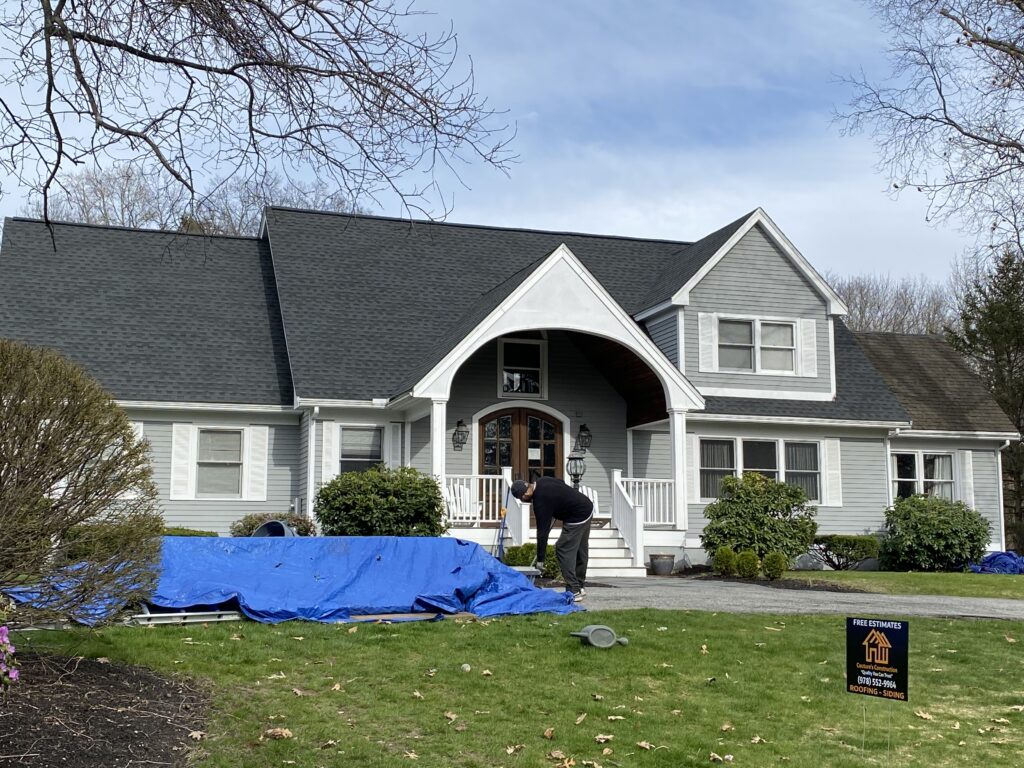
Derek walks the roof before anyone talks numbers. That means checking the membrane itself for splits, blistering, and open seams, checking every penetration and flashing detail around HVAC units, vents, and drains, and checking the perimeter edge metal, which is where a surprising number of commercial roof leaks actually start. If there’s access to the deck below, whether that’s an attic space over a mixed-use unit or open framing in a barn, we look at that too, because wet insulation and rotted decking change the scope of the job completely. We’re not going to recommend a full membrane replacement over a roof that needs a flashing repair, and we’re not going to patch a roof that’s past patching just to keep the invoice small. You get told what we actually see.
What the job involves
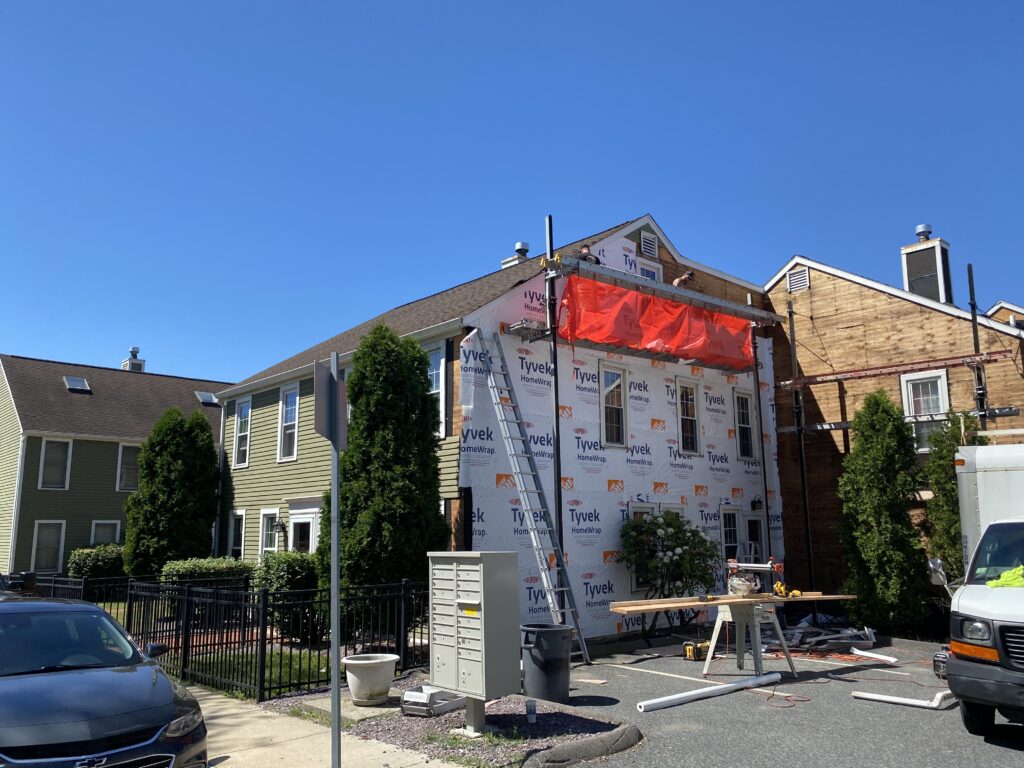
Every commercial or outbuilding roof job starts with figuring out what’s under the current membrane and whether it can stay. If the insulation is dry and the deck is sound, a recover over the existing roof is sometimes the right call and it costs less. If it’s wet, it comes off, because wet insulation under a new membrane just guarantees a callback in two years. From there it’s decking repair where needed, new flashing at every wall termination and penetration, and the membrane itself, fully adhered or mechanically fastened depending on the system and the wind exposure at the site. On buildings still in use, we phase the work so sections stay watertight overnight and traffic in and out of the building isn’t blocked.
What it costs
Commercial flat and low-slope roofing runs {PRICE_LOW} to {PRICE_HIGH} for most of the projects we see on Hamilton’s mixed-use and outbuilding stock, and the spread is wide because these jobs vary more than a straightforward residential re-roof. Size and access matter, a roof over an active retail space with limited staging room costs more to work around than an outbuilding with a driveway right up to it. Deck condition matters, rotted plywood or sheathing found once the old membrane comes off adds cost you can’t quote until we see it. And system choice matters, a recover is cheaper than a full tear-off and replacement. We’ll give you a real number after the assessment, not before it.
Does Hamilton have much commercial roofing work at all?
Not much, honestly. Most of what we handle here is above small retail on Bay Road, a municipal or church roof, or a barn and outbuilding on one of the town's larger properties. It's real work, it's just lower volume than towns with actual commercial districts.
Can you work on my roof while my business stays open?
Yes, that's normal for us. We phase the work in sections so the roof stays watertight at the end of each day and we plan access so it doesn't block customer or delivery traffic.
EPDM, TPO, or modified bitumen, how do I know which one is right?
It depends on the roof's slope, sun exposure, and what's already installed. We'll walk you through the tradeoffs after we've seen the roof rather than defaulting to one system.
What if you find rot once the old roof comes off?
We stop and show you before we go further. Wet insulation and rotted decking change the scope and the cost, and we'd rather tell you what we found than cover it up and hope.
Do you handle roofs on outbuildings and barns, not just main buildings?
How long it takes
A straightforward recover on a small commercial or outbuilding section can be a two to three day job. A full tear-off with deck repair and new insulation runs longer, and if the building is occupied, we phase it to keep it weathertight at the end of every work day rather than pushing straight through. Weather matters more on membrane work than on shingle work, since most of these systems need dry conditions and a workable temperature range to adhere and seal properly, so scheduling around a stretch of decent weather is part of planning the job right.
Get an estimate
If you own or manage a building in Hamilton with a flat roof, a low-slope addition, or an outbuilding that needs attention, call Couture’s Construction at {PHONE}. We’ll get up on the roof, tell you honestly what shape it’s in, and put together a scope that fits how the building is actually used.