
- Home
- Services
- Locations
Amesbury, MA
Boxford, MA
Chelmsford, MA
Danvers, MA
Dracut, MA
Essex, MA
Georgetown, MA
Groveland, MA
Hamilton, MA
Haverhill, MA
Ipswich, MA
Merrimac, MA
Methuen, MA
Middleton, MA
Newbury, MA
Newburyport, MA
North Andover, MA
North Reading, MA
Peabody, MA
Rowley, MA
Salem, MA
Salisbury, MA
Tewksbury, MA
Topsfield, MA
Topsfield, MA
West Newbury, MA
Atkinson, MA
Derry, NH
East Kingston, NH
Kensington, NH
Kingston, NH
Londonderry, NH
Plaistow, NH
Salem, NH
- Company
- Contact
- Home
- Services
- Locations
Amesbury, MA
Boxford, MA
Chelmsford, MA
Danvers, MA
Dracut, MA
Essex, MA
Georgetown, MA
Groveland, MA
Hamilton, MA
Haverhill, MA
Ipswich, MA
Merrimac, MA
Methuen, MA
Middleton, MA
Newbury, MA
Newburyport, MA
North Andover, MA
North Reading, MA
Peabody, MA
Rowley, MA
Salem, MA
Salisbury, MA
Tewksbury, MA
Topsfield, MA
Topsfield, MA
West Newbury, MA
Atkinson, MA
Derry, NH
East Kingston, NH
Kensington, NH
Kingston, NH
Londonderry, NH
Plaistow, NH
Salem, NH
- Company
- Contact
Commercial Roofing in Groveland, MA
Groveland does not have a business park or a strip of flat-roofed retail. What it has is a handful of small commercial buildings, a few mixed-use properties with an apartment or office over a storefront, municipal and church roofs, and outbuildings and barns on the larger estate-style properties that dot the town. If you own or manage one of those buildings, you are dealing with a low-slope or flat roof system that gets almost no attention until it leaks, and a repair market that is not really built around you.
We work on these roofs anyway, and we treat them the way we treat any other job: assess first, recommend second. Most of what we see on Groveland’s commercial and mixed-use buildings is EPDM rubber that has aged past its patchable years, or a modified bitumen roof over an addition that was never detailed right at the parapet.
Flat and Low-Slope Commercial Roofing Services in Groveland
The three systems that cover almost everything we install on small commercial buildings are EPDM, TPO, and modified bitumen. EPDM rubber membrane is the least expensive and has a long track record, but it depends on properly sealed seams and it will show its age at 15 to 20 years with cracking and shrinkage at the edges. TPO is a heat-welded seam system that handles reflective heat load better, which matters on a building with rooftop HVAC or a shallow attic space below. Modified bitumen is torch-applied or self-adhered and tends to show up on smaller additions, porch roofs converted to storage, and older mixed-use buildings where a membrane was laid over an original built-up roof decades ago.
On a church roof or a municipal building we are usually looking at a mix of steep-slope asphalt over the main structure and a lower-slope section over an addition, entry, or mechanical area. Those transitions are where flashing and drainage problems actually live.
What Groveland roofs are up against
Groveland’s building stock is spread out, wooded, and old in places, and that shapes what fails on both residential and the few commercial roofs in town. Long private driveways and setbacks mean equipment staging takes planning before a crew ever gets on the roof. Heavy tree cover drops debris into valleys and onto low-slope sections year-round, and that debris holds moisture against seams and flashing longer than an open roof would. On a flat commercial membrane, ponding water at a low spot combined with organic debris is exactly how a seam starts to fail years before the rest of the membrane is done.
Because so much of Groveland sits on the Merrimack River side of the town with open exposure in places, wind uplift is a real factor on any low-slope roof, especially at parapet edges and roof-mounted equipment curbs where the membrane is mechanically fastened or ballasted. On older mixed-use buildings downtown, we also see roofs that were never insulated or vented correctly when the space below was converted from storage to occupied use, which drives condensation problems that show up as soft decking long before anyone sees a drip.
How we assess it
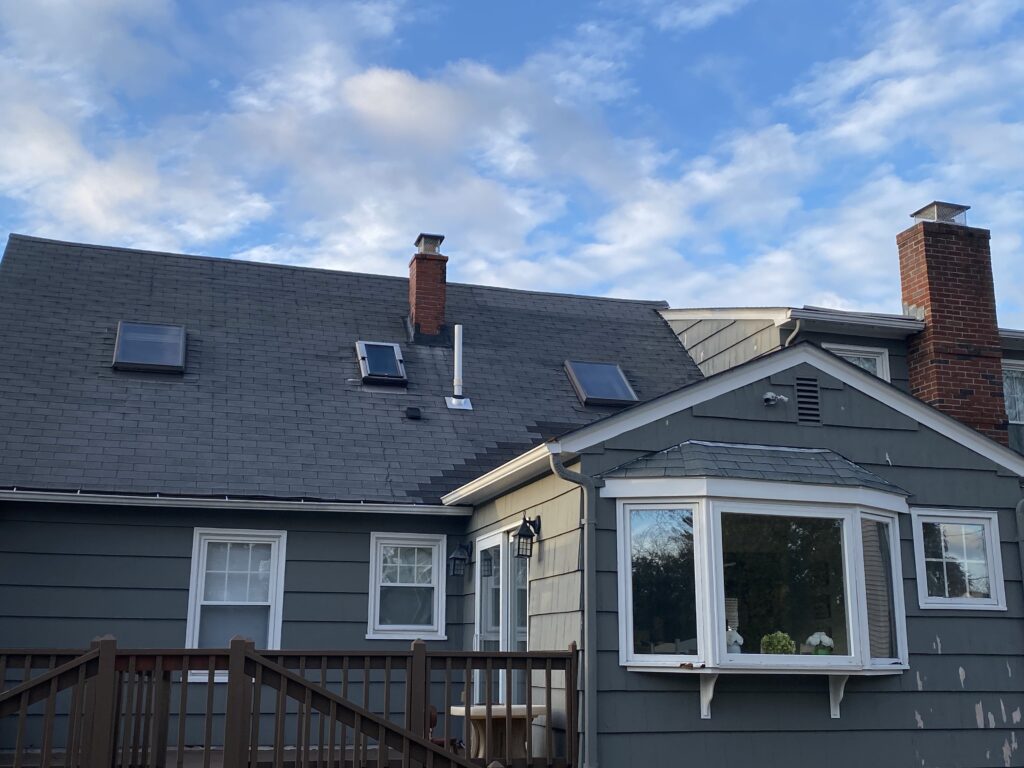
Derek walks the roof before we talk numbers. On a flat or low-slope commercial roof that means checking the membrane for seam separation, checking every penetration and curb flashing, and finding out where water actually pools versus where the drains and scuppers are supposed to be taking it. Ponding that sits more than 48 hours after a rain is a design problem, not a maintenance problem, and it needs to be called out as one.
Inside, if there is attic or plenum access, we look at the underside of the decking for staining, soft spots, and insulation that has gotten wet and stopped doing its job. We check ventilation where it exists, because a lot of the smaller commercial and mixed-use buildings in Groveland were never built with any real airflow above the insulation. You get a straight answer on what is actually wrong before we talk about what to do about it, not a sales pitch dressed up as an inspection.
What the job involves
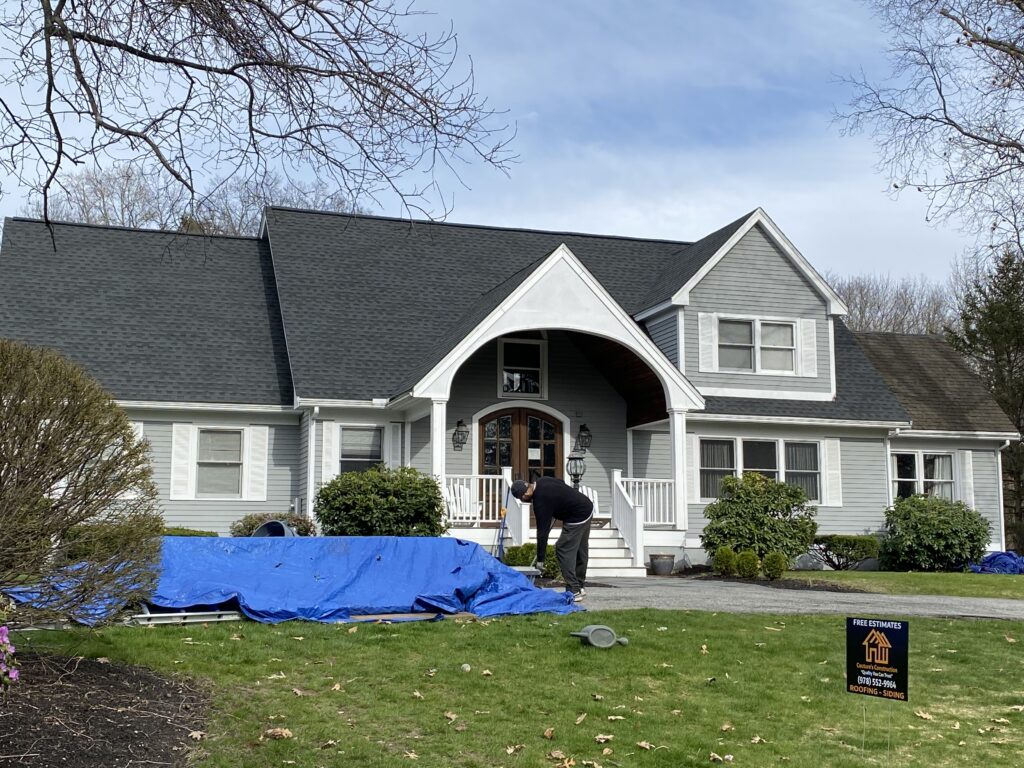
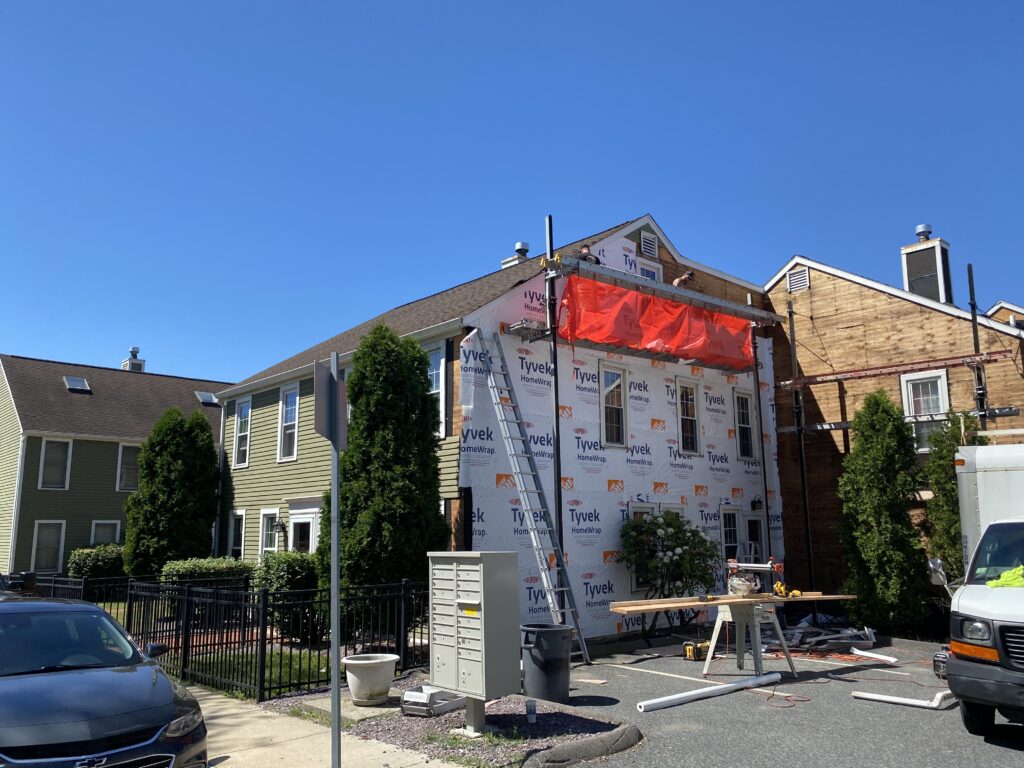
A small commercial or church roof gets a full tear-off to decking when the membrane has failed structurally or when there are multiple layers already down. If the deck is sound and the failure is isolated to seams, flashing, or a section that was patched wrong before, a repair or partial re-cover can be the right call, and we will tell you when it is. Full replacement means new insulation board where needed, new membrane fully adhered or mechanically fastened depending on the system and the roof’s exposure, new edge metal, and rebuilt flashing at every curb, wall, and penetration.
Phasing matters more here than on a house. If the building is occupied or open for business, we section the work so the space stays dry and usable, and we coordinate access and staging around parking, deliveries, and whatever the property actually needs to keep running during the job.
What it costs
Commercial low-slope roofing in Groveland runs a wide range because the buildings themselves vary so much, from a small mixed-use rooftop to a church addition to a barn conversion. As a rough range, expect {PRICE_LOW} to {PRICE_HIGH} depending on total square footage, how many layers have to come off, the condition of the decking once it’s exposed, how many penetrations and curbs need new flashing, and how difficult the site is to access and stage equipment on. A roof with a straightforward EPDM re-cover on sound decking costs a lot less than a torn-off modified bitumen roof with rotted decking underneath it. We give you the real number after the assessment, not before.
How long it takes
A small commercial re-cover or repair section can be done in a day or two. A full tear-off and replacement on a building in the 2,000 to 5,000 square foot range typically runs three to five working days depending on weather, decking condition, and how many flashing details need to be rebuilt. If the building needs to stay open, we plan the sequence so the occupied areas are never left exposed overnight.
Does Groveland actually have enough commercial buildings to need this service?
Not much, and we say that plainly. Groveland is mostly residential and estate-scale property. What commercial work exists here is small – mixed-use buildings, a church or municipal roof, outbuildings and barns on larger properties. We do that work, but we are not pretending there's an industrial park in town.
Can you repair an EPDM roof instead of replacing it?
Sometimes, yes. If the membrane is intact and the problem is a failed seam, a flashing detail, or a localized puncture, a repair is the honest answer and it will cost a fraction of a replacement. Once the membrane is cracking and shrinking across the whole roof, patching becomes a short-term fix that costs money without solving the underlying problem.
What's the difference between EPDM, TPO, and modified bitumen?
EPDM is a rubber membrane, glued or mechanically fastened, with a long track record and the lowest upfront cost. TPO is a heat-welded membrane that reflects more heat and holds seams differently. Modified bitumen is a torch- or adhesive-applied roll product, often used on smaller sections or additions. Which one makes sense depends on the building's use, roof shape, and budget.
Can you work around a building that stays open during construction?
Yes. We section the job so occupied space stays weathertight and we plan staging and access around the property's actual operating hours rather than around what's easiest for us.
Do you handle church and municipal roofs, not just retail?
Request Your Roof Estimate
Ready to find out what your Groveland commercial roof actually needs? Couture’s Construction provides straightforward, on-site estimates for property owners and facility managers throughout the area. We measure, inspect, and document the roof in person before quoting a number, so you get an accurate picture rather than a rough guess.
- On-site inspection, not a phone estimate
- Clear scope of work in writing
- No pressure to decide on the spot