
- Home
- Services
- Locations
Amesbury, MA
Boxford, MA
Chelmsford, MA
Danvers, MA
Dracut, MA
Essex, MA
Georgetown, MA
Groveland, MA
Hamilton, MA
Haverhill, MA
Ipswich, MA
Merrimac, MA
Methuen, MA
Middleton, MA
Newbury, MA
Newburyport, MA
North Andover, MA
North Reading, MA
Peabody, MA
Rowley, MA
Salem, MA
Salisbury, MA
Tewksbury, MA
Topsfield, MA
Topsfield, MA
West Newbury, MA
Atkinson, MA
Derry, NH
East Kingston, NH
Kensington, NH
Kingston, NH
Londonderry, NH
Plaistow, NH
Salem, NH
- Company
- Contact
- Home
- Services
- Locations
Amesbury, MA
Boxford, MA
Chelmsford, MA
Danvers, MA
Dracut, MA
Essex, MA
Georgetown, MA
Groveland, MA
Hamilton, MA
Haverhill, MA
Ipswich, MA
Merrimac, MA
Methuen, MA
Middleton, MA
Newbury, MA
Newburyport, MA
North Andover, MA
North Reading, MA
Peabody, MA
Rowley, MA
Salem, MA
Salisbury, MA
Tewksbury, MA
Topsfield, MA
Topsfield, MA
West Newbury, MA
Atkinson, MA
Derry, NH
East Kingston, NH
Kensington, NH
Kingston, NH
Londonderry, NH
Plaistow, NH
Salem, NH
- Company
- Contact
Roof Repair in Merrimac, MA
Merrimac still has a lot of roofs that predate electricity. Steep-pitched farmhouses and capes near the town center sit under mature oak and maple canopy that drops leaves and branches into valleys every fall, while the newer homes off Church Street and toward the Amesbury line have simpler ranch and gable rooflines with a lot less shade and a lot more open wind. Both types of roofs fail here. They just fail differently, and the fix depends on which one you own.
Roof Repair in Merrimac
Most calls we get from Merrimac start with a stain on a ceiling, a curled shingle someone spotted from the driveway, or an ice dam that backed up last winter and left a mark nobody wants to see again. We come out, get on the roof and in the attic, and tell you straight what’s going on. Sometimes that’s a two-hour flashing repair. Sometimes it’s a section of decking that’s gone soft and needs to come out. We don’t decide which one it is before we look, and we don’t quote a replacement to someone who called about a leak.
This page is about repair specifically. If your roof needs a full tear-off, we’ll tell you why and what that involves, but that’s not the starting assumption. A lot of roofs in this town have another five or ten years left in them with the right repair done correctly.
What Merrimac roofs are up against
The older housing stock in Merrimac, a lot of it built well before modern roofing standards existed, tends to have tighter roof decking, sometimes actual boards instead of plywood sheathing, and chimneys that were flashed decades ago with materials that have long since given up. Those chimney and valley flashings are usually the first thing to fail, and on a heavily treed lot the valleys fill with debris that holds moisture against the shingles year-round. North-facing slopes on these older homes, especially ones tucked back from the road under full shade, are where we see the worst ice damming. Snow melts on the warmer parts of the roof, refreezes at the cold eave, and backs water up under the shingles.
The newer construction on the outskirts of town has different problems. Simpler rooflines mean fewer flashing points, but these homes are more exposed to open wind coming off the Merrimack River valley, and we see wind-lifted shingle tabs and blow-offs on ridges and rakes that older, more sheltered homes rarely deal with. Ventilation is also inconsistent across this stock. Some newer builds were finished with minimal ridge or soffit venting, which traps heat and moisture in the attic and shortens the life of the shingles from underneath, regardless of what’s happening on the surface.
How we assess it
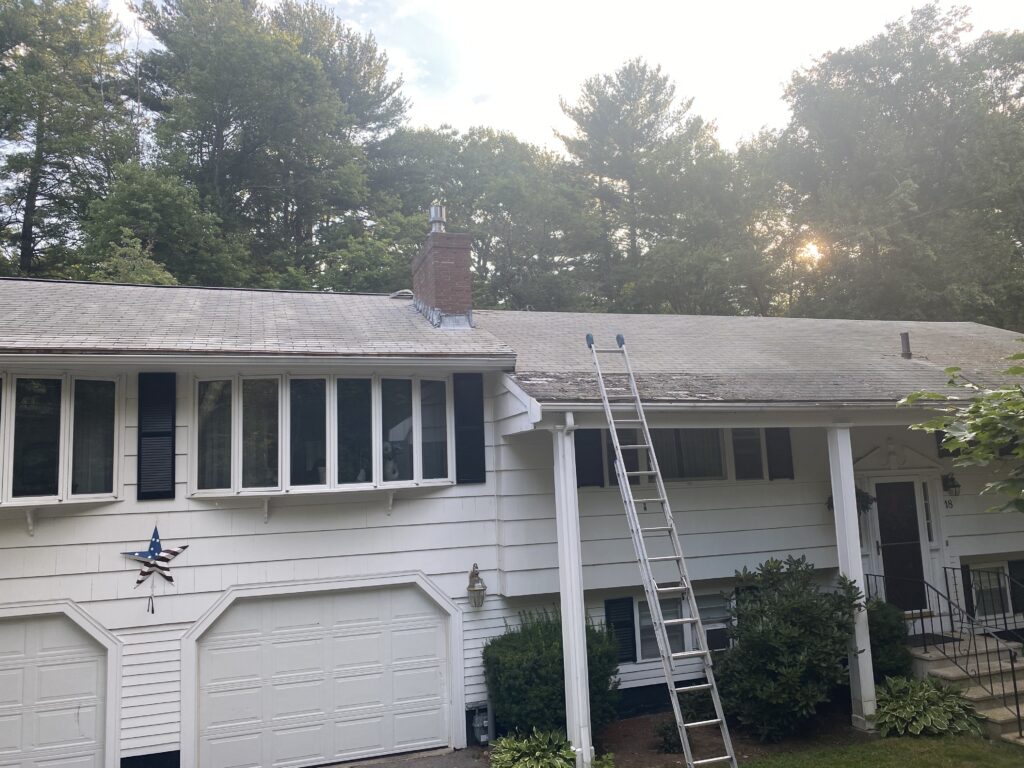
Before we tell you anything about cost or scope, Derek or one of our lead crew gets on the roof. We’re looking at the shingle condition itself, the flashing at every chimney, skylight, and valley, the state of the decking wherever we can check it, and whether the ridge and soffit vents are doing their job or just there for show. Then we go into the attic, because that’s where a roof tells you the truth. Water staining on the underside of the decking, dark mold streaks near the ridge, daylight coming through where it shouldn’t, all of that tells us more than a look from the ground ever will.
We won’t recommend anything until that assessment is done. If it’s a repair, we say so and explain what’s involved. If the decking is compromised in more than a spot or two, or the shingles are failing across the whole roof rather than in one section, we’ll say that too. But the assessment comes first, every time, no exceptions.
What the job involves
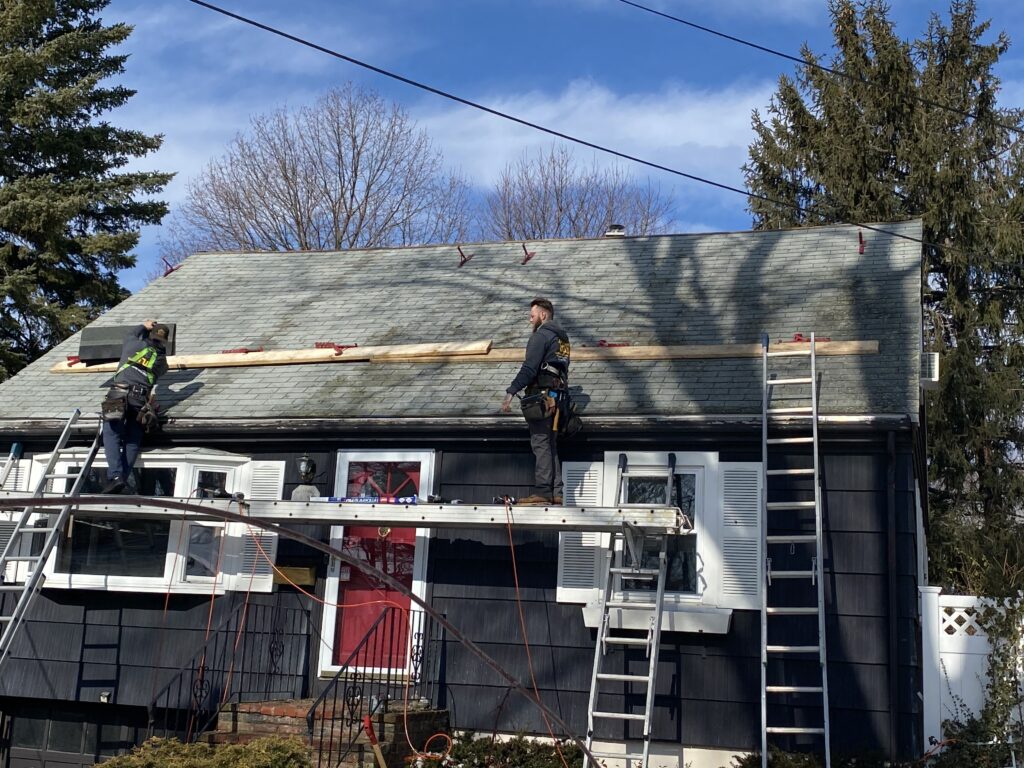
A typical repair starts with removing the damaged shingles and any surrounding material back to sound decking. If the decking underneath is soft or delaminated, we cut it out and replace it before anything else happens. From there we re-flash the area properly, which usually means step flashing at walls and chimneys and new ice and water shield in valleys and at eaves, since that membrane is what actually stops ice dam backup, not just the shingle layer on top of it. Matching shingles is the last step, and we’re upfront if an exact match to older, sun-faded shingles isn’t realistic. Sometimes the honest answer is that a patch will function fine but won’t be invisible.
For ventilation-related issues, the repair might include adding or clearing soffit vents, or cutting in additional ridge venting so the attic can breathe the way it’s supposed to. That’s not an upsell. An attic that can’t vent heat and moisture will cook the underside of a new patch just as fast as it damaged the old shingles.
What it costs
Most roof repairs in Merrimac run between {PRICE_LOW} and {PRICE_HIGH}, and where you land in that range depends on the roof, not on a flat fee. Pitch matters, since steep older farmhouse roofs take longer to work safely than a simple ranch. Access matters too, especially on tree-covered lots where we need to manage debris and protect landscaping. If we get into a repair and find the decking underneath is worse than expected, which happens more often on the pre-1900 homes in this town, that changes the scope and we’ll walk you through it before doing any additional work. We never expand a job without telling you first.
How long it takes
A straightforward flashing or shingle repair is usually a single-day job, start to finish. If we’re replacing decking or dealing with a larger section, particularly on a steep or hard-to-access roof, it can run into a second day. Weather plays a role too. We won’t put a crew on a wet or icy roof, and in a river-valley town like Merrimac, morning dew and shade under heavy tree cover can push a start time later than you’d expect even on a clear day.
Can a roof repair really fix an ice dam problem, or do I need a new roof?
In most cases a repair can address it. Ice dams usually come down to missing or failing ice and water shield at the eaves and inadequate attic ventilation, not a roof that's beyond saving. We fix both when we're on the roof for a repair, and it often solves the problem without a full replacement.
How do I know if it's a repair or I actually need a replacement?
We won't know until we get on the roof and into the attic. A single flashing failure or a section of wind-damaged shingles is almost always a repair. Widespread shingle failure across the whole roof, or decking that's soft in multiple areas, points toward replacement. We tell you which one it is after the assessment, not before.
Do you match shingles on an older Merrimac home?
We try, but sun-faded or discontinued shingles on older homes sometimes can't be matched exactly. We'll tell you upfront if that's the case so there are no surprises when the patch goes in.
Does tree cover actually make repairs more likely in this town?
Yes. Heavy tree cover holds moisture in valleys and against shingles longer than an open roof, and it drops debris that clogs drainage paths. We see more valley and flashing failures on heavily shaded lots than on open ones.
Will you try to sell me a full roof when I only asked about a repair?
No. We assess and quote what the roof actually needs. If that's a repair, that's what we recommend and what we do.
Get an estimate
If you’ve got a leak, a stain, or a shingle that came loose in the last windstorm, call {PHONE} and we’ll get someone out to look at it. You’ll get a straight answer about what’s actually wrong and what it takes to fix it, not a sales pitch dressed up as an inspection.