
- Home
- Services
- Locations
Amesbury, MA
Boxford, MA
Chelmsford, MA
Danvers, MA
Dracut, MA
Essex, MA
Georgetown, MA
Groveland, MA
Hamilton, MA
Haverhill, MA
Ipswich, MA
Merrimac, MA
Methuen, MA
Middleton, MA
Newbury, MA
Newburyport, MA
North Andover, MA
North Reading, MA
Peabody, MA
Rowley, MA
Salem, MA
Salisbury, MA
Tewksbury, MA
Topsfield, MA
Topsfield, MA
West Newbury, MA
Atkinson, MA
Derry, NH
East Kingston, NH
Kensington, NH
Kingston, NH
Londonderry, NH
Plaistow, NH
Salem, NH
- Company
- Contact
- Home
- Services
- Locations
Amesbury, MA
Boxford, MA
Chelmsford, MA
Danvers, MA
Dracut, MA
Essex, MA
Georgetown, MA
Groveland, MA
Hamilton, MA
Haverhill, MA
Ipswich, MA
Merrimac, MA
Methuen, MA
Middleton, MA
Newbury, MA
Newburyport, MA
North Andover, MA
North Reading, MA
Peabody, MA
Rowley, MA
Salem, MA
Salisbury, MA
Tewksbury, MA
Topsfield, MA
Topsfield, MA
West Newbury, MA
Atkinson, MA
Derry, NH
East Kingston, NH
Kensington, NH
Kingston, NH
Londonderry, NH
Plaistow, NH
Salem, NH
- Company
- Contact
Roof Repair in Haverhill, MA
Walk down most streets in Haverhill’s older neighborhoods and you’ll see the same roof twice – a steep main gable over the original house, and a low-slope addition tacked onto the back or side sometime in the last fifty years. Those two roofs age at completely different speeds, and the flat one almost always fails first.
Roof Repair in Haverhill
Not every roof problem needs a new roof. A lot of what we get called out for in Haverhill is a section of flashing that pulled loose, a handful of cracked shingles from a branch strike, or a soft spot over a bathroom vent that was never sealed right. If a repair will hold, we say so and we do the repair. We don’t use a repair call as a pretext to sell a full tear-off.
That said, Haverhill’s housing stock is old enough in a lot of places that a repair call sometimes turns into a harder conversation, and we’ll walk you through that honestly too, with photos from the roof itself, not a guess from the ground.
What Haverhill roofs are up against
Haverhill’s roofs split into two very different problems, and which one you have depends on when your house was built. The mill-city core – the triple-deckers and older two- and three-family homes near downtown and along the river – carries a lot of flat and low-slope rear additions, kitchen bump-outs, porch roofs, and second-story extensions that were built with tar or rolled roofing decades ago. Those low-slope sections fail years before the main roof does, because they hold water and ice longer and they were rarely detailed with a real membrane in the first place. If your addition roof is leaking and your main roof is fine, that’s not a coincidence, that’s just how flat roofs on old houses behave.
Out toward the newer subdivisions on the west and south sides of town, you’re looking at a different clock. A lot of that housing went up in the 1990s and early 2000s with three-tab or early architectural shingles, and those roofs are all crossing the twenty to twenty-five year mark at roughly the same time. Add in heavy tree cover in a lot of those neighborhoods, which means valleys clogged with pine needles and leaves that hold moisture against the shingle mat, and you get granule loss and valley leaks well before the field of the roof looks obviously worn. North-facing slopes near the Merrimack River corridor also see more ice damming in a hard winter than south-facing ones, simply because they don’t get the sun to melt snow off between storms.
How we assess it
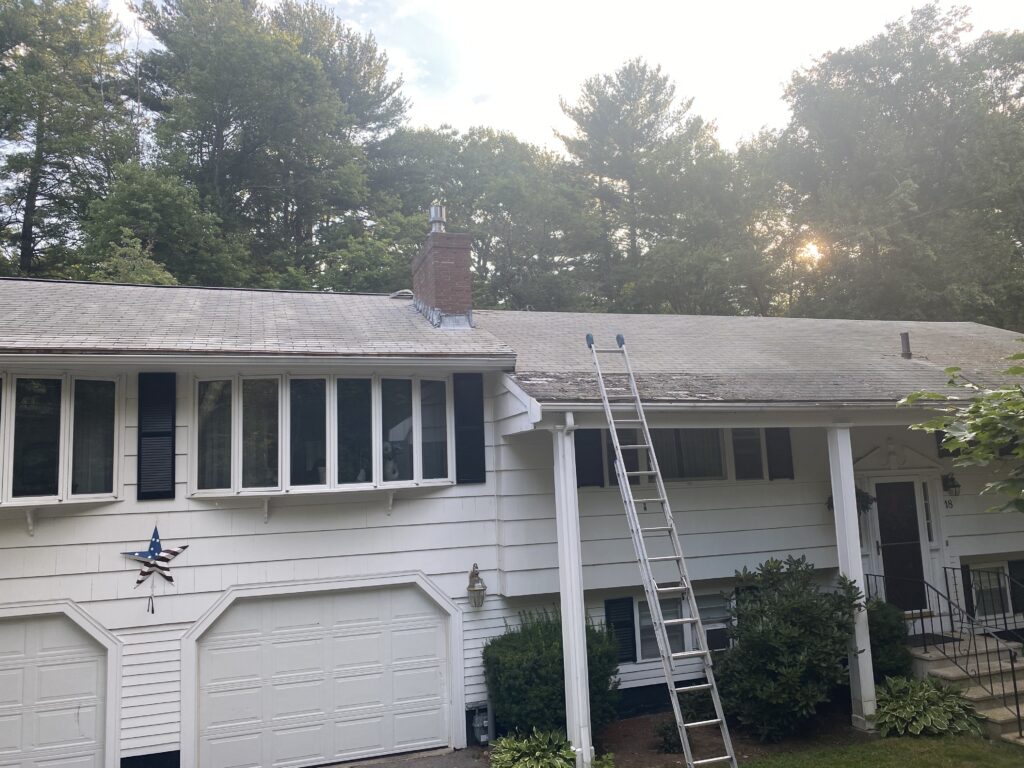
Derek gets on the roof before he tells you anything. That means checking the decking for soft spots and delamination, pulling back shingles at the trouble spot to see what the underlayment and ice and water shield actually look like, and checking flashing at every chimney, wall tie-in, and valley – those are the three places almost every leak actually starts, not the open field of shingles people assume is the problem. He’ll also get into the attic if there’s access, because a stain on a bedroom ceiling can come from a roof leak, a ventilation problem, or both, and you treat those differently. Poor ridge and soffit ventilation cooks shingles from underneath and drives ice dams in winter, so it matters even when it isn’t the reason you called.
You get a straight answer before any recommendation. If the decking is sound and the damage is contained to one area, we say repair. If we find rot spreading under multiple courses of shingles, or flashing failure that’s been letting water in for a season or more, we’ll show you exactly what we found and what it means.
What the job involves
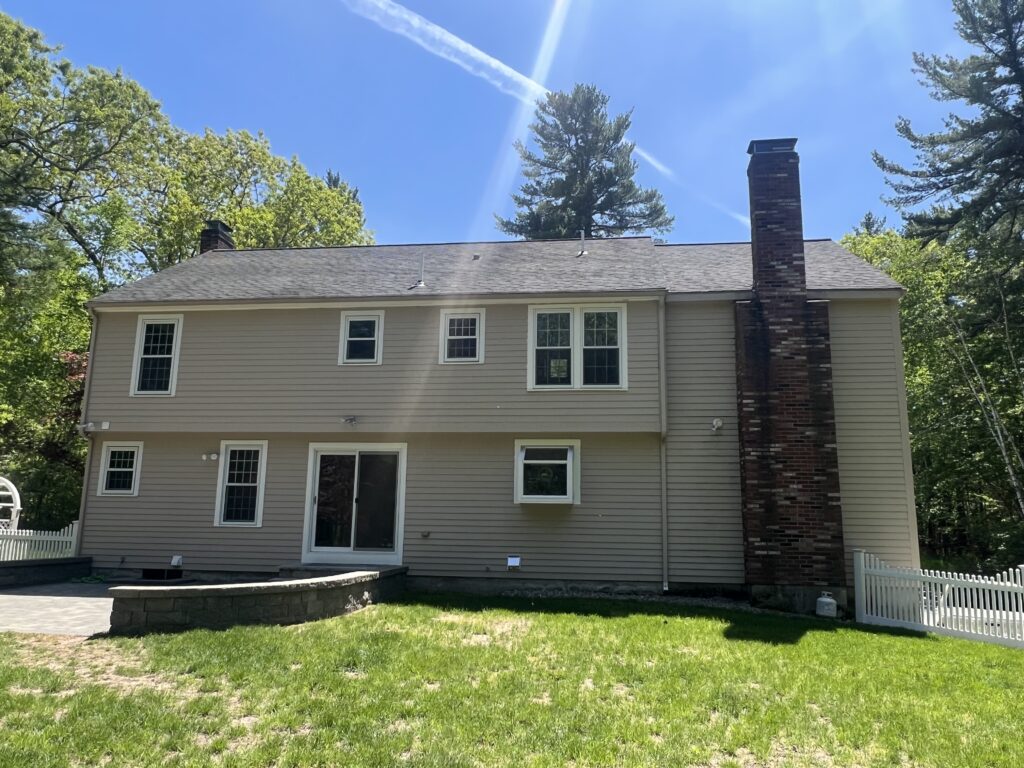
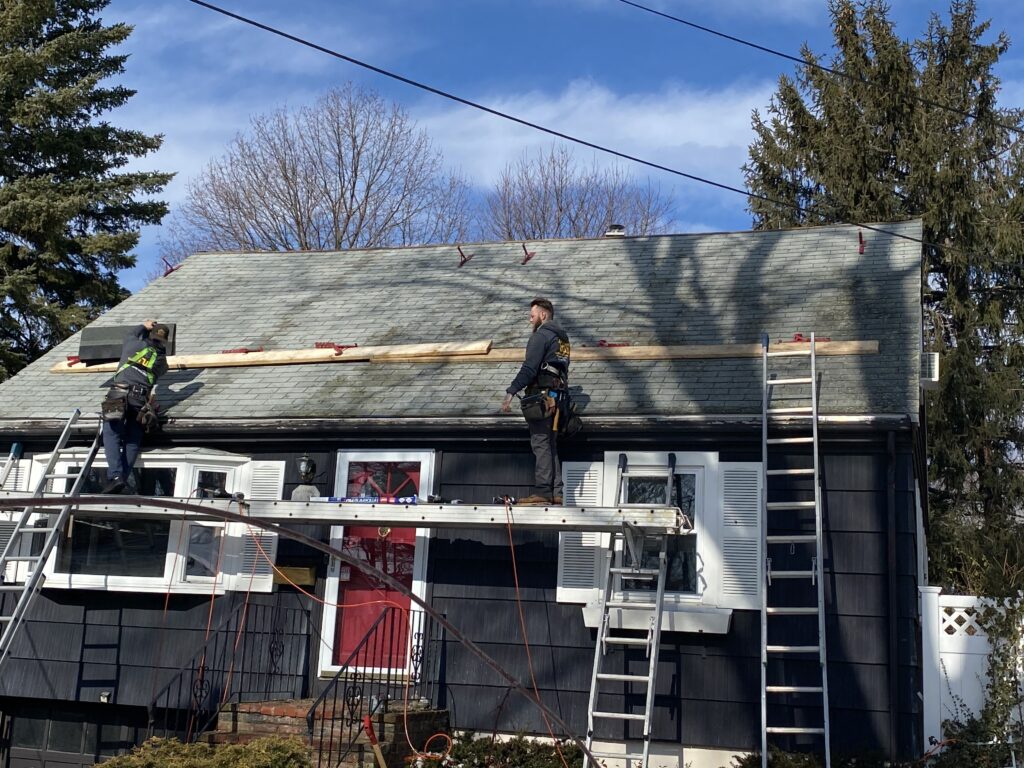
A typical repair means removing the damaged shingles and any compromised underlayment, checking the decking underneath for rot or soft wood, replacing any bad sheathing, installing new ice and water shield at the repair zone, and reshingling with a matching or close-matching shingle. Flashing repairs at chimneys and valleys often need new step flashing or counter-flashing, not just a bead of sealant, because sealant alone is a temporary fix that fails within a season or two. On low-slope additions, a real repair usually means a proper modified bitumen or membrane patch, not another layer of tar, since another layer of tar just buys you a year or two before you’re back in the same spot.
What it costs
Most straightforward repairs in Haverhill run in the {PRICE_LOW} to {PRICE_HIGH} range, but that spread exists for real reasons. A single flashing repair on an easy one-story roof costs less than a multi-spot repair on a steep, cut-up roofline with three valleys and a chimney. Roof size and pitch matter, how many layers of old shingles are already up there matters, and what we find once we open up the decking matters most of all – rotted plywood or old skip sheathing under the damaged area adds material and labor that you can’t price accurately until the shingles come off. Access plays a role too, since a roof over a tight city lot with parking on the street costs more to work on than one with a driveway you can stage from.
How long it takes
A single-area repair, like a flashing fix or a patch of storm-damaged shingles, is usually a one-day job. Larger repairs involving multiple sections, deck replacement, or a full low-slope membrane patch on an addition can run two to three days depending on weather and what we find once we’re into it. We don’t start a repair we can’t finish that day unless the roof can be safely dried in overnight, and we’ll tell you that upfront, not after you’ve got a tarp on your house.
Can a roof leak really be fixed without replacing the whole roof?
Yes, in a lot of cases. If the decking underneath is sound and the damage is limited to one area – a flashing failure, a section of wind-damaged shingles, a worn valley – a repair is the right call and it's what we'll recommend. Replacement only makes sense when the problem has spread beyond a section, or the roof is old enough that a repair won't hold for long.
How do I know if it's a repair or I need a new roof?
The honest answer is you usually can't tell from the ground. A stained ceiling can mean a small flashing leak or a much bigger ventilation and moisture problem. That's why we get on the roof and into the attic before giving you a recommendation, instead of guessing from a photo you send us.
My roof addition leaks but the main roof is fine, why?
This is extremely common on Haverhill's older housing. Low-slope additions – kitchen bump-outs, porch roofs, second-story extensions – hold water and ice longer than a steep main roof and were often built without a real waterproof membrane. They fail first, and repeatedly, unless they're redone properly.
Do you repair flat roofs on additions and porches?
Yes. A proper repair on a low-slope section uses a membrane material like modified bitumen, not another layer of tar or roll roofing patched on top of the old one. Patching over patches just buys a season or two before the same spot fails again.
What causes ice dams on Haverhill roofs?
Poor attic ventilation combined with heat escaping into the roof deck melts snow, which refreezes at the colder eaves and backs water up under the shingles. North-facing slopes near the river corridor see this more than south-facing ones because they get less sun between storms to clear snow naturally.
Get an estimate
If you’ve got a leak, a soft spot, or a section of roof that just doesn’t look right, call {PHONE} and describe what you’re seeing. Derek will get out to look at it in person and give you a straight read on whether it’s a repair or something bigger, with photos to back it up either way. Couture’s Construction is based in Methuen and works Haverhill and the rest of the Merrimack Valley regularly, so we know what these roofs are dealing with before we even climb the ladder.