
- Home
- Services
- Locations
Amesbury, MA
Boxford, MA
Chelmsford, MA
Danvers, MA
Dracut, MA
Essex, MA
Georgetown, MA
Groveland, MA
Hamilton, MA
Haverhill, MA
Ipswich, MA
Merrimac, MA
Methuen, MA
Middleton, MA
Newbury, MA
Newburyport, MA
North Andover, MA
North Reading, MA
Peabody, MA
Rowley, MA
Salem, MA
Salisbury, MA
Tewksbury, MA
Topsfield, MA
Topsfield, MA
West Newbury, MA
Atkinson, MA
Derry, NH
East Kingston, NH
Kensington, NH
Kingston, NH
Londonderry, NH
Plaistow, NH
Salem, NH
- Company
- Contact
- Home
- Services
- Locations
Amesbury, MA
Boxford, MA
Chelmsford, MA
Danvers, MA
Dracut, MA
Essex, MA
Georgetown, MA
Groveland, MA
Hamilton, MA
Haverhill, MA
Ipswich, MA
Merrimac, MA
Methuen, MA
Middleton, MA
Newbury, MA
Newburyport, MA
North Andover, MA
North Reading, MA
Peabody, MA
Rowley, MA
Salem, MA
Salisbury, MA
Tewksbury, MA
Topsfield, MA
Topsfield, MA
West Newbury, MA
Atkinson, MA
Derry, NH
East Kingston, NH
Kensington, NH
Kingston, NH
Londonderry, NH
Plaistow, NH
Salem, NH
- Company
- Contact
Roof Repair in Dracut, MA
Dracut sits along the Merrimack with a housing mix that swings hard in both directions – Colonial-era farmhouses and mill-worker doubles near the center, ranch and split-level subdivisions from the 60s and 70s off Bridge Street and Broadway, and newer colonials pushing up toward the Pelham and Windham lines. That spread means the roof problems here are not one problem. It’s chimney flashing pulling loose on a farmhouse built before anyone thought about ice and water shield, and it’s a twenty-two-year-old architectural shingle roof on a 1990s split-level that’s finally curling at the tab edges.
Roof Repair in Dracut
We get calls about a stain on a bedroom ceiling, a shingle that blew into the yard after a nor’easter, or a soft spot a homeowner found walking the attic looking for insulation. Those are all repair calls, and most of the time that’s exactly what they turn out to be. Our job is to find what’s actually failing, tell you straight whether a repair fixes it, and only bring up replacement if the roof genuinely can’t be patched anymore.
We’re a Methuen-based crew and Dracut is a short drive down Route 113 for us, so we’re not squeezing your job between two other towns. Derek looks at most of these roofs himself before a crew ever shows up.
What Dracut roofs are up against
The tree canopy in Dracut is heavy in a lot of neighborhoods, especially the older lots near the river and around Lakeview Ave, and that means valley debris. Pine needles and oak leaves pack into valleys and behind chimneys, hold water against the shingle mat, and rot the felt or ice and water shield underneath long before the rest of the roof shows its age. If your valleys are shaded most of the day, that’s usually the first place we look, regardless of what brought you to call us.
The bigger pattern is the subdivision clustering. Dracut’s ranch and split-level neighborhoods from the 60s through the 80s, and the colonial subdivisions built out through the 90s and early 2000s, are all hitting the same wall at roughly the same time – twenty to twenty-five years on the original architectural shingle. One roof failing doesn’t mean the whole street needs replacement tomorrow, but it does mean the shingles have used up most of their granule protection, and repairs on a roof that old behave differently than repairs on a ten-year-old roof. We’ll tell you which situation you’re in. North-facing slopes with less sun exposure also carry more ice dam risk in a hard winter, which shows up as water intrusion at the eaves even on a roof that looks fine from the driveway.
How we assess it
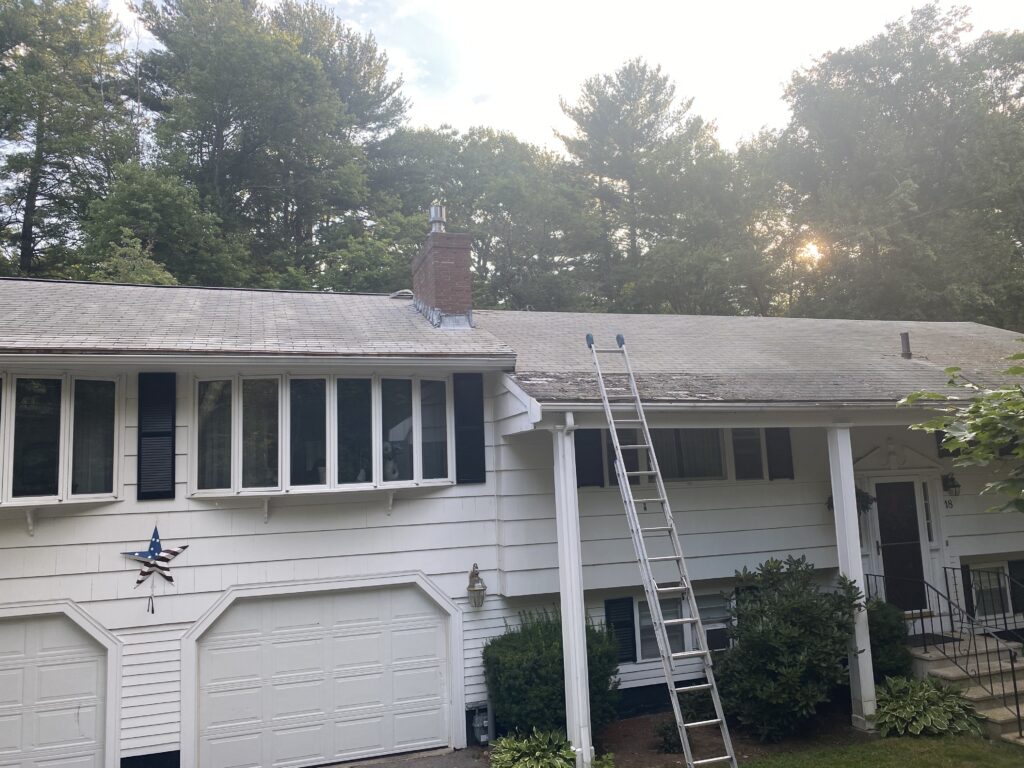
Before we talk about fixing anything, we look. That means getting on the roof to check the decking for soft spots, pulling back shingles near the problem area to see the felt or ice and water shield condition, and checking flashing at every chimney, sidewall, and valley – flashing failure is behind more leaks than worn-out shingle field. We also go into the attic if we can. That’s where you actually see whether ventilation is working, whether there’s staining on the sheathing that tells us how long water has been getting in, and whether insulation is compressed or missing in a way that’s contributing to ice damming.
We don’t quote a repair off a photo you texted us and we don’t recommend a fix before we’ve seen the cause. A stain on the ceiling can come from three feet away from where it shows up on the roof, and guessing wrong means paying twice.
What the job involves
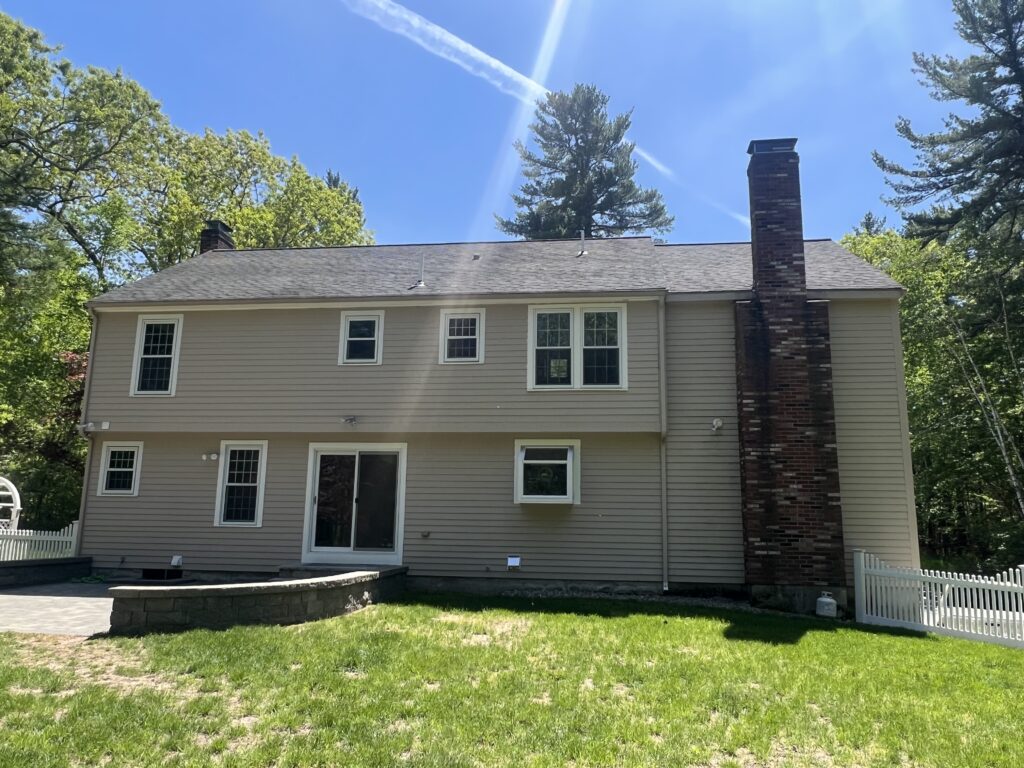
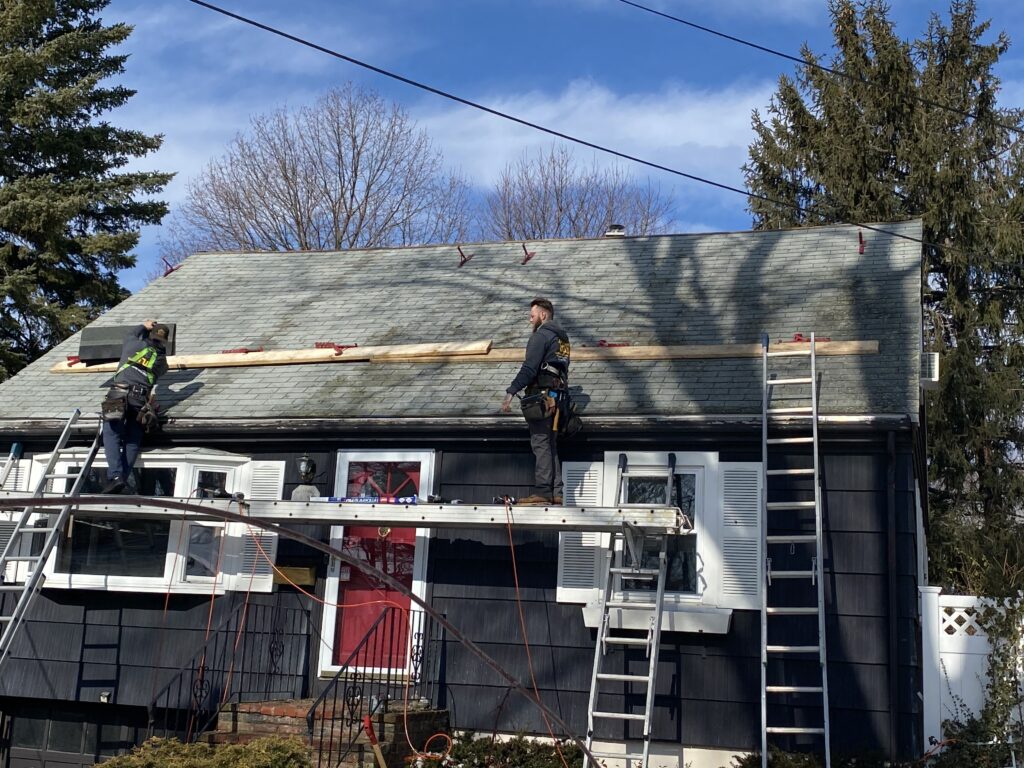
Most Dracut repair calls fall into a handful of categories. Flashing repair or replacement at chimneys, skylights, and wall step-flashing where sealant has failed or metal has pulled away. Shingle replacement for wind damage or aged tabs, matched as close as we can to what’s already up there. Valley repair where debris and moisture have broken down the underlayment. Ice dam damage repair along eaves, which sometimes means opening up the roof edge to add ice and water shield that wasn’t there originally. And ventilation fixes – adding or clearing ridge and soffit vents – because a roof that can’t breathe cooks its own shingles from underneath and fails early no matter how good the materials were.
If the decking underneath is rotted or delaminated, we tell you before we close anything up, not after. Sometimes that turns a repair into a slightly bigger repair. It rarely means the whole roof needs to come off.
What it costs
Repairs in Dracut typically run somewhere between {PRICE_LOW} and {PRICE_HIGH}, and where you land in that range depends on what’s actually wrong. A single flashing repair or a handful of replaced shingles sits at the low end. Valley reconstruction, ice dam damage that requires opening up the eave, or a repair that turns up rotted decking once we’re into it costs more, because now there’s material and labor for sheathing replacement on top of the original scope. Steep pitch, tricky access, and how many roofs are already stacked up on your job also move the number. We give you a real figure after the assessment, not a phone estimate, because a phone estimate on a roof repair is a guess dressed up as a quote.
How long it takes
A straightforward flashing or shingle repair is usually a same-day job, sometimes a few hours. Valley repairs or eave work for ice dam damage can run one to two days depending on how much decking needs attention. We’ll give you a realistic window once we know the scope, and if weather pushes it, we’ll tell you before it becomes a surprise.
How do I know if I need a repair or a full roof replacement?
It comes down to how much of the roof is affected and how old the shingles already are. A localized leak at a flashing point or a small area of storm damage on an otherwise sound roof is almost always a repair. If the shingles are past 20 years and showing granule loss across the whole field, or if multiple areas are failing at once, a repair might buy you a season but replacement becomes the more honest recommendation. We'll tell you which situation applies before we suggest anything.
Will my homeowners insurance cover a Dracut roof repair?
It depends on the cause. Wind and storm damage is often covered; wear from age typically is not. We can document what we find during the assessment, which helps if you're filing a claim, but the coverage decision is between you and your insurer.
Can you match my existing shingles?
In most cases, yes, especially on roofs under 10 to 15 years old where the manufacturer's color line is still current. On older roofs, some sun-fading is unavoidable and a perfect match isn't always possible. We'll show you the closest option before we order material.
What causes ice dams on Dracut roofs?
Heat escaping from the attic melts snow on the upper roof, which refreezes at the colder eave and backs up under the shingles. It's a ventilation and insulation problem as much as a roofing problem. If we see it repeatedly on a house, we'll talk about ridge and soffit ventilation, not just patching the eave.
Do you work on the low-slope additions common on older Dracut homes?
Yes. Low-slope rear additions and porch roofs fail differently than the main pitched roof, usually because standard shingles don't shed water fast enough at that angle. We look at those separately during the assessment and recommend materials suited to low-slope application when that's what's actually needed.
Get an estimate
If you’ve got a leak, a missing shingle, or a soft spot you found in the attic, don’t wait for it to get worse over a Merrimack Valley winter. Call {PHONE} and we’ll get someone out to look at it and give you a straight answer about what it needs.