
- Home
- Services
- Locations
Amesbury, MA
Boxford, MA
Chelmsford, MA
Danvers, MA
Dracut, MA
Essex, MA
Georgetown, MA
Groveland, MA
Hamilton, MA
Haverhill, MA
Ipswich, MA
Merrimac, MA
Methuen, MA
Middleton, MA
Newbury, MA
Newburyport, MA
North Andover, MA
North Reading, MA
Peabody, MA
Rowley, MA
Salem, MA
Salisbury, MA
Tewksbury, MA
Topsfield, MA
Topsfield, MA
West Newbury, MA
Atkinson, MA
Derry, NH
East Kingston, NH
Kensington, NH
Kingston, NH
Londonderry, NH
Plaistow, NH
Salem, NH
- Company
- Contact
- Home
- Services
- Locations
Amesbury, MA
Boxford, MA
Chelmsford, MA
Danvers, MA
Dracut, MA
Essex, MA
Georgetown, MA
Groveland, MA
Hamilton, MA
Haverhill, MA
Ipswich, MA
Merrimac, MA
Methuen, MA
Middleton, MA
Newbury, MA
Newburyport, MA
North Andover, MA
North Reading, MA
Peabody, MA
Rowley, MA
Salem, MA
Salisbury, MA
Tewksbury, MA
Topsfield, MA
Topsfield, MA
West Newbury, MA
Atkinson, MA
Derry, NH
East Kingston, NH
Kensington, NH
Kingston, NH
Londonderry, NH
Plaistow, NH
Salem, NH
- Company
- Contact
Roof Repair in North Reading, MA
Walk a North Reading neighborhood in late fall and you can pick out the roofs sitting under the heaviest tree canopy before you even get up a ladder. There’s a dark stripe running down the north slope, a soft spot in the valley where leaves pile up every October, and a decking board that’s gone soft under a limb that’s been dropping needles onto the same three shingles for a decade. On lots this size, with this much mature tree cover, the roof doesn’t fail evenly. It fails in the places the trees decide.
Roof Repair in North Reading
Most calls we get from North Reading start with someone standing in the driveway pointing up at a stain, a streak, or a spot where a branch came down last winter. Sometimes it’s a small fix – a section of flashing that pulled loose, a handful of cracked shingles, a valley that needs to be cleared and resealed. Sometimes what looks small from the ground turns out to be soft decking once we’re up there. We don’t guess from the driveway. We get on the roof, look at what’s actually happening, and tell you straight whether a repair holds or whether you’re better off putting your money into something more permanent.
Repair is almost always the right first move when the damage is localized – one slope, one valley, one flashing detail – and the rest of the roof is sound. We’re not going to talk you into a full tear-off because it’s a bigger job for us. If a repair gets you another five or ten good years out of a roof that’s otherwise in decent shape, that’s what we’ll recommend.
What North Reading roofs are up against
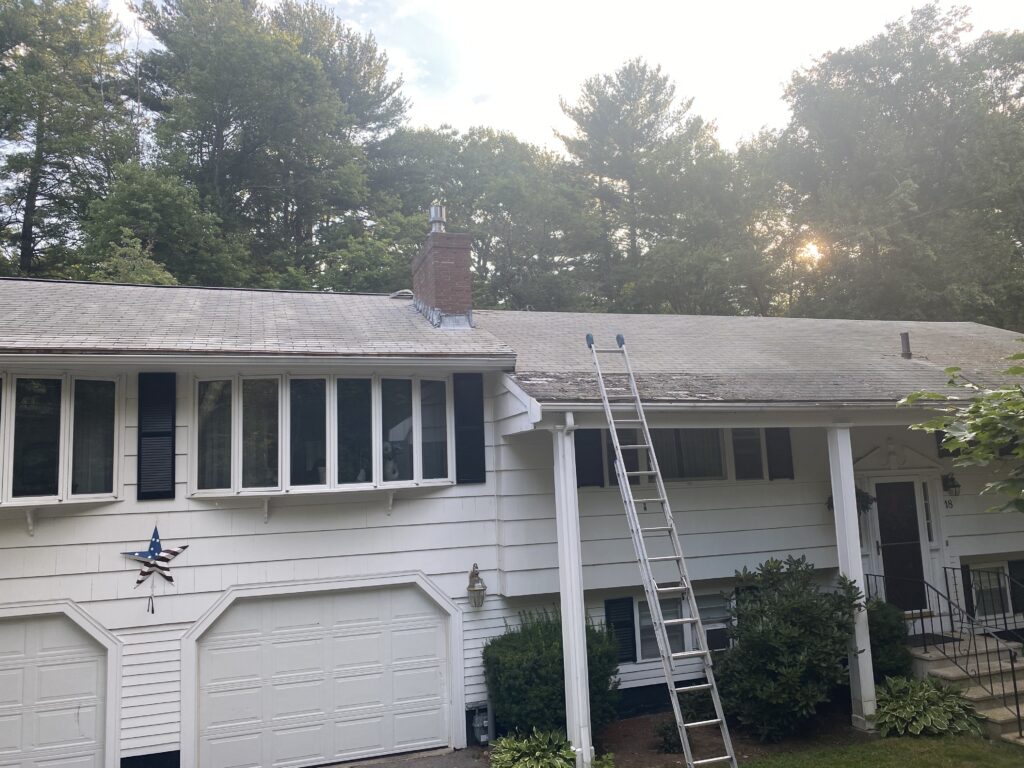
North Reading is one of the more heavily wooded towns we work in, and that changes what breaks first. Overhanging limbs drop debris into valleys and behind chimneys constantly, and that debris holds moisture against the shingles long after the rest of the roof has dried out. Give that enough seasons and you get granule loss, soft spots in the decking underneath, and eventually a leak that shows up somewhere in the house that has nothing to do with where the water actually got in. North-facing slopes here get almost no direct sun for months at a time, which is exactly why we see so much moss and black algae streaking on them – and why homeowners often call about staining before they realize there’s a ventilation or moisture problem behind it.
The other thing tree cover does is shorten a roof’s working life below its rated span. A thirty-year architectural shingle rated for that kind of wear can still be done in twenty if it’s spent every one of those years under a canopy that never lets it fully dry. On the larger lots common in North Reading, we also see a fair number of additions and garages with lower-slope roofs tucked in behind the main house, and those low-slope sections need different underlayment and flashing details than the steep-pitch roof up front – if that transition wasn’t detailed right when it was built, that’s often where the leak actually starts.
How we assess it
Before we tell you anything about repair versus replacement, someone gets on the roof. We check the decking for soft spots by walking it and by feel, not by guessing from a photo. We pull back shingles near the problem area to see what the underlayment and ice and water shield look like underneath. We look at every flashing point – chimney, sidewall, valley, any roof-to-wall transition – because that’s where the vast majority of real leaks originate, not out in the open field of shingles. And we go into the attic if we can get to it, because the underside of the roof deck tells you things the top side won’t. Dark staining, damp insulation, and rusted nail tips coming through the decking all point to a moisture problem that’s been going on longer than the stain on your ceiling suggests.
We give you that assessment before we give you a recommendation. If it’s a repair, we say so and explain why. If the decking’s compromised over a wider area than the visible damage suggests, we’ll show you what we found and let you decide how to handle it. No one gets a sales pitch standing on their own roof.
What the job involves
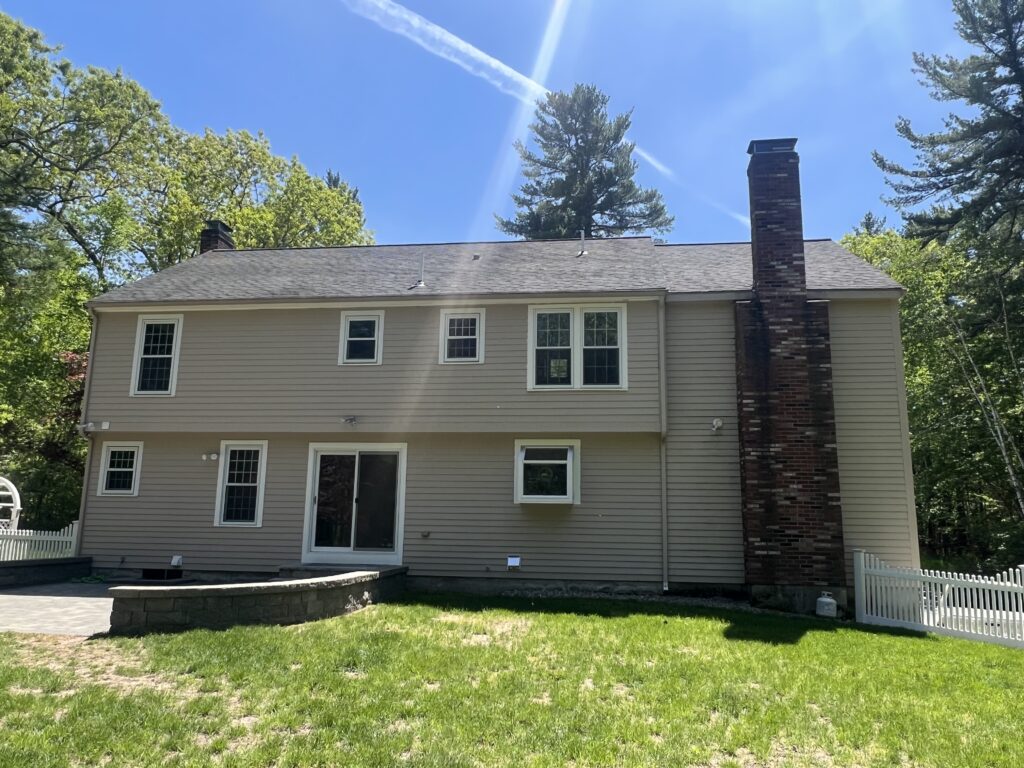
A typical North Reading repair starts with clearing out whatever debris caused the problem in the first place – pine needles and leaf mat packed into a valley, moss scraped off a north slope, a limb cut back so it stops dropping material on the same spot. From there we replace the damaged shingles, matching them as closely as we can to what’s already up there, and we check the underlayment and ice and water shield underneath before closing it back up. Flashing repairs get resealed or replaced outright rather than just caulked over, because caulk is a temporary answer and we don’t leave temporary answers behind. If soft decking turns up, we cut it back to solid wood and sister or replace the section before anything new goes down on top of it.
What it costs
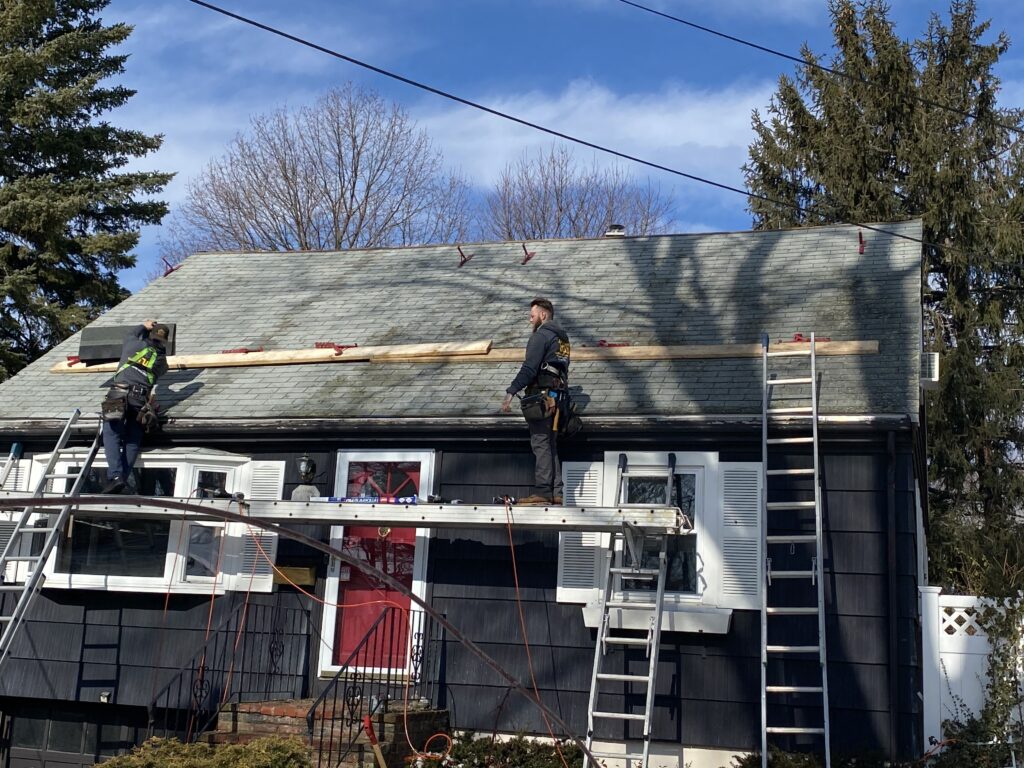
Most North Reading repair jobs run in the range of {PRICE_LOW} to {PRICE_HIGH}, and where you land in that range depends on a few things: how much of the roof is affected, how steep it is, how hard it is to access given the trees and the setback of the house, and whether we find sound decking or soft decking once we open things up. A single flashing repair or a small section of shingles is on the low end. A valley that’s been leaking for a while and has taken the decking with it costs more, because that’s real structural work, not just a shingle swap. We’ll never quote you a number sight unseen, and we’ll never pad a small job to look bigger than it is.
How long it takes
A straightforward repair – a valley, a flashing section, a cluster of damaged shingles – is usually a one-day job for our crew, weather permitting. If we find soft decking that needs to come out and be replaced, add a day. Access matters too. A house set back on a wooded North Reading lot with limited driveway room takes a bit longer to stage than one with a clear approach, and we account for that when we schedule the crew, not after we’ve already started.
How do I know if my North Reading roof needs a repair or a full replacement?
It comes down to how much of the roof is affected and what shape the decking is in. If the damage is contained to one valley, one flashing point, or a handful of shingles, and the rest of the roof is sound, a repair is the honest answer. If we find widespread granule loss, soft decking in multiple areas, or a roof that's already near the end of its shingle life, we'll tell you that too. We don't decide that from the ground – we get up there first.
Why is the north side of my roof black and green while the rest looks fine?
That's algae and moss growth, and it's common on north-facing slopes in North Reading because that side of the roof gets little to no direct sun, especially under tree cover. It stays damp longer than the rest of the roof. It's often cosmetic at first, but left long enough it holds moisture against the shingles and shortens their life, so it's worth having someone look at it rather than ignoring it.
Does homeowners insurance cover roof repair from storm or tree damage?
Often, yes, if the damage came from a specific event like a fallen limb or wind, though every policy is different. We can document the damage for you with photos and a written assessment, which your insurance company will typically want, but you'll need to check your own policy for coverage details and deductible.
Can you match the existing shingles on an older North Reading roof?
We do our best to match color and style as closely as the manufacturer's current line allows. On older roofs where the original shingle has been discontinued or has faded significantly, an exact match isn't always possible, and we'll tell you that upfront rather than promise something we can't deliver.
How often should I have my roof checked given all the trees around my house?
With heavy tree cover, we'd suggest a look at least once a year, ideally after leaves come down in the fall, plus anytime you get a significant windstorm or heavy limb comes down nearby. Debris in the valleys is the number one thing that turns a healthy roof into a leaking one on wooded lots like these.
Request your estimate
Before you commit to any repair, get a clear picture of what your North Reading roof actually needs. Couture’s Construction walks the property, checks the trouble spots, and explains the findings in plain terms—no pressure, no guesswork.
- Straightforward assessment of the damage
- Written estimate you can review at your own pace
- Honest recommendation on repair versus replacement
Reach out today to schedule your visit.