
- Home
- Services
- Locations
Amesbury, MA
Boxford, MA
Chelmsford, MA
Danvers, MA
Dracut, MA
Essex, MA
Georgetown, MA
Groveland, MA
Hamilton, MA
Haverhill, MA
Ipswich, MA
Merrimac, MA
Methuen, MA
Middleton, MA
Newbury, MA
Newburyport, MA
North Andover, MA
North Reading, MA
Peabody, MA
Rowley, MA
Salem, MA
Salisbury, MA
Tewksbury, MA
Topsfield, MA
Topsfield, MA
West Newbury, MA
Atkinson, MA
Derry, NH
East Kingston, NH
Kensington, NH
Kingston, NH
Londonderry, NH
Plaistow, NH
Salem, NH
- Company
- Contact
- Home
- Services
- Locations
Amesbury, MA
Boxford, MA
Chelmsford, MA
Danvers, MA
Dracut, MA
Essex, MA
Georgetown, MA
Groveland, MA
Hamilton, MA
Haverhill, MA
Ipswich, MA
Merrimac, MA
Methuen, MA
Middleton, MA
Newbury, MA
Newburyport, MA
North Andover, MA
North Reading, MA
Peabody, MA
Rowley, MA
Salem, MA
Salisbury, MA
Tewksbury, MA
Topsfield, MA
Topsfield, MA
West Newbury, MA
Atkinson, MA
Derry, NH
East Kingston, NH
Kensington, NH
Kingston, NH
Londonderry, NH
Plaistow, NH
Salem, NH
- Company
- Contact
Roof Repair in Boxford, MA
A lot of the roofs we get called out to in Boxford were built before anyone was thinking about ridge vents or ice and water shield. Add in two-acre lots shaded by mature oak and pine, long driveways that make staging a lift truck a real conversation, and roof planes that intersect four or five times over a single dormer, and you get a town where repairs are rarely a five-minute patch job.
Roof Repair in Boxford
When you call about a leak or a missing shingle, we’re not trying to sell you a new roof before we’ve been on the ladder. Repair is the right call more often than people expect, especially on roofs under fifteen or twenty years old with sound decking underneath. Our job on the first visit is to figure out what’s actually failing and tell you straight whether a repair holds or whether you’re looking at something bigger.
We work on the estate-belt properties around Boxford all the time, so we’re used to the access issues, the multiple roof planes, and the older construction that comes with colonial and antique homes. We also handle outbuildings, barns, and detached garages that share the same roofline problems as the main house.
What Boxford roofs are up against
Boxford’s tree canopy is heavier than most towns in our service area, and that changes how a roof fails. Valleys fill with pine needles and oak leaves faster than they do in a more open neighborhood, and that debris holds moisture against the shingles long after a rain. Over a few seasons that turns into granule loss, soft spots in the valley metal, and leaks that show up at the first hard freeze-thaw cycle. North-facing slopes on the older colonials, especially the ones with narrow soffit overhangs, build ice dams every winter that push water back up under the shingle courses and into the ceiling below.
The building stock itself adds another layer. A lot of these houses started as simple colonial forms and picked up additions, dormers, and ells over the decades, which means the roof is really four or five roofs stitched together with valleys, step flashing, and the occasional low-slope shed roof over a rear addition. Every one of those transitions is a place water can find its way in, and matching new shingle to fifteen-year-old shingle on a complex roofline takes more judgment than a straightforward gable roof ever will. Some of the oldest properties still carry slate or cedar in sections, which changes the repair approach completely.
How we assess it
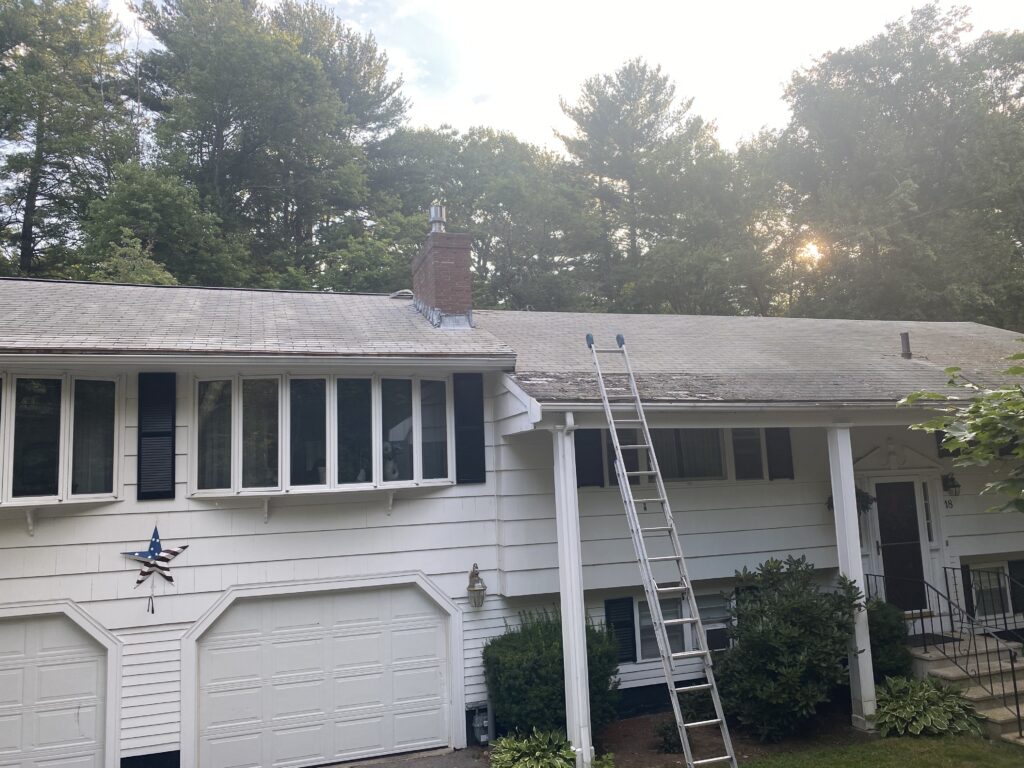
We don’t quote a repair from the driveway. Derek gets on the roof and looks at the decking directly around the problem area, checks the flashing at every chimney, sidewall, and valley nearby, and looks at what the ventilation is actually doing. If there’s attic access, we go up there too, because the underside of the decking tells you things the topside won’t. Staining, soft wood, and rusted nail heads on the underside usually mean the leak has been going on longer than the homeowner realized.
Once we know what we’re looking at, we tell you the honest read. If the decking is solid and the damage is isolated to a section of flashing or a run of storm-damaged shingles, we say so and we fix that. We don’t pad a repair estimate into a replacement pitch, and we don’t downplay a problem that’s bigger than a patch either.
What the job involves
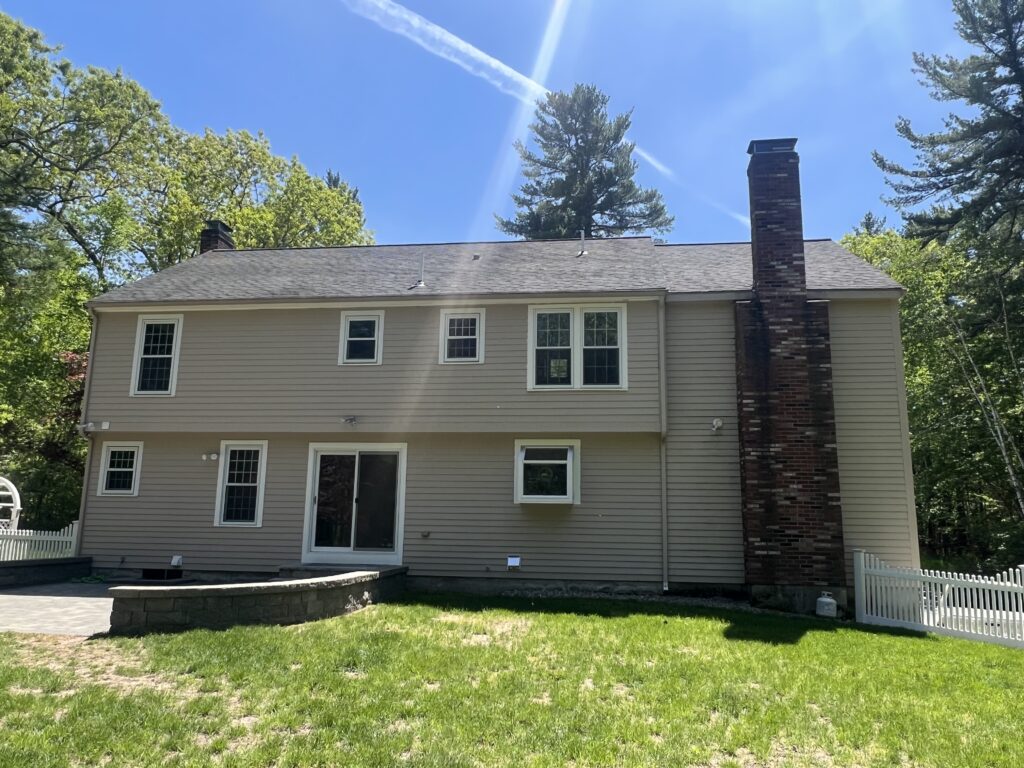
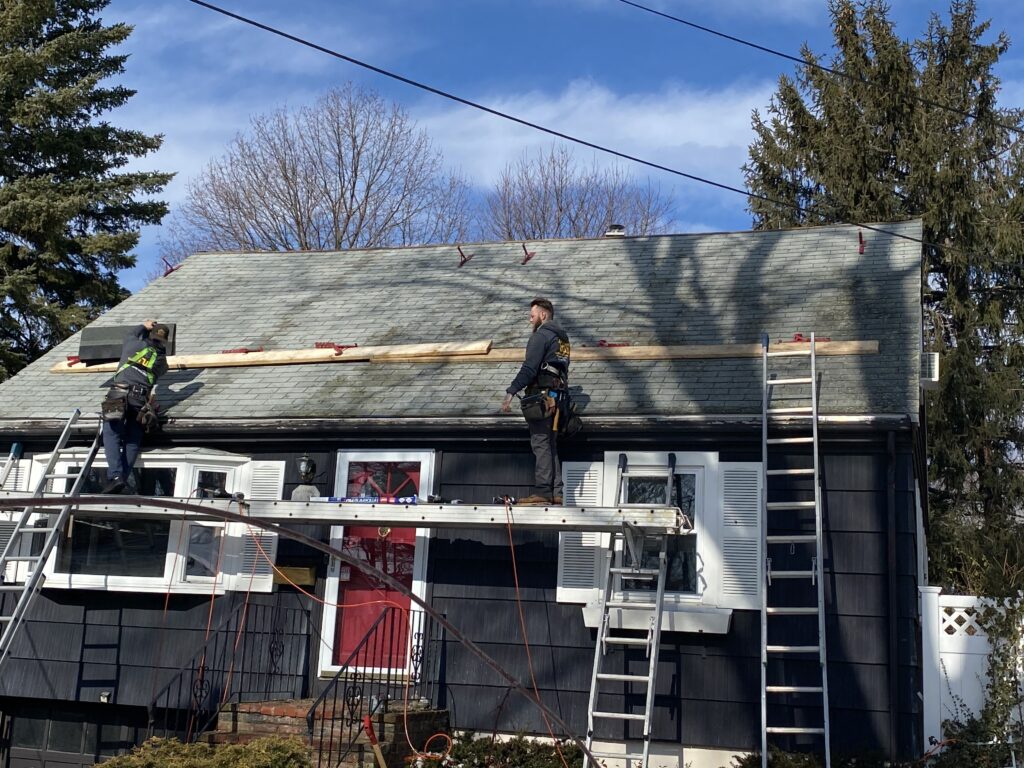
Most repair calls fall into a few categories. Flashing failures at chimneys and skylights get cut back to sound material, re-flashed with new step and counter flashing, and sealed properly instead of just caulked over. Valley repairs mean pulling shingles back far enough to check the underlying valley metal or ice and water shield, replacing what’s compromised, and reinstalling with proper overlap. Ice dam damage often means opening up a section of roof to check decking, adding or extending ice and water shield along the eave, and in some cases improving soffit and ridge ventilation so the same dam doesn’t rebuild next winter. Storm damage, wind-lifted shingles, and squirrel or woodpecker penetration get handled section by section, matching shingle as closely as the roof’s age allows.
What it costs
Straightforward repairs, a flashing section or a small area of shingles, generally run in the {PRICE_LOW} to {PRICE_HIGH} range. What moves that number is the size of the affected area, the pitch you’re working on, how many roof planes the crew has to access, and whether we find rotted decking once we open things up. Access matters more in Boxford than in tighter neighborhoods too. A steep roof over a three-story colonial with limited driveway clearance for a ladder truck costs more to work on safely than the same repair on a single-story ranch with a flat front yard. We give you a number after the assessment, not before it.
How long it takes
Most single-issue repairs, a flashing fix or a valley section, are a one-day job once we’re scheduled and the material is on hand. Ice dam repairs that require opening decking can run into a second day if we find damage that needs to dry out or be replaced before we close it back up. Weather is the other variable. We don’t shingle in the rain and we’re careful about working steep, wet roofs in the shoulder seasons, so a job can shift a day or two if the forecast doesn’t cooperate.
Can a roof this old still be repaired, or does it need full replacement?
It depends on the decking, not the age alone. We've repaired sections on colonial roofs older than the homeowners who called us, as long as the plywood or board sheathing underneath is still sound. If the decking is soft or delaminating around the leak, replacement of that section, or in some cases the whole roof, is the honest recommendation.
Why does my north-facing roof keep forming ice dams?
North-facing slopes lose less heat and hold snow longer, and if the soffit and ridge ventilation isn't moving enough air, the roof surface warms unevenly. Snow melts near the ridge, refreezes at the cold eave, and backs water up under the shingles. We can address the immediate leak and, if it makes sense for the roof, improve the ventilation so it happens less often.
Do you repair slate or cedar sections on older Boxford homes?
Yes, we handle repairs on the mixed roofing you often find on antique properties, including sections of slate or cedar shake alongside asphalt. Matching material and technique on these roofs takes more care than a standard shingle repair, and we treat it that way.
Will you charge to come out and look at the roof?
We'll talk specifics when you call at {PHONE}. Our approach is always to assess before we quote, because a driveway guess on a roof this complex isn't worth much to either of us.
How do you handle access on properties with long driveways or tight tree cover?
We plan for it before the crew shows up. Long driveways and low branches change how we stage ladders and material, and on some Boxford properties that means a different truck or a different route to the roof than we'd use in a more open subdivision. We work that out during scheduling, not on the day of the job.
Get an estimate
If you’ve got a leak, a missing shingle, or a soft spot on the ceiling below a valley, call Couture’s Construction at {PHONE}. We’re based in Methuen and cover Boxford and the rest of the estate belt regularly, so we know the access issues and the roof types before we get here. We’ll give you a straight answer on repair versus replacement after we’ve actually looked, not before.