
- Home
- Services
- Locations
Amesbury, MA
Boxford, MA
Chelmsford, MA
Danvers, MA
Dracut, MA
Essex, MA
Georgetown, MA
Groveland, MA
Hamilton, MA
Haverhill, MA
Ipswich, MA
Merrimac, MA
Methuen, MA
Middleton, MA
Newbury, MA
Newburyport, MA
North Andover, MA
North Reading, MA
Peabody, MA
Rowley, MA
Salem, MA
Salisbury, MA
Tewksbury, MA
Topsfield, MA
Topsfield, MA
West Newbury, MA
Atkinson, MA
Derry, NH
East Kingston, NH
Kensington, NH
Kingston, NH
Londonderry, NH
Plaistow, NH
Salem, NH
- Company
- Contact
- Home
- Services
- Locations
Amesbury, MA
Boxford, MA
Chelmsford, MA
Danvers, MA
Dracut, MA
Essex, MA
Georgetown, MA
Groveland, MA
Hamilton, MA
Haverhill, MA
Ipswich, MA
Merrimac, MA
Methuen, MA
Middleton, MA
Newbury, MA
Newburyport, MA
North Andover, MA
North Reading, MA
Peabody, MA
Rowley, MA
Salem, MA
Salisbury, MA
Tewksbury, MA
Topsfield, MA
Topsfield, MA
West Newbury, MA
Atkinson, MA
Derry, NH
East Kingston, NH
Kensington, NH
Kingston, NH
Londonderry, NH
Plaistow, NH
Salem, NH
- Company
- Contact
Roof Repair in Newbury, MA
Newbury runs from Plum Island marsh grass to farmhouses set back off Route 1A, and both ends of town take a different kind of beating. Out toward the water, wind is the problem. Back from the coast, it’s tree cover and long, shaded roof slopes that never quite dry out. Either way, the roof that’s calling us usually didn’t fail all at once. It’s been losing the fight for a season or two.
Professional Roof Repair Solutions for Newbury Homes
We get called to Newbury roofs for a handful of honest reasons: a soffit stain that showed up after the last nor’easter, a shingle patch that’s gone missing off the back slope, a chimney flashing that was never sealed right the first time. Some of these are a two-hour fix. Some are a sign the whole field of shingles is done and a patch is just delaying the real conversation. We tell you which one you’ve got before we touch the roof, not after.
Couture’s Construction is family owned, based in Methuen, and BBB accredited with an A+ rating. We work roofs across northern Massachusetts and southern New Hampshire, and Newbury is well inside that territory. We’re not going to sell you a full tear-off because it’s a bigger job. We’re going to tell you what we actually see up there.
What Newbury roofs are up against
Newbury sits close enough to open water that wind uplift is not a theoretical concern here. A shingle rated for a moderate wind zone inland can lift at the tab edge in a straight coastal blow, especially on a roof with poor nailing pattern or shingles that are already brittle from age. When we replace shingles here, even a section repair, we’re thinking about the wind rating on the product going down, not just matching the color.
Tree cover is the other half of the story. A lot of Newbury’s older lots, especially around the center of town and along the river, have mature oak and pine hanging over roof valleys. Valleys under heavy tree cover collect needles and leaf litter that hold moisture against the shingles and rot the felt underneath long before the shingles themselves look worn. Combine that with a north-facing slope that gets less sun in winter, and you’ve got a spot that’s primed for an ice dam every time we get a hard freeze-thaw cycle. That’s usually where the water finds its way into the attic, not at the ridge, and not where the stain shows up on the ceiling below.
How we assess it
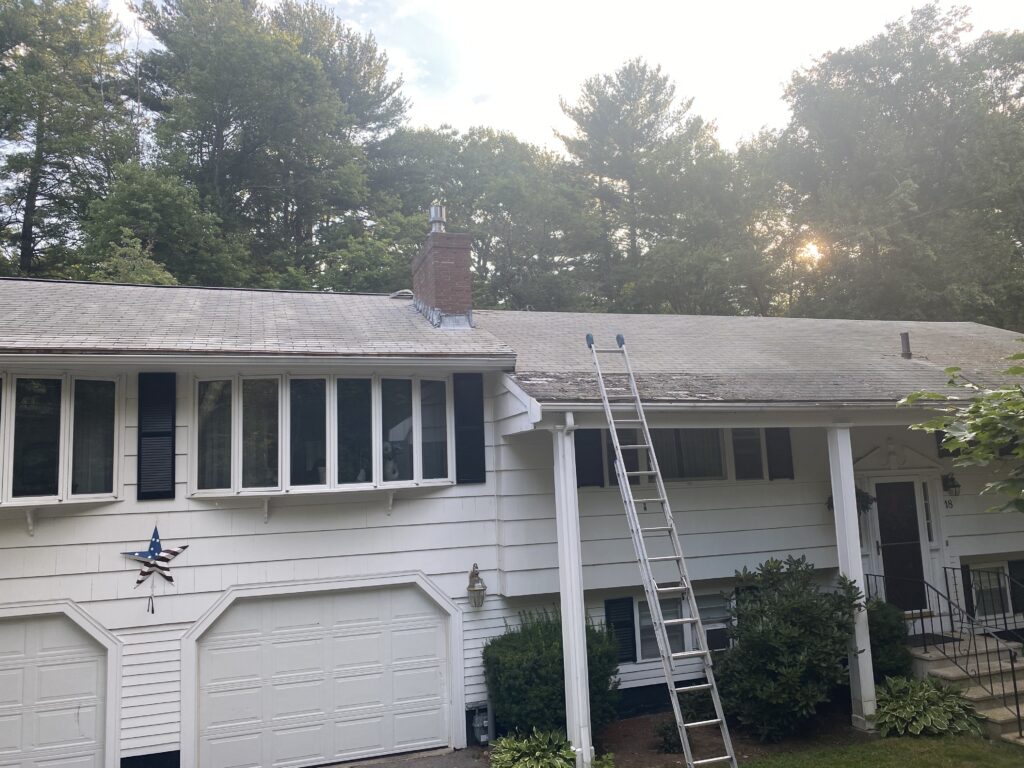
We start on the ground, walking the roofline and looking at how the shingles are aging across different slopes. Then we get up there. We check the decking for soft spots, especially near valleys and around any roof penetration. We pull back flashing at the chimney and any sidewall to see if it was step-flashed correctly or just caulked over, which is a common shortcut on older Newbury re-roofs. We check ridge and soffit ventilation, because a roof that can’t breathe cooks itself from the inside regardless of the shingle quality.
Then, if the attic is accessible, we go up there too. That’s where you actually see moisture staining, rot at the sheathing, and whether insulation is blocking the soffit vents. A roof problem almost always shows up in the attic before it shows up on the ceiling. We don’t quote a repair or a replacement until we’ve done this. Anyone who prices a roof from the driveway is guessing.
What the job involves
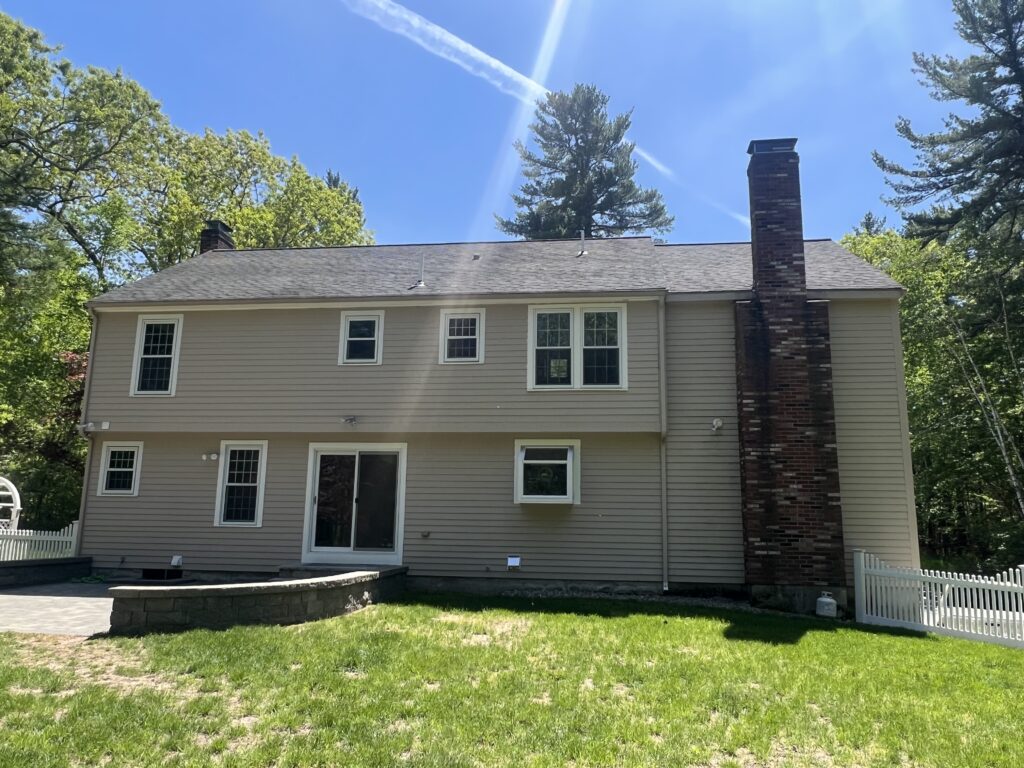
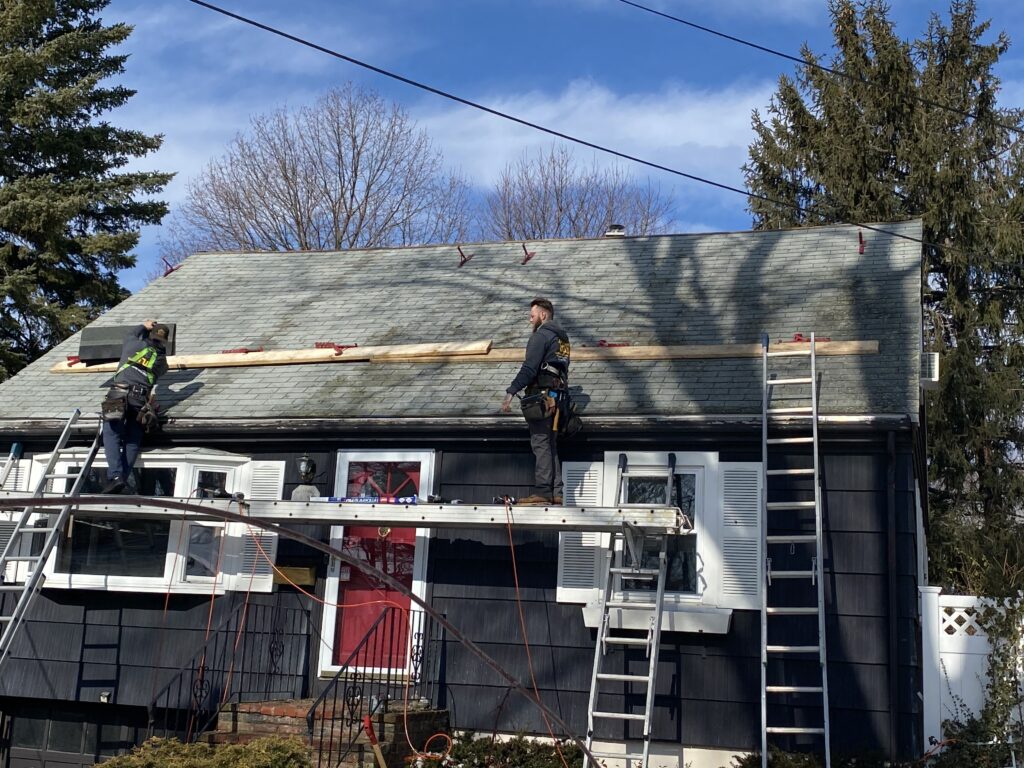
A straightforward repair usually means pulling the damaged shingles, checking the decking underneath, and replacing any rotted sheathing before new shingles and flashing go back down. If ice and water shield wasn’t run properly along the eaves or valleys the first time, that’s the moment to add it, since it’s the single best defense against ice dam leaks in a roof like this. Flashing repairs at chimneys and walls get step-flashed and sealed properly rather than just caulked, which is a temporary fix at best.
If the damage is isolated, we match shingles as close as we can to the existing field and blend the repair in. If we find widespread granule loss, brittle shingles across multiple slopes, or decking that’s soft in more than one spot, we’ll say so plainly and lay out what a full section or full roof replacement would look like, with real numbers, not pressure.
How long it takes
Most section repairs on a Newbury roof are a one-day job, sometimes finished by early afternoon if access is easy and the weather cooperates. Flashing repairs at a chimney or valley run a few hours on their own. If we open up decking and find rot that needs replacing, add a half day. Weather is the real variable this close to the coast. We don’t put shingles down in wind or rain, and a nor’easter can push a scheduled repair back a few days without much notice.
What it costs
A localized shingle and flashing repair generally runs {PRICE_LOW} to {PRICE_HIGH}, and that range moves based on how much of the roof is affected, the pitch, how many layers of old shingles are already down, and whether we find rotted decking once we open things up. Steep pitches and hard-to-reach sections, which show up plenty on Newbury’s older farmhouses and additions, add labor time. We give you a number after the assessment, not before, because a phone estimate on a roof repair is a guess dressed up as a quote.
Is it ever fine to just patch part of a Newbury roof instead of replacing it?
Yes, when the damage is isolated and the rest of the roof is still in reasonable shape. If the shingles around the damaged area are still flexible and holding granules, a section repair is the honest answer and we'll tell you that.
How do I know if my roof problem is wind damage or an ice dam?
Wind damage tends to show up as missing or lifted shingles right after a storm. Ice dam leaks usually show up mid-winter as staining near the eaves or in a north-facing corner of the attic, weeks after any obvious storm event.
Do you work on older Newbury homes with steep or complex rooflines?
Yes. Farmhouses and older colonials with multiple roof planes and additions are common in Newbury, and they need careful flashing work at every transition, which is exactly where most leaks start.
Will you tell me if my roof actually needs full replacement instead of repair?
Yes. We assess before we recommend anything. If a repair is the right call, that's what we quote. If the roof is past that point, we'll show you what we found and explain why.
Request Your Estimate
If your Newbury home has a leak, missing shingles, or storm damage, don’t wait for it to get worse. Couture’s Construction will take a close look at your roof, explain what’s actually going on, and give you a clear, no-pressure estimate for the repair.
- Straightforward pricing, no hidden surprises
- Honest recommendations based on what your roof needs
- Local knowledge of Newbury homes and weather conditions