
- Home
- Services
- Locations
Amesbury, MA
Boxford, MA
Chelmsford, MA
Danvers, MA
Dracut, MA
Essex, MA
Georgetown, MA
Groveland, MA
Hamilton, MA
Haverhill, MA
Ipswich, MA
Merrimac, MA
Methuen, MA
Middleton, MA
Newbury, MA
Newburyport, MA
North Andover, MA
North Reading, MA
Peabody, MA
Rowley, MA
Salem, MA
Salisbury, MA
Tewksbury, MA
Topsfield, MA
Topsfield, MA
West Newbury, MA
Atkinson, MA
Derry, NH
East Kingston, NH
Kensington, NH
Kingston, NH
Londonderry, NH
Plaistow, NH
Salem, NH
- Company
- Contact
- Home
- Services
- Locations
Amesbury, MA
Boxford, MA
Chelmsford, MA
Danvers, MA
Dracut, MA
Essex, MA
Georgetown, MA
Groveland, MA
Hamilton, MA
Haverhill, MA
Ipswich, MA
Merrimac, MA
Methuen, MA
Middleton, MA
Newbury, MA
Newburyport, MA
North Andover, MA
North Reading, MA
Peabody, MA
Rowley, MA
Salem, MA
Salisbury, MA
Tewksbury, MA
Topsfield, MA
Topsfield, MA
West Newbury, MA
Atkinson, MA
Derry, NH
East Kingston, NH
Kensington, NH
Kingston, NH
Londonderry, NH
Plaistow, NH
Salem, NH
- Company
- Contact
Roof Repair in Chelmsford, MA
Chelmsford has a mix you don’t see everywhere in one town: subdivisions off Route 129 and Westford Street built out through the 1990s and early 2000s, older neighborhoods closer to the center with additions tacked onto the back of the house over the years, and a lot of mature tree canopy that drops a season’s worth of debris into every valley and gutter. That combination means we get called out for two very different roofs on the same street sometimes – one shedding granules off a twenty-year-old architectural shingle, the other leaking at a low-slope addition that was never built to shed water fast in the first place.
Professional Roof Repair Solutions for Chelmsford Homes
Not every leak means a new roof. That’s the honest answer, and it’s the one homeowners in Chelmsford deserve before anyone climbs a ladder. A lot of the repair calls we get are legitimate repairs – a cracked boot at a plumbing vent, a section of flashing that pulled away from a chimney, a few courses of shingles that lifted in a wind event. We fix those and move on. The roof underneath is often sound for another decade or more if the rest of the field is intact.
Where it gets more complicated is when the shingles are original to the house and the house is in that 1998-2005 build window. Architectural shingles from that era are hitting twenty to twenty-five years now, and when one section starts failing, the rest usually isn’t far behind. We’ll still repair what needs repairing today. We just won’t tell you it’s a permanent fix if the whole roof is running out of life at the same time.
What Chelmsford roofs are up against
The subdivision houses built through the 90s and early 2000s are hitting their shingles’ natural end of life more or less all at once, and that clustering matters. When a whole street was roofed by the same builder in the same year, you’ll often see the same failure – granule loss, curling at the tabs, nail heads working loose – show up on multiple houses within a season or two of each other. If your neighbor just got a new roof, it’s worth having yours looked at even if it isn’t leaking yet.
Older housing stock closer to town center carries a different problem: low-slope rear additions – kitchen bumpouts, sunrooms, converted porches – that were roofed with materials or pitch that were never meant to shed water the way a steep main roof does. These fail years, sometimes a decade, before the main roof shows any wear at all. Add in heavy tree cover along streets like North Road and parts of the Westlands, and you get valleys that clog with leaves and pine needles, holding water against the shingles longer than they should. In winter, north-facing slopes on colonials with tight eaves are the ones we see forming ice dams, backing water up under the shingle edge and into the soffit.
How we assess it
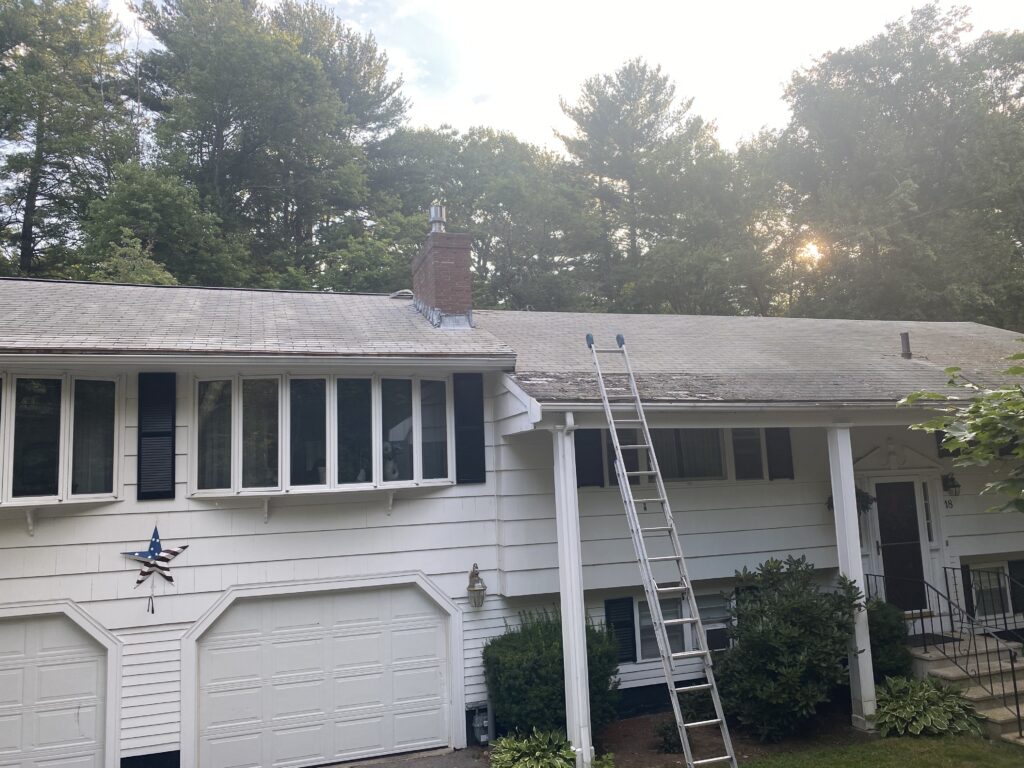
Derek doesn’t quote a repair off a photo you text him. He gets on the roof. That means checking the decking for soft spots or delamination, looking at flashing at every chimney, skylight, and valley, and checking ridge and soffit ventilation because a roof that isn’t breathing right ages faster and holds ice longer in winter. He’ll also get into the attic if there’s access, because the underside of the roof deck tells you things the shingles never will – staining, daylight through nail holes, insulation that’s wet or compressed.
You get a straight answer after that, not a sales pitch. If it’s a repair, we say so and price the repair. If the decking is soft or the shingles are failing broadly and a repair would just be a stopgap, we say that too, and we’ll tell you why. Either way, the assessment happens before the recommendation, not the other way around.
What the job involves
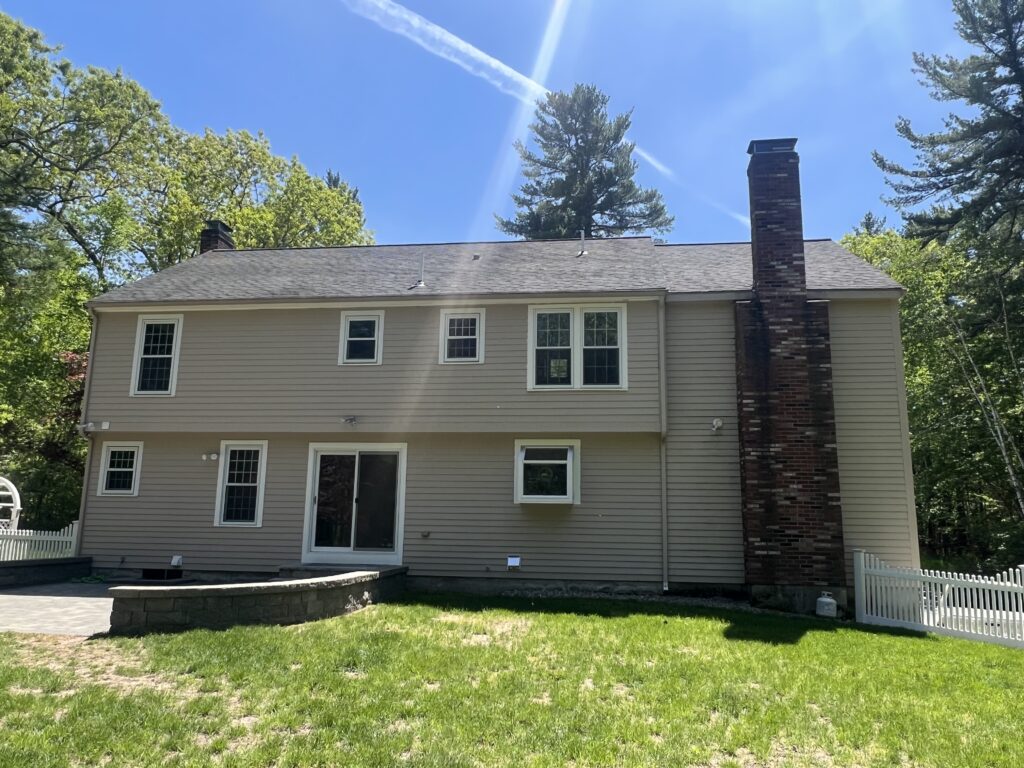
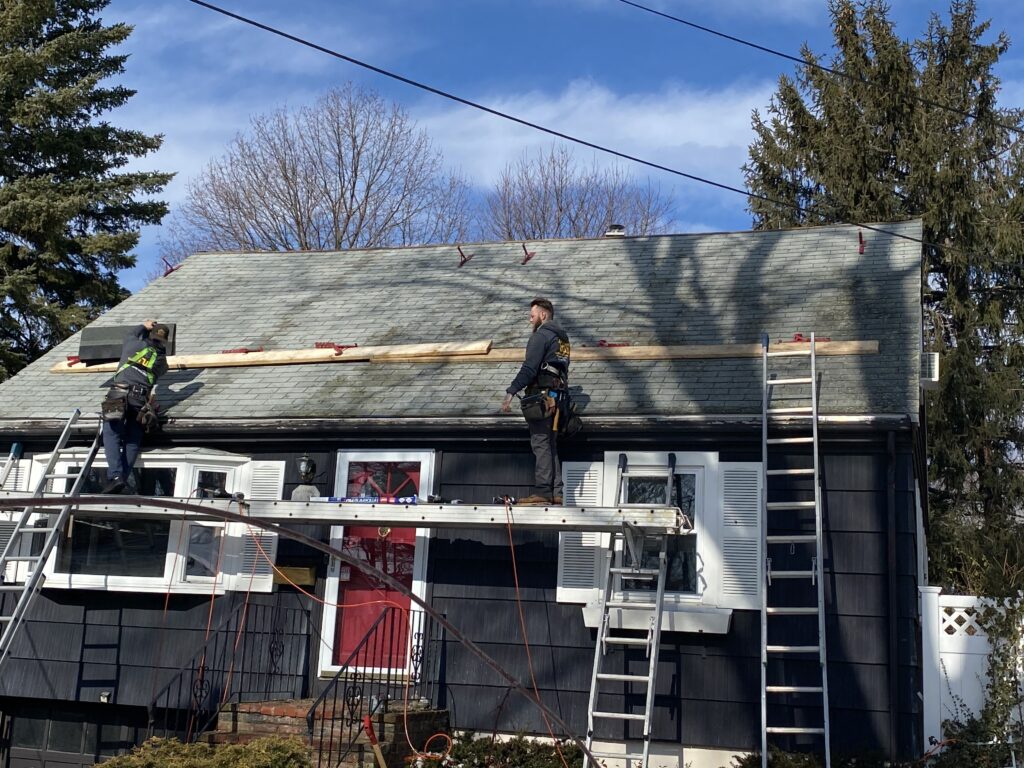
Most repair jobs in Chelmsford fall into a handful of categories: replacing a section of shingles damaged by wind or a fallen branch, re-flashing a chimney or valley where the metal has pulled away or corroded, sealing or replacing pipe boots that have cracked with age, and patching low-slope additions where the roofing membrane has failed at a seam. We match shingle color and profile as close as we can get to the existing roof, tie flashing into the existing underlayment correctly rather than just caulking over the problem, and check that ice and water shield is present at eaves and valleys where code and common sense both call for it.
On older homes we’re also watching for decking that’s gone soft from years of slow leaking. If we find it during a repair, we’ll show you before we cut into it and price that separately. We don’t expand small jobs into big ones without walking you through exactly what we found and why it needs addressing.
What it costs
Repair costs in Chelmsford typically run between {PRICE_LOW} and {PRICE_HIGH}, and the spread is wide because the work varies so much. A single-slope shingle repair with easy ground access is at the low end. A chimney re-flash with masonry work involved, a repair that requires stripping multiple layers of old roofing to get at the deck, or a low-slope addition needing membrane replacement all push toward the high end. Roof pitch and how many stories up we’re working also factor in – steep roofs and third-floor triple-decker pitches take longer and need more safety setup than a straightforward ranch.
We won’t quote a number before we’ve been on the roof. Anyone who does is guessing.
How long it takes
A straightforward shingle or flashing repair is usually a same-day job, start to finish, weather permitting. Re-flashing a chimney or fixing a low-slope addition roof can run one to two days depending on what’s underneath once we open it up. If we find deck damage that needs plywood replaced, add time for the material and the extra labor, but we’ll tell you that up front once we see it, not after.
Can my roof actually be repaired, or do I need a full replacement?
It depends on what we find during the assessment. Isolated damage – a section of missing shingles, a failed flashing point, a cracked vent boot – is usually a straightforward repair. Widespread granule loss, soft decking in multiple spots, or shingles failing across the whole field are signs a repair would only be temporary. We'll tell you which situation you're in before recommending anything.
How do I know if my Chelmsford roof is old enough to be a concern?
If your house was built or roofed between the late 1990s and mid-2000s and still has its original shingles, it's in the age range where architectural shingles start failing. That doesn't mean it needs replacing today, but it's worth a look, especially if you've noticed granules in the gutters or neighbors on your street getting new roofs recently.
What about the roof over my addition or sunroom?
Low-slope additions are common in Chelmsford's older neighborhoods and they fail differently than a main roof. Flat or low-pitch sections rely more on membrane and flashing than on shingle overlap to shed water, so they wear out faster. If that section is leaking while the main roof is fine, that's a separate repair, not a sign the whole roof needs work.
Do you repair ice dam damage?
Yes. Ice dams typically show up on north-facing slopes with tight eaves, backing meltwater up under the shingles and into the soffit or interior. We assess the ventilation and ice and water shield at the eave, repair the resulting damage, and can talk through options to reduce the chance of it happening again.
Will you try to sell me a full roof when I only called about a repair?
No. We repair what's fixable and say so plainly. If the roof is at a point where a repair genuinely wouldn't hold, we'll explain exactly why, but that conversation only happens if the roof actually calls for it, not as a default pitch.
Get an estimate
If you’ve got a leak, a soft spot, or shingles that look worse than they did last fall, call and we’ll get eyes on it. Derek handles the assessment himself and gives you a straight read on whether it’s a repair, and what that repair actually involves, before any work is scheduled. Call {PHONE} or reach out through the site to set up a time.