
- Home
- Services
- Locations
Amesbury, MA
Boxford, MA
Chelmsford, MA
Danvers, MA
Dracut, MA
Essex, MA
Georgetown, MA
Groveland, MA
Hamilton, MA
Haverhill, MA
Ipswich, MA
Merrimac, MA
Methuen, MA
Middleton, MA
Newbury, MA
Newburyport, MA
North Andover, MA
North Reading, MA
Peabody, MA
Rowley, MA
Salem, MA
Salisbury, MA
Tewksbury, MA
Topsfield, MA
Topsfield, MA
West Newbury, MA
Atkinson, MA
Derry, NH
East Kingston, NH
Kensington, NH
Kingston, NH
Londonderry, NH
Plaistow, NH
Salem, NH
- Company
- Contact
- Home
- Services
- Locations
Amesbury, MA
Boxford, MA
Chelmsford, MA
Danvers, MA
Dracut, MA
Essex, MA
Georgetown, MA
Groveland, MA
Hamilton, MA
Haverhill, MA
Ipswich, MA
Merrimac, MA
Methuen, MA
Middleton, MA
Newbury, MA
Newburyport, MA
North Andover, MA
North Reading, MA
Peabody, MA
Rowley, MA
Salem, MA
Salisbury, MA
Tewksbury, MA
Topsfield, MA
Topsfield, MA
West Newbury, MA
Atkinson, MA
Derry, NH
East Kingston, NH
Kensington, NH
Kingston, NH
Londonderry, NH
Plaistow, NH
Salem, NH
- Company
- Contact
Roof Replacement in Essex, MA
Essex sits right on the marsh, and that changes what a roof deals with over its life. You’ve got open water pushing wind across Essex Bay and the causeway, salt air working on flashing and fasteners year-round, and a lot of older farmhouse and cape-style roofs with additions tacked on over the decades, each with its own low-slope tie-in that’s a likely leak point. If you’re standing in your driveway wondering whether your roof needs a patch or a full tear-off, that’s the question this page is built to answer.
Roof Replacement in Essex
We replace roofs on the older farmhouses and capes that make up a lot of Essex’s housing stock, on the newer builds off Southern Avenue and John Wise Avenue, and on the handful of larger waterfront and marsh-view properties where wind exposure is the main design factor. Essex doesn’t have the dense downtown access problems you get in Newburyport, but it has its own version of the same coastal problem: roofs here take wind and salt that a roof twenty miles inland never sees. That changes what shingle, what fastening pattern, and what flashing detail actually holds up.
This is the biggest job we do and the one we get called for most, and it’s also the one where doing it right the first time matters most. A roof replacement is a fifteen-to-thirty-year decision. We’d rather spend an extra twenty minutes on your roof explaining what we’re seeing than rush you into signing something.
What Essex roofs are up against
Wind is the first thing we look at on any roof near the water in Essex. Standard three-tab shingles are rated for around 60 to 70 mph gusts. A lot of the architectural shingles installed here twenty years ago carry the same low rating, and they were never really matched to the site. When a roof sits within a mile or two of open water on the bay or the marsh, we spec shingles rated for 110 mph gusts or better, and we make sure the fastening pattern and nail count actually meet that rating instead of just the shingle wrapper.
The second issue is moisture, and it shows up two different ways depending on which side of the roof you’re standing on. North-facing slopes on the older capes and farmhouses hold snow longer and are the ones that build ice dams in a hard winter, backing water up under the shingles at the eaves. Meanwhile the marsh-adjacent lots tend to have mature tree cover on at least one side, and valleys under that cover collect leaves and pine debris that hold moisture against the shingle mat long after the rest of the roof has dried out. We also see a fair number of low-slope additions and porch roofs on the older Essex homes, tied into a steeper main roof, and that transition is where a surprising share of the leaks we get called about actually originate.
How we assess it
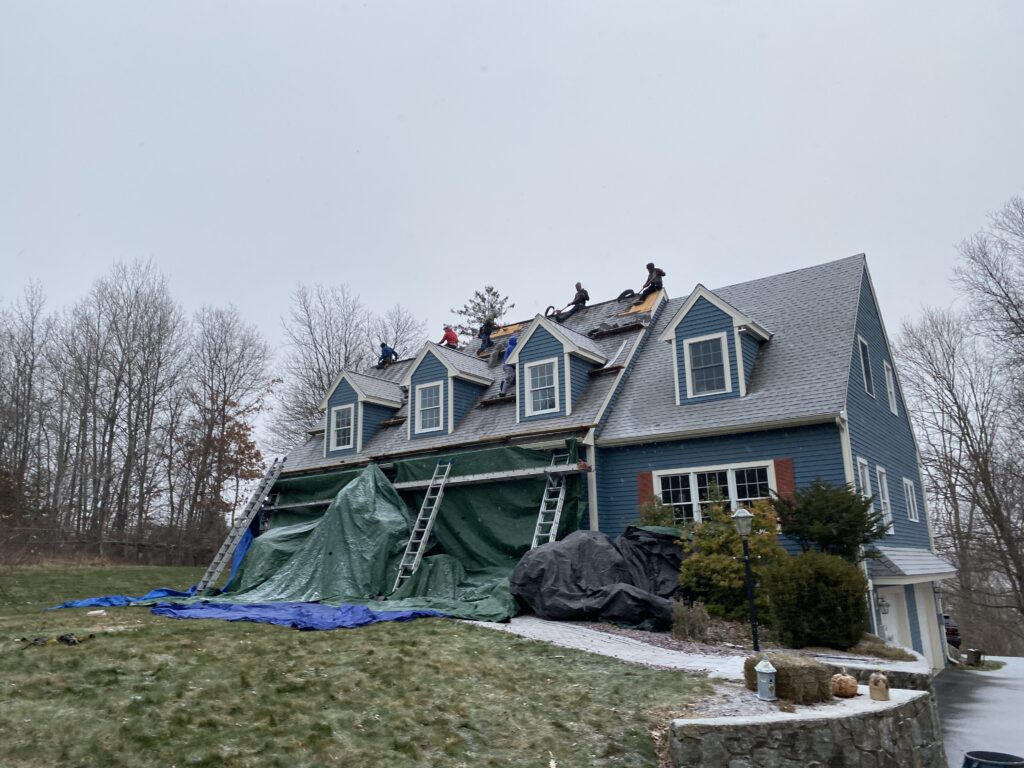
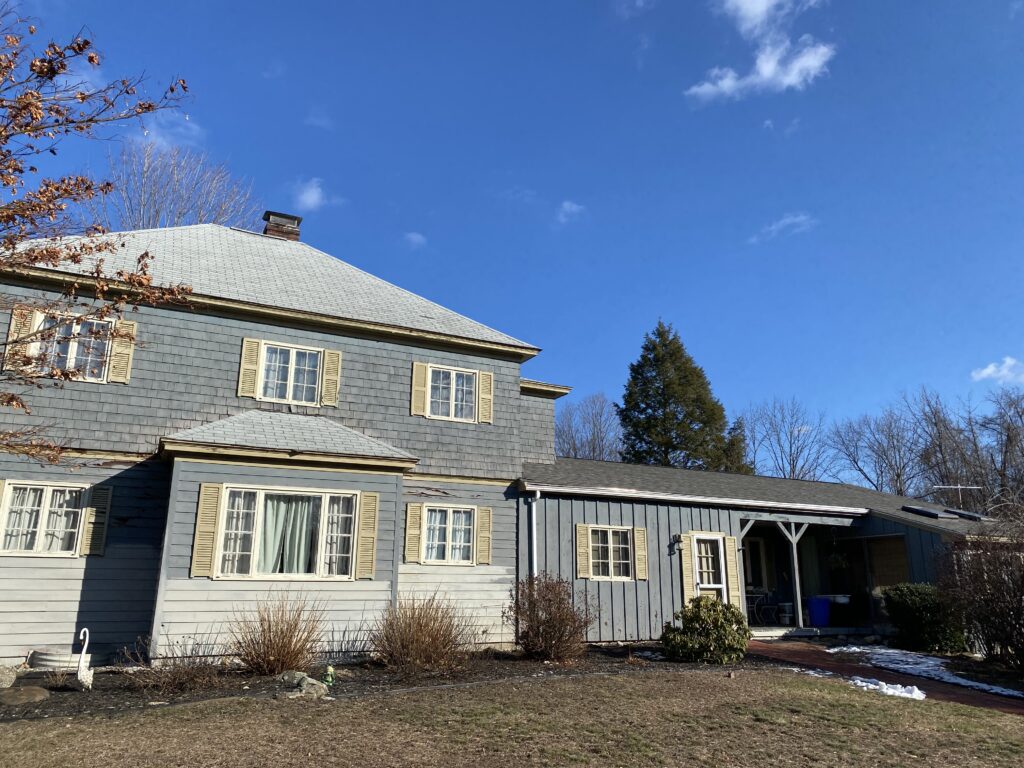
Before Derek recommends anything, he’s up on the roof and in the attic. On the roof, we’re checking decking for soft spots, especially near valleys and around any chimney or plumbing vent. We’re pulling back shingle edges where we can to see how many layers are already up there and what the flashing at chimneys and sidewalls looks like underneath. Rusted or improperly stepped flashing is one of the most common things we find on older Essex homes, and it’s often the real source of a leak that’s been blamed on the shingles for years.
From the attic, we’re looking at the underside of the decking for water staining or rot, checking whether there’s any ridge or soffit ventilation at all, and if there is, whether it’s actually balanced so the roof can breathe. A lot of older homes here were built before soffit venting was standard, and adding it during a replacement is often the single best thing we can do for the life of the new roof. We don’t recommend a full replacement until we’ve seen all of this. If a roof needs a repair, we say so.
What the job involves
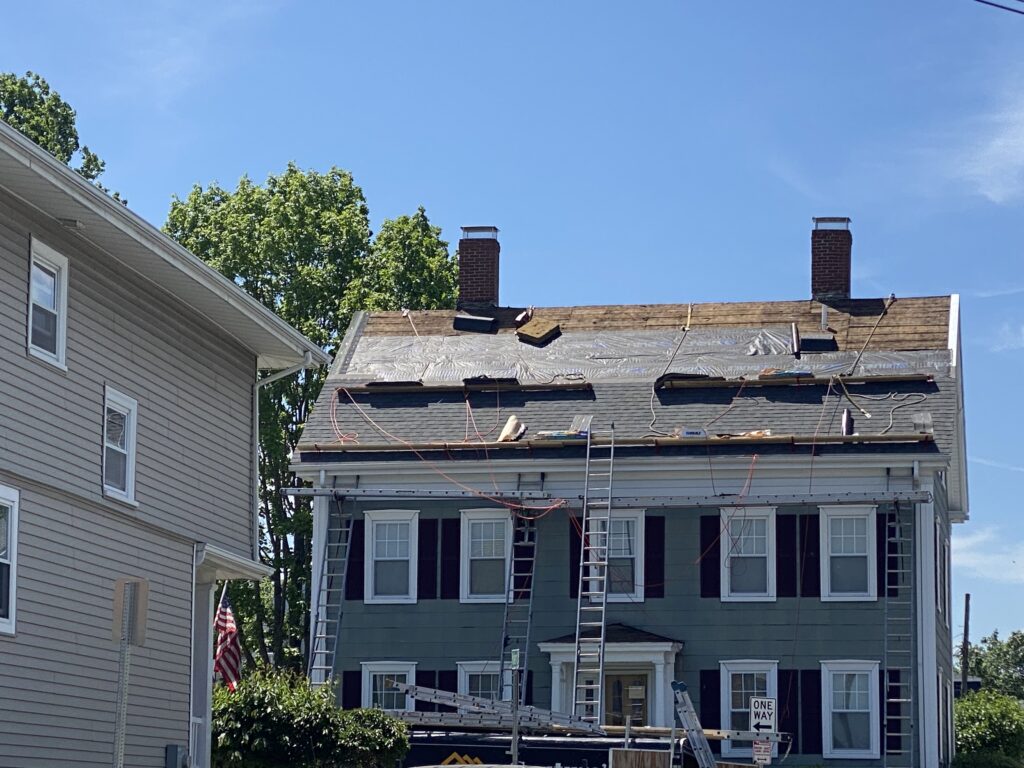
A full tear-off means stripping the existing roof down to decking, not layering over it. We replace any decking that’s soft or delaminated, board by board, and price that separately once we can see it, because you can’t always tell from the ground or even from the attic how bad a section is until the old shingles are off. From there we install ice and water shield along the eaves, in all valleys, and around every penetration, which matters more in Essex than it does further inland because of the ice dam risk on those north slopes. Then synthetic underlayment across the rest of the deck, new flashing at every chimney, sidewall, and valley, the shingle system itself, and ridge and soffit venting sized to the roof, not just whatever was there before. We haul everything off site and do a nail sweep of the yard and driveway before we call the job done.
How long it takes
Most single-family roof replacements in Essex run one to three days once the crew is on site, weather permitting. A straightforward cape or ranch roof with a simple footprint can be a single-day tear-off and reinstall. A larger home with multiple roof planes, dormers, and a low-slope addition tie-in runs longer, and decking replacement adds time once we know how much needs to come out. We’ll give you a realistic window before we start, not an optimistic one.
What it costs
Roof replacement in Essex typically runs {PRICE_LOW} to {PRICE_HIGH}, and where you land in that range depends on a handful of things: total roof size, how many planes and how steep the pitch is, how many layers of old shingles have to come off, how much decking turns out to be bad once it’s exposed, and how hard the roof is to access, which matters more than people expect on the older, tighter lots near the village center. We’ll walk you through the number before we sign anything, and we’ll tell you up front what could move it once we start.
How do I know if I need a repair or a full replacement?
If the leak is isolated to one flashing point, a valley, or a small area of damaged shingles and the decking underneath is sound, a repair is usually the right call and we'll tell you that. Replacement makes sense when you've got widespread shingle failure, multiple existing layers, soft decking in more than one spot, or a roof that's simply past its expected life for the wind and moisture exposure it sits in near the water.
Why does wind rating matter more in Essex than inland towns?
Essex sits close to open water on the bay and marsh, and sustained wind and gusts here are noticeably higher than a roof would see twenty miles inland. Standard shingles rated around 60 to 70 mph gusts can lift or lose granules faster in that exposure. We typically spec shingles rated 110 mph or higher for anything near the water, with a fastening pattern to match.
Do you handle the permit for a roof replacement in Essex?
Yes, we handle the local building permit as part of the job. Essex requires a permit for roof replacement work, and we file it before the crew shows up.
What happens if you find bad decking once the roof is torn off?
We stop and show you before replacing anything beyond the original scope. Bad decking gets priced separately, by the board, because it's genuinely impossible to know the full extent until the old roofing is off and we can see the wood.
Do you install ice and water shield on every roof?
On every roof in this area, yes, at minimum along the eaves and in all valleys. Given how many Essex roofs have north-facing slopes prone to ice damming in winter, it's not an upsell, it's standard practice here.
Request your estimate
Thinking about a new roof for your Essex home? Couture’s Construction will walk your property, inspect the current roofing, and put together a clear, no-pressure estimate before any work begins. We take the time to explain what we find and why we recommend the materials and approach we do, so you can make an informed decision.
- On-site inspection
- Written estimate
- No obligation