
- Home
- Services
- Locations
Amesbury, MA
Boxford, MA
Chelmsford, MA
Danvers, MA
Dracut, MA
Essex, MA
Georgetown, MA
Groveland, MA
Hamilton, MA
Haverhill, MA
Ipswich, MA
Merrimac, MA
Methuen, MA
Middleton, MA
Newbury, MA
Newburyport, MA
North Andover, MA
North Reading, MA
Peabody, MA
Rowley, MA
Salem, MA
Salisbury, MA
Tewksbury, MA
Topsfield, MA
Topsfield, MA
West Newbury, MA
Atkinson, MA
Derry, NH
East Kingston, NH
Kensington, NH
Kingston, NH
Londonderry, NH
Plaistow, NH
Salem, NH
- Company
- Contact
- Home
- Services
- Locations
Amesbury, MA
Boxford, MA
Chelmsford, MA
Danvers, MA
Dracut, MA
Essex, MA
Georgetown, MA
Groveland, MA
Hamilton, MA
Haverhill, MA
Ipswich, MA
Merrimac, MA
Methuen, MA
Middleton, MA
Newbury, MA
Newburyport, MA
North Andover, MA
North Reading, MA
Peabody, MA
Rowley, MA
Salem, MA
Salisbury, MA
Tewksbury, MA
Topsfield, MA
Topsfield, MA
West Newbury, MA
Atkinson, MA
Derry, NH
East Kingston, NH
Kensington, NH
Kingston, NH
Londonderry, NH
Plaistow, NH
Salem, NH
- Company
- Contact
Roof Repair in Methuen, MA
Walk through the Currier neighborhood or up around Pleasant Valley and you’ll see two different roofs failing for two different reasons. The triple-deckers and mill-era two-families are shedding granules off shingles nobody has looked at in decades, and the low-slope additions tacked onto the back of them are already leaking. Out toward the newer streets off Route 110 and near the Lawrence line, the 1990s and early-2000s colonials are all hitting the same wall at once: their original architectural shingles are twenty-plus years old and starting to curl at the same time, on the same streets, in the same season.
Roof Repair in Methuen
A repair call in Methuen usually means one of three things: a leak that’s already showing up on a ceiling or in an attic, a section of shingles that’s visibly damaged after wind or ice, or a homeowner who spotted granules in the gutter and wants a straight answer before it turns into water damage. We treat all three the same way. We come look at the roof, we tell you what we actually see, and we tell you whether a repair holds or whether you’re past that point. We don’t decide that from the driveway.
Most of the repair work we do in this city is flashing failures at chimneys and sidewalls, valley leaks where debris has backed water up under the shingles, and soft or rotted decking on those rear low-slope additions that are so common on the older housing stock here. None of that requires tearing off a whole roof. It requires knowing exactly where the water is getting in and fixing that spot correctly.
What Methuen roofs are up against
The two building eras in this city create two different repair problems. The mill-era two- and three-family homes were mostly built with steep main roofs and flat or low-slope rear additions bolted on later for a kitchen or a porch. Those low-slope sections use different materials and different flashing details than the main roof, and they fail years before the field of the house does. If you own one of these and you’ve never had the flat section looked at separately from the rest of the roof, that’s usually where the leak is.
The newer subdivisions built through the 1990s and early 2000s are hitting a different problem: age. Architectural shingles from that era were typically rated for twenty to twenty-five years, and a huge share of Methuen’s post-war and modern colonial stock landed those roofs within a few years of each other. That means a lot of these houses are now shedding granules, curling at the tab edges, and losing wind resistance all at roughly the same time. Add in heavy tree cover on the older, more established streets, which loads valleys with pine needles and leaves that trap moisture, and you’ve got a city with two very different failure patterns depending on which side of town you’re standing on. Ice damming on north-facing slopes with poor attic ventilation is the other constant here, and it shows up on both old and new roofs alike.
How we assess it
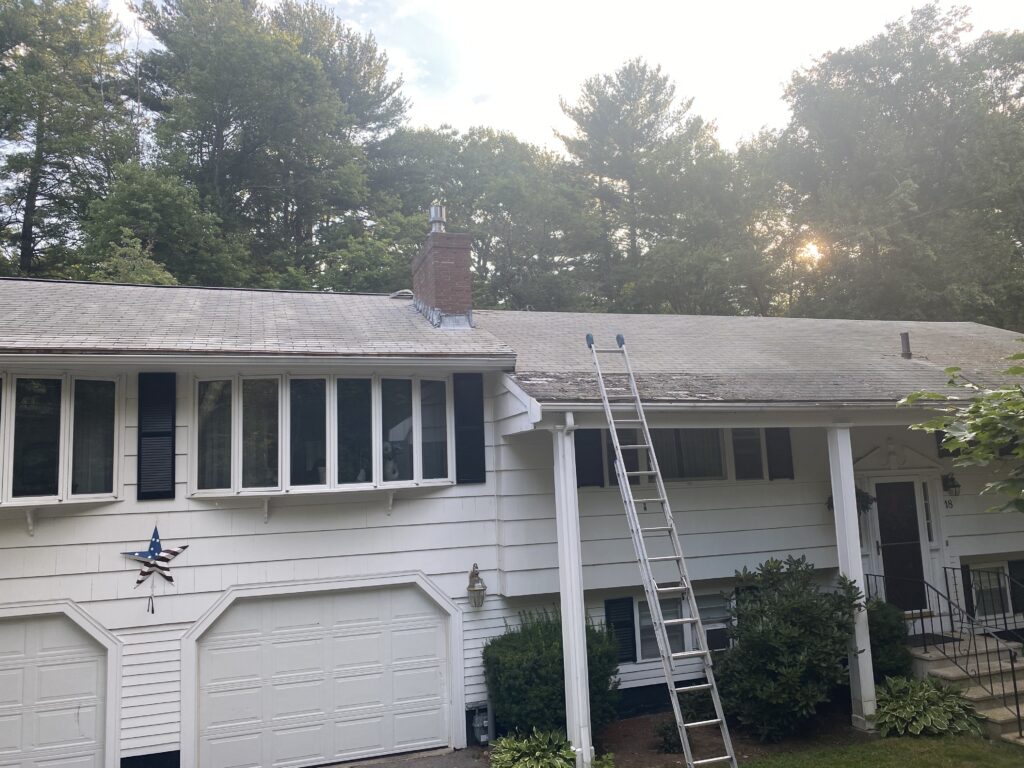
Derek gets on the roof. Not just the ladder at the eave, on the roof, walking the field, checking shingle condition tab by tab where it matters, and looking closely at every flashing point: chimney, sidewall, valley, any pipe boot or vent. Then we go into the attic if there’s access, because the underside tells you things the topside doesn’t. Dark staining on the decking, damp insulation, daylight where there shouldn’t be any, and the state of the ridge and soffit vents all tell us whether this roof is breathing correctly or cooking itself from the inside.
We check decking condition, because a repair on rotted plywood is a repair that fails again in a year. We check how many layers of shingles are already up there, because that changes what a future job would even involve. And we say plainly what we find. If a patch and new flashing solves it, we say that. If the decking underneath is soft or the shingles are past any reasonable repair, we say that too, and we explain why, not just quote a bigger number.
What the job involves
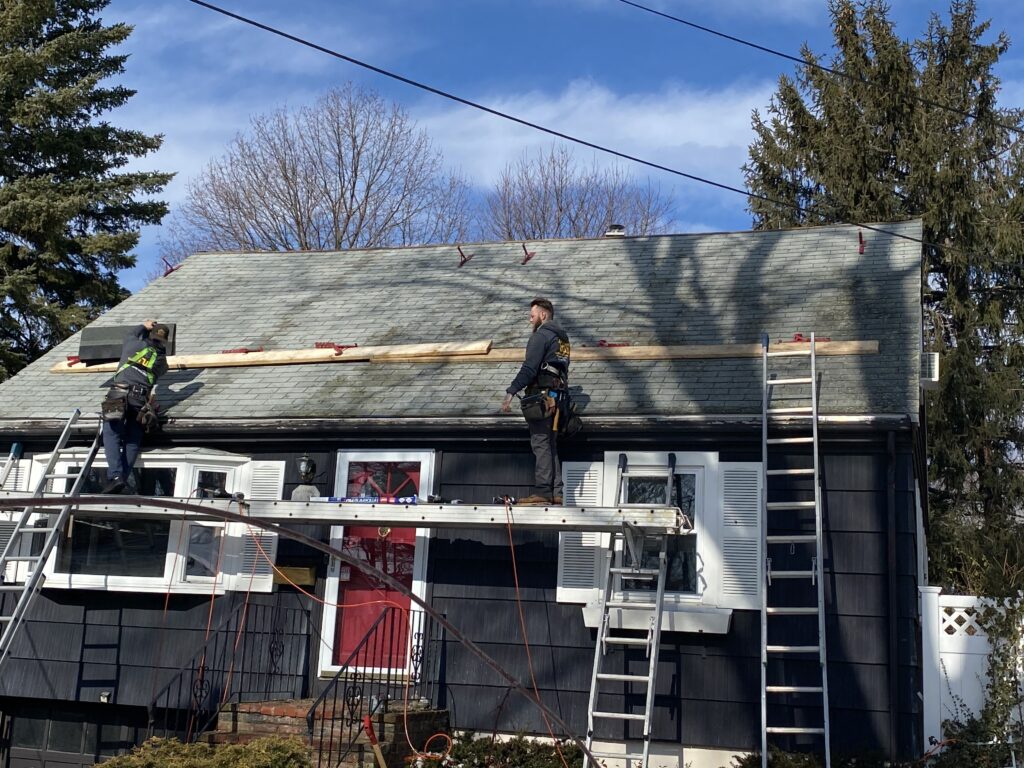
A real repair starts with stripping the damaged section down to decking, not just laying new shingles over a compromised area. If the decking underneath is soft, spongy, or stained through, it gets replaced before anything else happens. Flashing at chimneys, sidewalls, and valleys gets rebuilt correctly rather than caulked over, because caulk is a temporary fix that always comes back to bite you in a year or two. We use ice and water shield at eaves and valleys, which matters more in Methuen than in a lot of places because of how many roofs here deal with ice damming every winter.
Matching shingle color and style to an existing roof isn’t always exact, especially on an older roof where the original product is discontinued, and we’ll tell you upfront if a patch is going to be visible. Ventilation gets a look too. If the ridge or soffit vents are blocked, painted shut, or undersized, that gets flagged as part of the repair conversation, because a repair on a roof that can’t breathe properly is a short-term fix.
What it costs
Repairs in Methuen typically run somewhere between {PRICE_LOW} and {PRICE_HIGH}, and the honest answer is that the number depends on what we find once we’re actually up there. A single flashing repair on an accessible chimney is a different job than a full valley rebuild with rotted decking underneath it. Roof size, pitch, how many layers need to come off, and how easy the roof is to access all move the price. Steep pitches and tall two- and three-story homes take longer and need more safety setup than a single-story ranch, and that’s reflected in the estimate, not hidden in it.
We never quote a fixed number before we’ve seen the roof, and we never pad a repair estimate to make replacement look cheaper by comparison. If a repair is the right call, that’s the estimate we give you.
How long it takes
Most single-area repairs in Methuen, a chimney flashing rebuild or a valley section, are a one-day job for our crew, weather permitting. If decking replacement is involved or the damage covers more of the roof, plan on one to two days. We don’t rush flashing work to hit a timeline, because a flashing job done fast is usually a flashing job you’re calling us back about next spring.
Can my roof actually be repaired, or do I need a full replacement?
It depends on the decking underneath and how much of the roof is affected. A single flashing failure or one damaged section is usually a straightforward repair. Widespread granule loss, multiple leak points, or rotted decking across a large area point toward replacement. We tell you which situation you're in after we've actually inspected the roof, not before.
How do I know if it's a repair or something bigger?
Look at how localized the damage is. A leak at one chimney or valley is usually a repair. Staining in multiple rooms, sagging sections, or shingles that are curling and losing granules across the whole roof usually mean the roof is at the end of its life everywhere, not just in one spot.
Do you patch the flat roof on my house's rear addition separately?
Yes. Low-slope additions on older Methuen homes use different materials and flashing than the main roof and they fail on their own timeline. We assess and repair them separately from the main roof field.
Will a patched section match the rest of my roof?
We do our best to match color and shingle style, but exact matches aren't always possible, especially on older roofs where the original shingle has been discontinued. We'll tell you honestly what to expect before the work starts.
What causes ice dams on Methuen roofs?
Poor attic ventilation combined with heat escaping into the attic melts snow on the roof, which refreezes at the colder eave and backs water up under the shingles. North-facing slopes with limited sun exposure are the most common spot we see this. Proper ridge and soffit ventilation and ice and water shield at the eaves are the fix.
Get an estimate
If you’ve got a leak, a stain on a ceiling, or a spot on the roof that doesn’t look right, get it looked at before the next storm makes the decision for you. Call {PHONE} and we’ll set up a time to get on the roof and give you a straight read on what’s actually going on, repair or otherwise.