
- Home
- Services
- Locations
Amesbury, MA
Boxford, MA
Chelmsford, MA
Danvers, MA
Dracut, MA
Essex, MA
Georgetown, MA
Groveland, MA
Hamilton, MA
Haverhill, MA
Ipswich, MA
Merrimac, MA
Methuen, MA
Middleton, MA
Newbury, MA
Newburyport, MA
North Andover, MA
North Reading, MA
Peabody, MA
Rowley, MA
Salem, MA
Salisbury, MA
Tewksbury, MA
Topsfield, MA
Topsfield, MA
West Newbury, MA
Atkinson, MA
Derry, NH
East Kingston, NH
Kensington, NH
Kingston, NH
Londonderry, NH
Plaistow, NH
Salem, NH
- Company
- Contact
- Home
- Services
- Locations
Amesbury, MA
Boxford, MA
Chelmsford, MA
Danvers, MA
Dracut, MA
Essex, MA
Georgetown, MA
Groveland, MA
Hamilton, MA
Haverhill, MA
Ipswich, MA
Merrimac, MA
Methuen, MA
Middleton, MA
Newbury, MA
Newburyport, MA
North Andover, MA
North Reading, MA
Peabody, MA
Rowley, MA
Salem, MA
Salisbury, MA
Tewksbury, MA
Topsfield, MA
Topsfield, MA
West Newbury, MA
Atkinson, MA
Derry, NH
East Kingston, NH
Kensington, NH
Kingston, NH
Londonderry, NH
Plaistow, NH
Salem, NH
- Company
- Contact
Roof Repair in North North Andover, MA, MA
A good chunk of North North Andover, MA’s colonial and Cape stock went up during the subdivision boom of the 1990s and early 2000s, and the architectural shingles on those roofs are all aging out at roughly the same time. Add in the older housing near the town center with additions tacked onto the back at a low pitch, and you get two very different repair calls happening on the same street.
Professional Roof Repair Solutions for North Andover, MA Homes
We fix roofs. That sounds obvious, but a lot of companies that show up for a repair call spend the whole visit trying to talk you into a full tear-off. We do not work that way. Derek looks at what you actually have, tells you what’s wrong with it, and gives you a straight answer on whether a repair holds or whether you’re better off putting the money toward something bigger down the line. Most of the time on a roof under fifteen years old, a repair is exactly the right call.
We handle flashing failures, damaged valleys, shingle blow-off, soft decking around chimneys and skylights, and the low-slope rear addition leaks that are common on the older housing stock in this area. If your roof needs a patch, you get a patch, priced fairly, done right.
What North North Andover, MA roofs are up against
The subdivisions built off Salem Street, Sutton Hill, and the newer construction pushing out toward Boxford Street are almost all sitting on original architectural shingles now pushing twenty to twenty-five years old. That’s the point where the granule loss accelerates, the seal strips give up in high wind, and small leaks start showing up around penetrations that were fine for two decades. When a whole neighborhood was built in the same three-year window, the roofs fail in the same three-year window too, and we see it happen street by street.
The older housing closer to town, and the properties bordering conservation land and the reservoir where tree cover is heavy, deal with a different set of problems. Valleys pack with pine needles and leaf debris and hold moisture against the shingle mat longer than they should. North-facing slopes in shaded lots build up ice dams every winter that older houses without proper ice and water shield were never built to handle. And a fair number of these homes have low-slope rear additions, porches, or bump-outs where the roof pitch drops below what standard shingles are rated for. Those sections fail years before the main roof does, and they’re often the actual source of a leak a homeowner assumes is coming from the main field.
How we assess it
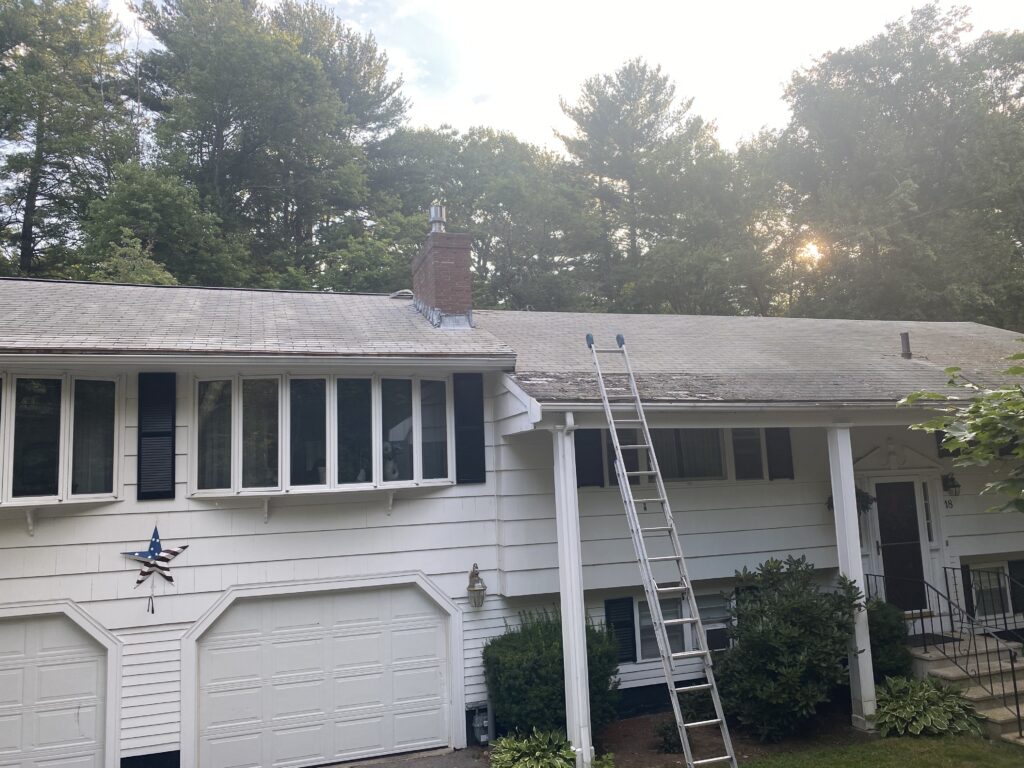
We don’t quote a repair off a drive-by. Derek gets on the roof and checks the decking for soft spots, especially around chimneys, skylights, and any low-slope section. He pulls back shingles near the leak point to see what the flashing actually looks like underneath, not just what’s visible from the ground. He checks ridge and soffit ventilation, because a roof that isn’t breathing right cooks itself from the inside and that shows up as premature shingle failure and ice damming in winter.
Then, if there’s attic access, he goes up and looks at the underside of the decking. Water stains, dark streaking, or daylight coming through tell you more about the real condition of a roof than anything visible from the driveway. Only after that does he tell you what’s actually going on and what your options are. No recommendation gets made before the assessment. That’s not a sales line, it’s just the only way to give someone an honest answer.
What the job involves
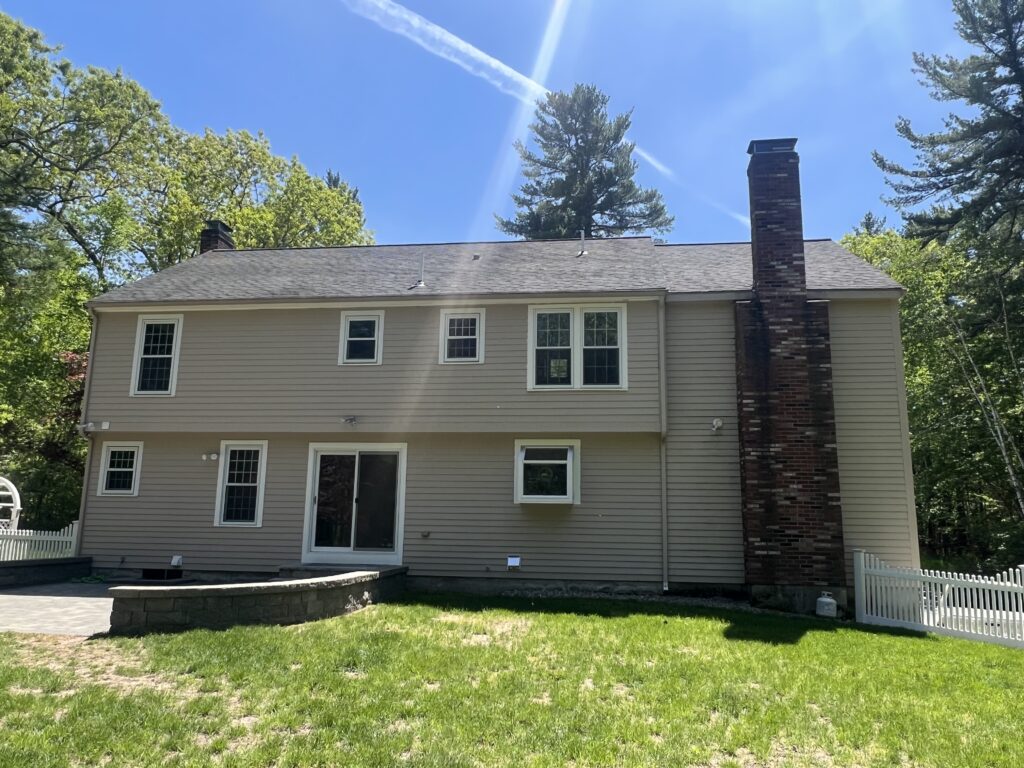
A straightforward flashing repair or shingle patch is usually a one-day job. We strip the damaged section back to sound decking, replace any rotted plywood, install new ice and water shield at the vulnerable points, re-flash chimneys and valleys with new step and counter flashing where needed, and match the shingle as closely as the existing product allows. If the leak turns out to be a ventilation problem rather than a material failure, we’ll say so and address the ridge or soffit vents instead of just patching over a symptom.
On the low-slope additions common in the older parts of North North Andover, MA, sometimes a shingle repair isn’t the right fix at all. If the pitch is too low for architectural shingle, we’ll tell you that upfront and talk about a membrane option instead of putting a Band-Aid on a roof that’s going to leak again in a year regardless of how well the patch is done.
What it costs
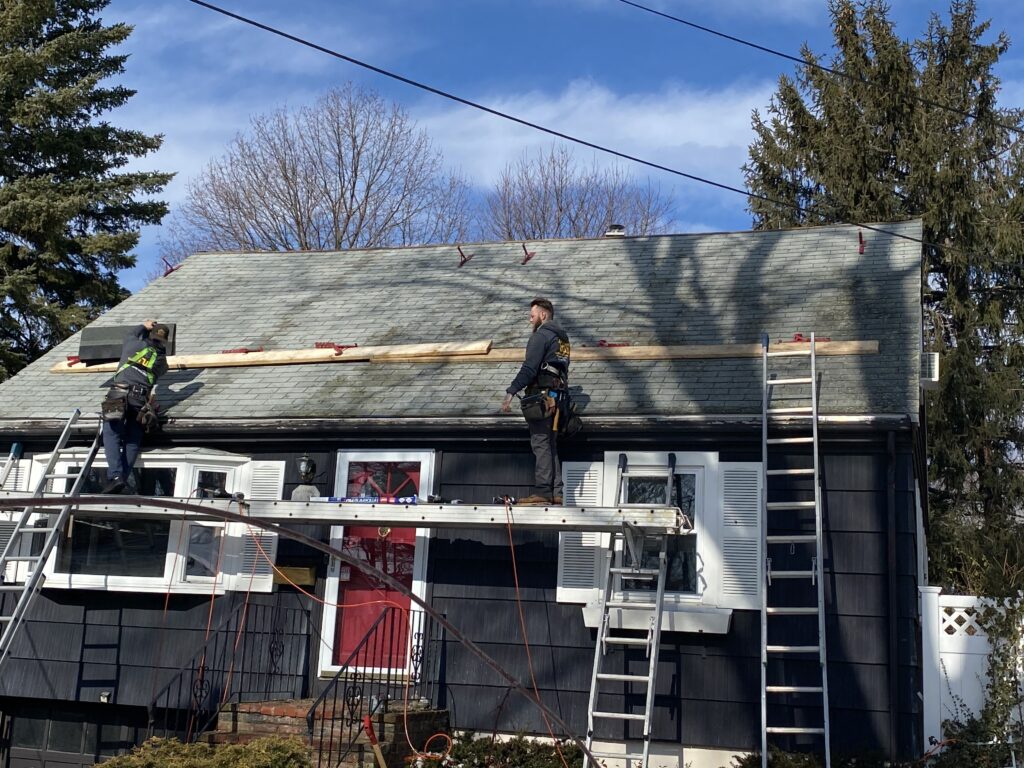
Most repair jobs in North North Andover, MA run between {PRICE_LOW} and {PRICE_HIGH}, and where you land in that range depends on a handful of things: how much decking needs to be replaced, how many layers of shingle are already on the roof, the pitch and how the crew has to access it, and whether the flashing at chimneys or valleys needs to be rebuilt or just resealed. A single flashing repair on an easy one-story roof is a different job than a valley rebuild on a steep, two-story colonial with a chimney tie-in. We give you a number after the assessment, not before it, and we tell you what’s driving that number.
How long it takes
Most repairs are done in a day. If we’re replacing decking, rebuilding a valley, or addressing a low-slope addition with a membrane fix, plan on one to two days depending on weather and how much of the roof deck turns out to be compromised once we open it up. We won’t know the exact timeline until we’re on the roof, and we’ll tell you if the scope changes once we start.
Can a roof repair actually fix a leak, or will it just come back?
If the roof is under fifteen years old and the decking is sound, a proper repair holds. Leaks come back when the underlying cause, usually ventilation or a flashing detail, doesn't get fixed along with the visible damage. That's why we check both before quoting anything.
How do I know if I need a repair or a full replacement?
Age and extent are the two big factors. A roof under fifteen years old with an isolated flashing or shingle issue is almost always a repair. A roof over twenty years old with granule loss across multiple slopes, or soft decking in more than one area, usually isn't worth patching. We'll tell you honestly which category your roof falls into.
Do you repair the low-slope additions on older North North Andover, MA homes?
Yes. Those sections often need a different material than the main roof, since standard shingles aren't rated for very low pitches. We'll look at the slope and recommend the right fix, which is sometimes a membrane system rather than shingle.
What causes ice dams on North North Andover, MA roofs?
Heat escaping into the attic melts snow on the roof, which refreezes at the cold eave and backs water up under the shingles. It's worse on north-facing slopes and shaded lots. Proper ridge and soffit ventilation, plus ice and water shield at the eaves, is the real fix, not just chipping ice off in January.
How fast can you get to a leak?
Call {PHONE} and describe what you're seeing. We schedule assessments based on severity, and an active interior leak gets priority over a cosmetic shingle issue.
Get an estimate
If you’ve got a leak, a stain on the ceiling, or shingles in the yard after a windy week, call {PHONE} and we’ll get someone out to look at it. Couture’s Construction is based in Methuen and works throughout North North Andover, MA and the rest of the Merrimack Valley. We’re BBB accredited with an A+ rating, and we’ll give you a straight answer on whether your roof needs a repair or something more, based on what we actually find up there.