
- Home
- Services
- Locations
Amesbury, MA
Boxford, MA
Chelmsford, MA
Danvers, MA
Dracut, MA
Essex, MA
Georgetown, MA
Groveland, MA
Hamilton, MA
Haverhill, MA
Ipswich, MA
Merrimac, MA
Methuen, MA
Middleton, MA
Newbury, MA
Newburyport, MA
North Andover, MA
North Reading, MA
Peabody, MA
Rowley, MA
Salem, MA
Salisbury, MA
Tewksbury, MA
Topsfield, MA
Topsfield, MA
West Newbury, MA
Atkinson, MA
Derry, NH
East Kingston, NH
Kensington, NH
Kingston, NH
Londonderry, NH
Plaistow, NH
Salem, NH
- Company
- Contact
- Home
- Services
- Locations
Amesbury, MA
Boxford, MA
Chelmsford, MA
Danvers, MA
Dracut, MA
Essex, MA
Georgetown, MA
Groveland, MA
Hamilton, MA
Haverhill, MA
Ipswich, MA
Merrimac, MA
Methuen, MA
Middleton, MA
Newbury, MA
Newburyport, MA
North Andover, MA
North Reading, MA
Peabody, MA
Rowley, MA
Salem, MA
Salisbury, MA
Tewksbury, MA
Topsfield, MA
Topsfield, MA
West Newbury, MA
Atkinson, MA
Derry, NH
East Kingston, NH
Kensington, NH
Kingston, NH
Londonderry, NH
Plaistow, NH
Salem, NH
- Company
- Contact
Roof Repair in Atkinson, NH
Atkinson has a lot of roofs built in the 1980s and 90s boom that put up colonials and capes on wooded half-acre and acre lots along Hemlock, Meetinghouse, and the roads off Route 111. Those roofs are hitting the age where the first repair calls turn into bigger conversations, and the heavy tree cover across town means valleys and north slopes take a beating that a more open lot never would.
Roof Repair in Atkinson
We get calls from Atkinson for the same reasons every fall and spring: a stain on a bedroom ceiling after a hard rain, a shingle blown into the yard after a windy night, ice damming up over the eaves in January. Most of the time the roof does not need to come off. It needs the right section fixed by someone who knows why it failed in the first place, not just patched where it is leaking.
We work both sides of the Massachusetts and New Hampshire line out of Methuen, and Atkinson is a regular stop for us, not a special trip. Different state, different permitting desk in Atkinson town hall, but the same crew and the same process we use ten minutes away in Massachusetts.
What Atkinson roofs are up against
The tree canopy is the first thing we look at on almost every Atkinson roof. Oak and pine debris builds up in valleys and behind chimneys, holds moisture against the shingles, and rots the felt or ice and water shield underneath long before the shingles themselves wear out. If your roof has a valley running under a big oak, that valley is usually the first place we check, and often the first place we find the problem.
The second issue is ice damming. A lot of the capes and colonials built here in the 80s and 90s subdivision wave have modest attic ventilation by today’s standards, sometimes just gable vents with no continuous ridge and soffit flow. That traps heat in the attic, melts snow on the roof deck, and sends water back up under the shingles at the eaves where it refreezes and backs up into the house. North-facing slopes and roofs over unheated additions or garages are the usual trouble spots. We also see low-slope rear additions on some of the older farmhouse-style homes near the center of town, and those flat or near-flat sections fail differently than a standard pitched roof and need their own fix, not a shingle patch.
How we assess it
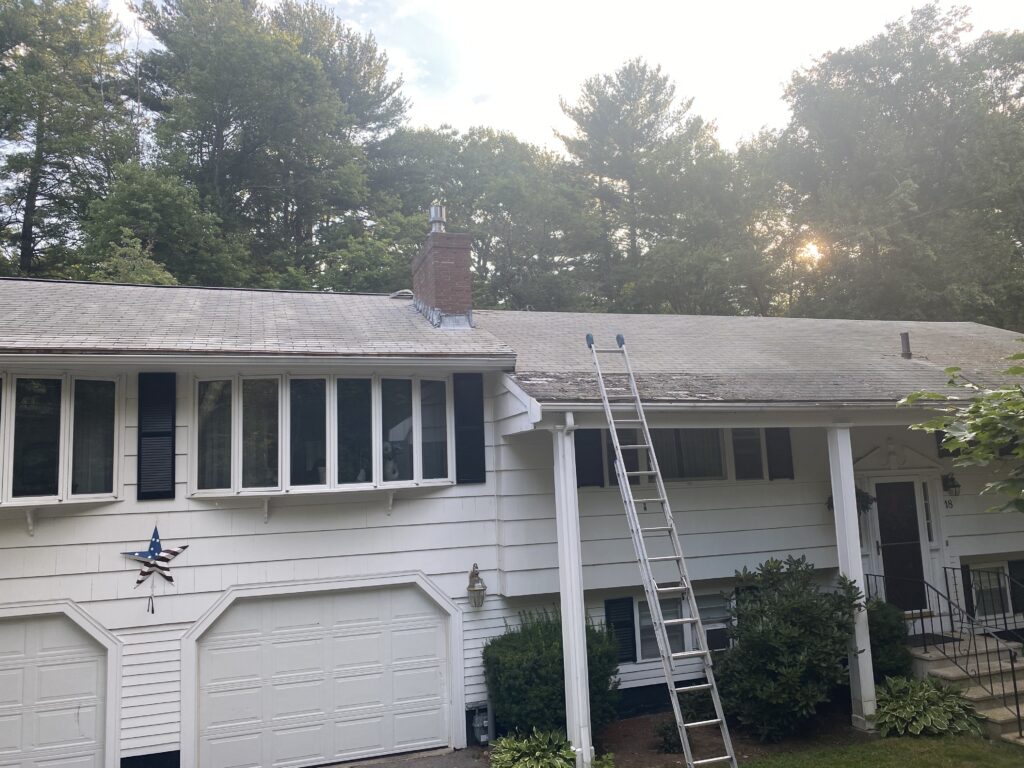
Derek gets on the roof before anyone quotes anything. We check the decking for soft spots, pull back shingles near the leak to see what the underlayment and ice and water shield actually look like, and check flashing at every chimney, sidewall, and valley since that is where most leaks start, not in the open field of shingles. We also go into the attic. That is where you see the real story: daylight through the decking, water staining on the rafters, wet or compressed insulation, and whether the ridge and soffit vents are actually connected to airflow or just there for looks. A roof can look fine from the driveway and still be rotting from the inside, and the only way to know is to go up and look.
You get a straight answer before any recommendation. If it is a repair, we say so.
What the job involves
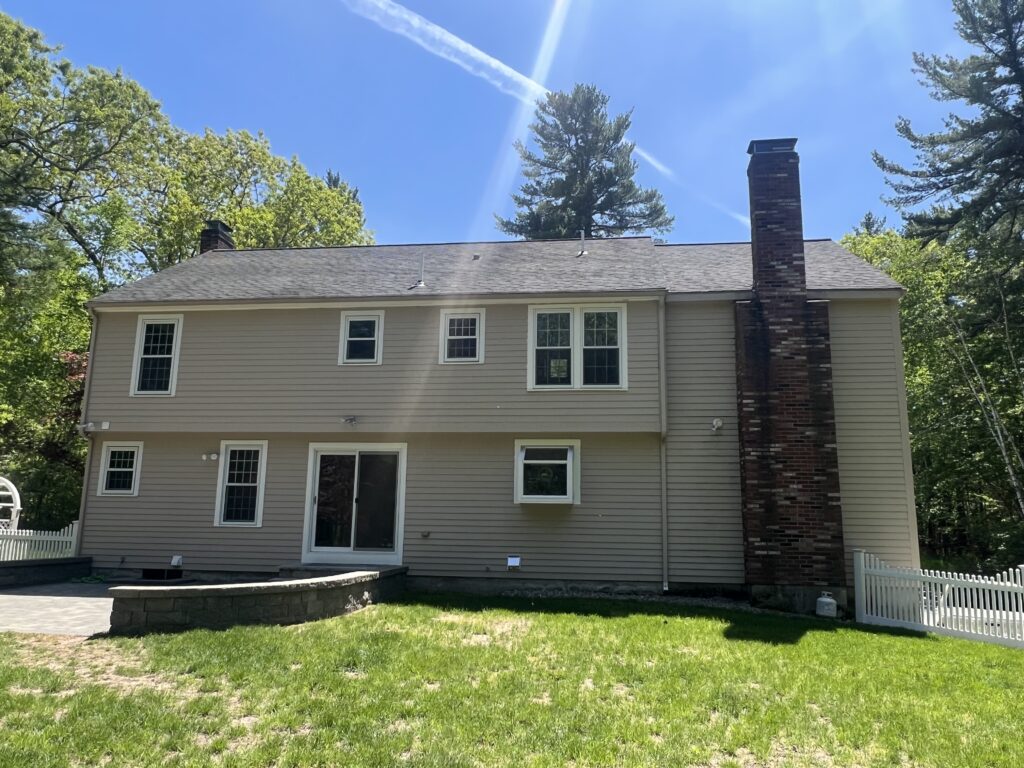
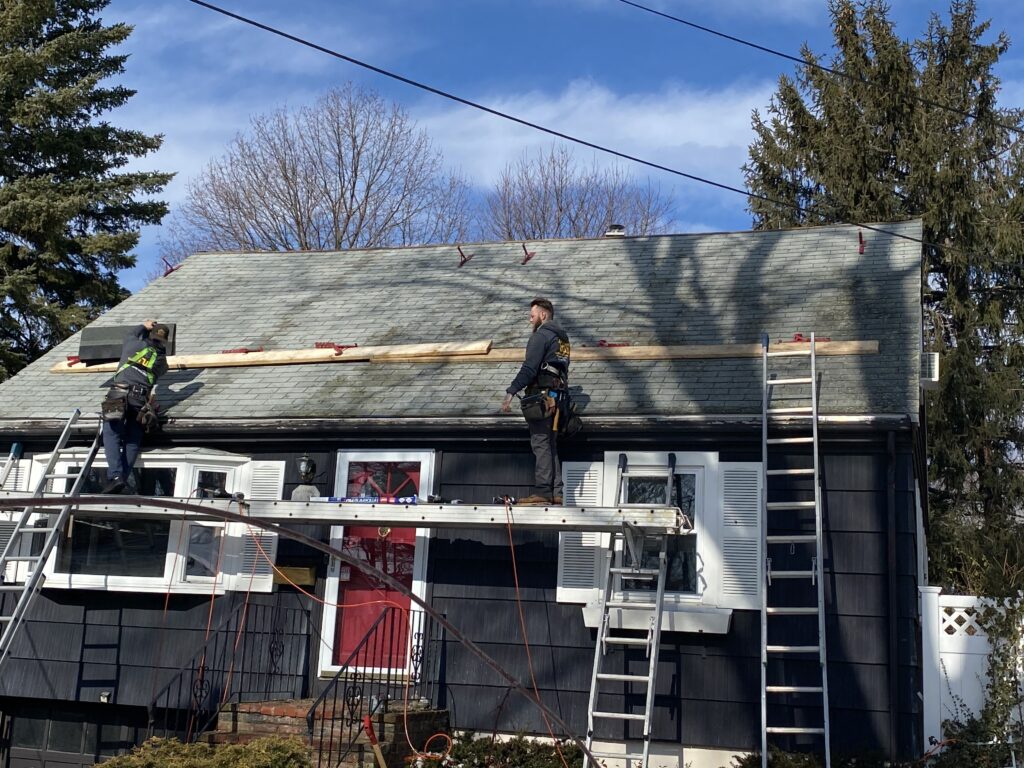
A real repair means matching the existing shingle as close as we can get it, cutting back to sound decking, replacing any rotten sheathing, and re-flashing the area properly with new step flashing or counter flashing instead of just caulking over the old metal. On a leak at a chimney or valley we install fresh ice and water shield under the new shingles, since that membrane is what actually stops water once it gets past the shingle layer. If ventilation is part of the problem, we will say that too, because a repair that ignores the ice damming cause just brings you back to the same leak next winter. This is often a genuinely right answer for a localized leak, storm damage to one slope, or a roof that is otherwise sound and just took a hit in one spot. We are not going to tell you the whole roof needs replacing to fix a bad valley.
What it costs
Most Atkinson repairs run {PRICE_LOW} to {PRICE_HIGH}, and the spread comes down to a few things: how much decking has to be replaced once we open things up, how steep the roof is and what it takes to work safely on it, how many layers of old shingles are already up there, and how hard the spot is to access, like a valley over a bay window or a chimney tucked against a tall gable. We will not give you a number before we have actually looked at the roof and, ideally, the attic underneath it. Any price given sight unseen is a guess, and we do not work off guesses.
How long it takes
A single-slope or flashing repair is usually a one-day job, start to finish, weather permitting. If we find rotten decking that needs to come out and replacing, or if the fix turns into a full valley rebuild, plan on a day and a half to two days. We will tell you upfront if we think it is going to run longer once we see what is under the shingles.
Do you actually work in New Hampshire, or just Massachusetts?
Both. We are based in Methuen but Atkinson, Salem, Windham, Derry, and Londonderry are regular parts of our territory, not an occasional trip across the line.
Is a repair ever the wrong call and I should just replace the roof?
Sometimes, and we will tell you when that is true. If the decking is rotten across most of the roof, if you are dealing with multiple layers of old shingles already, or if the shingles are simply at the end of their life on top of the leak, replacement is the honest answer. But a single bad valley, a chimney flashing failure, or storm damage to one slope is usually a repair, not a reason to redo the whole roof.
Will you match my existing shingles?
We do our best to match color and style as close as the manufacturer's current line allows. Exact matches get harder on older roofs since shingle lines change over the years, but we will show you options before starting.
Do I need a permit for a roof repair in Atkinson?
Small repairs typically do not require a permit, but larger repair work involving structural decking replacement can. We handle that conversation with the town when it applies.
What causes ice dams on Atkinson roofs specifically?
Heat escaping into the attic melts snow on the roof, the water runs down to the cold eaves and refreezes, and it backs up under the shingles. Homes with limited ridge and soffit ventilation, common in the 80s and 90s subdivisions here, are more prone to it, especially on north-facing slopes.
Get an estimate
If you have a stain on a ceiling, a soft spot on the roof, or ice building up over the eaves every winter, call and we will come look at it. Bring us the address in Atkinson and we will get on the roof, check the attic, and tell you straight what is going on and what it will take to fix it. {PHONE}.