
- Home
- Services
- Locations
Amesbury, MA
Boxford, MA
Chelmsford, MA
Danvers, MA
Dracut, MA
Essex, MA
Georgetown, MA
Groveland, MA
Hamilton, MA
Haverhill, MA
Ipswich, MA
Merrimac, MA
Methuen, MA
Middleton, MA
Newbury, MA
Newburyport, MA
North Andover, MA
North Reading, MA
Peabody, MA
Rowley, MA
Salem, MA
Salisbury, MA
Tewksbury, MA
Topsfield, MA
Topsfield, MA
West Newbury, MA
Atkinson, MA
Derry, NH
East Kingston, NH
Kensington, NH
Kingston, NH
Londonderry, NH
Plaistow, NH
Salem, NH
- Company
- Contact
- Home
- Services
- Locations
Amesbury, MA
Boxford, MA
Chelmsford, MA
Danvers, MA
Dracut, MA
Essex, MA
Georgetown, MA
Groveland, MA
Hamilton, MA
Haverhill, MA
Ipswich, MA
Merrimac, MA
Methuen, MA
Middleton, MA
Newbury, MA
Newburyport, MA
North Andover, MA
North Reading, MA
Peabody, MA
Rowley, MA
Salem, MA
Salisbury, MA
Tewksbury, MA
Topsfield, MA
Topsfield, MA
West Newbury, MA
Atkinson, MA
Derry, NH
East Kingston, NH
Kensington, NH
Kingston, NH
Londonderry, NH
Plaistow, NH
Salem, NH
- Company
- Contact
Roof Replacement in Andover, MA
Walk a street in one of Andover’s 1990s or early-2000s subdivisions and you’ll see the same roof over and over: architectural shingles, moderate pitch, a couple of dormers, and a lot of them are now twenty to twenty-five years old. That’s the design life of the shingle most of these homes were built with. Add in the older colonials and capes scattered through South Andover and near the town center, some with additions tacked on at a low slope out back, and you get two very different roofing problems happening in the same zip code at the same time.
Complete Residential Roof Replacement Services in Andover
We handle full tear-offs and re-roofs on the housing stock you actually find in Andover – center-entrance colonials, raised ranches, capes with additions, and the larger newer builds up toward North Andover. That means asphalt architectural shingle systems most often, but it also means knowing when a low-slope rear addition needs a membrane roof instead of shingles run past their pitch limit, and when a chimney or valley detail on an older home needs more attention than the field of the roof does.
We’re a family-owned company based in Methuen, and we’re BBB accredited with an A+ rating, which matters more than a slogan when you’re deciding who gets on your roof. We give you a straight assessment first, then a scope, then a schedule. No pressure, no inflated urgency.
What Andover roofs are up against
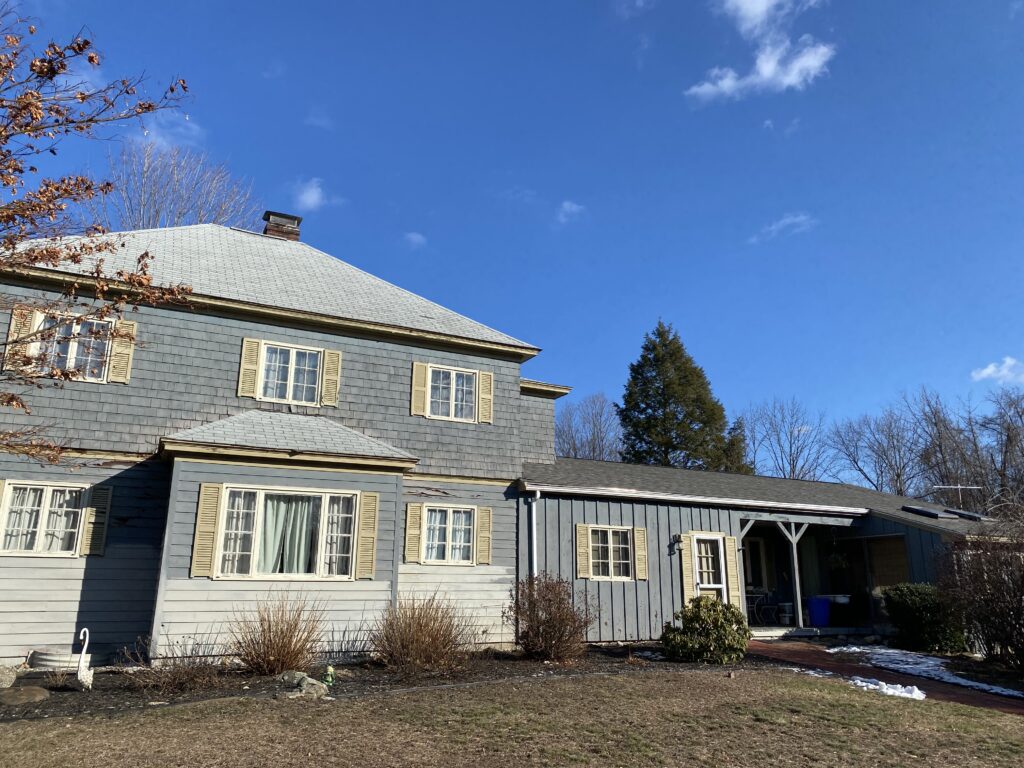
Two things drive most of the replacement calls we get in this area. First, age clustering. Whole subdivisions went up within a few years of each other, which means whole streets of original architectural shingles are hitting failure age at the same time – granule loss, curling at the tab edges, and shingles that have gone brittle enough to crack when you walk them. Second, the older mill-city and pre-1980 housing common in and around Andover center often carries a low-slope rear addition – a kitchen bump-out, a sunroom, a garage tie-in – where the roof fails years before the main roof does because it was built with the wrong material or not enough slope for standard shingles to shed water.
Andover has heavy tree canopy in a lot of neighborhoods, particularly the older sections near the center and along the river, and that means valley debris builds up fast. Wet leaves and pine needles sitting in a valley hold moisture against the shingle and the flashing underneath it, and that’s where we find rot and granule loss well before the rest of the roof shows its age. On the north-facing slopes of homes near wooded lots, ice dams are the other recurring issue – snow melts off the warmer parts of the roof, refreezes at the eave, and backs water up under the shingles. If you’ve had staining on an interior ceiling near an exterior wall in winter, that’s usually what you’re looking at.
How we assess it
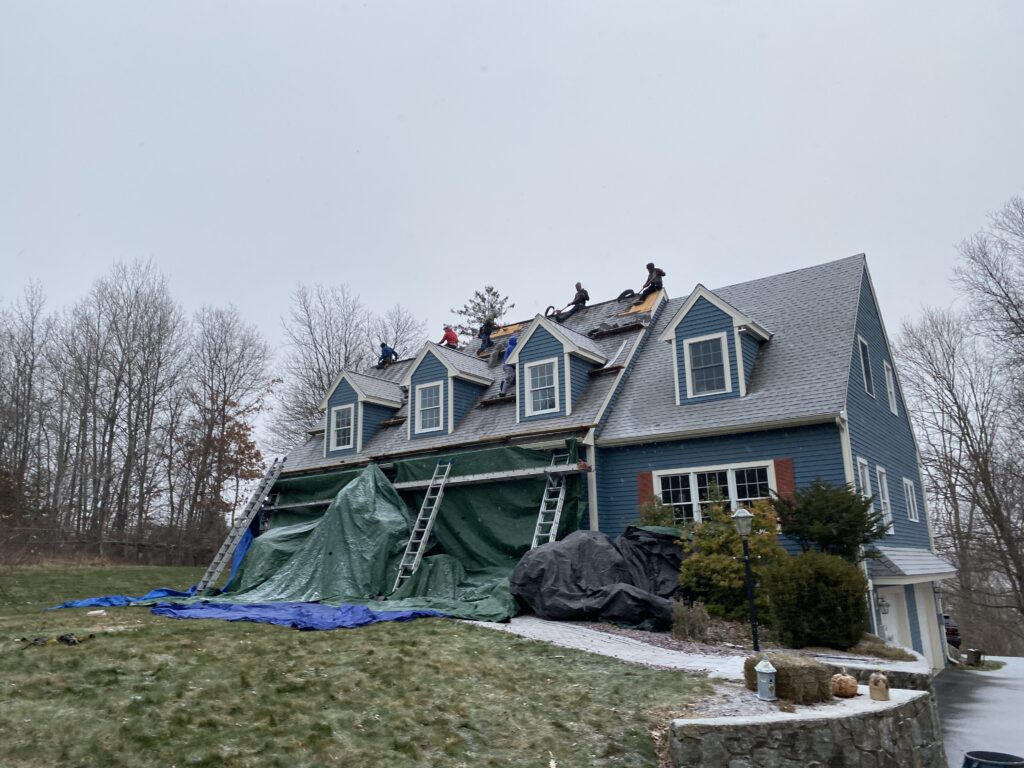
Before we recommend anything, Derek gets up on the roof and looks at what’s actually there. That means checking the decking for soft spots or delamination, pulling back shingles at a few spots to look at nail pattern and underlayment, checking flashing at every chimney, skylight, and valley, and looking at ridge and soffit ventilation – a roof that isn’t breathing right ages faster no matter what shingle is on it. We also go into the attic when we can, because the underside of the deck tells you things the topside never will: dark staining, nail rust, daylight where there shouldn’t be any.
If the roof is sound and the problem is isolated – a chimney flashing leak, a section of storm damage, a valley that needs re-flashing – we’ll say so and repair it. Not every call ends in a replacement conversation. If the shingles are broadly at the end of their life, the decking is compromised in multiple spots, or the roof has multiple layers already and a repair would just be patching a system that’s done, we’ll walk you through why replacement is the honest answer and what your options are.
What the job involves
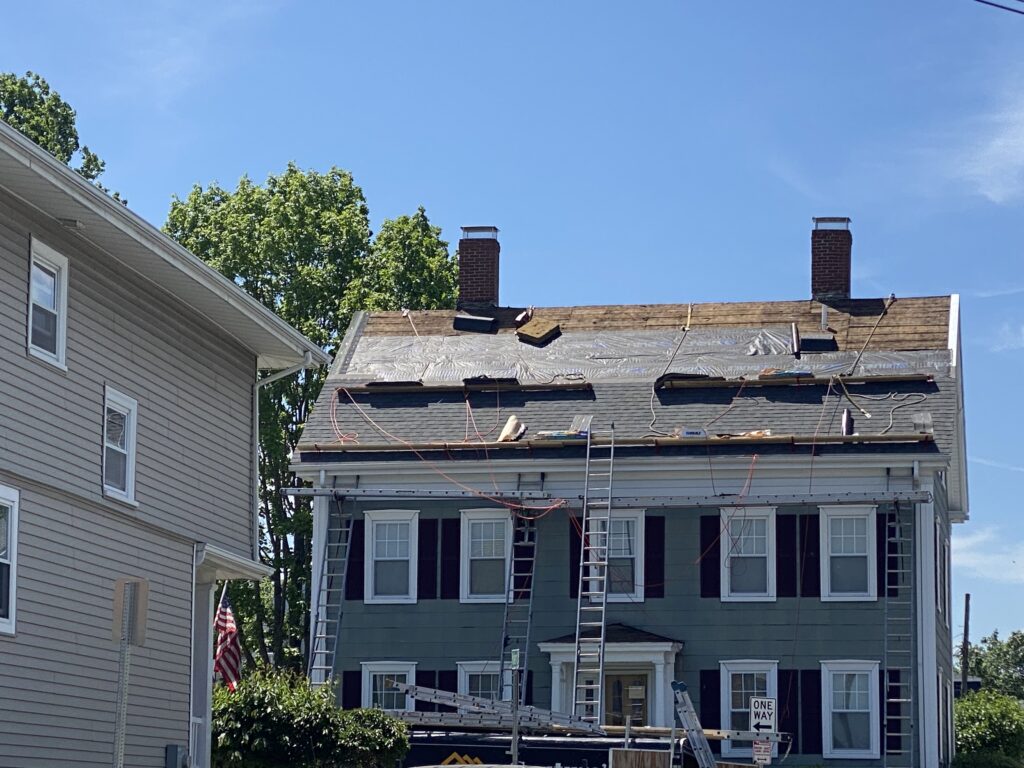
A full replacement starts with tear-off down to the decking, because covering a bad layer with a new one just hides problems and shortens the life of the new roof. We check every sheet of decking as it’s exposed and replace anything soft, delaminated, or damaged before anything new goes down. From there it’s ice and water shield along the eaves, valleys, and around penetrations – non-negotiable in this climate given how common ice damming is on north-facing slopes here. Then synthetic underlayment across the field, new flashing at chimneys, sidewalls, and valleys, the shingle system itself, and ridge venting tied into proper soffit intake so the attic actually vents the way it’s supposed to.
We install architectural shingle systems rated for New England wind exposure, and we’ll walk you through the wind rating and warranty terms of whatever system fits your roof before we order material. On the low-slope additions we mentioned, we spec a proper low-slope membrane rather than trying to stretch a shingle warranty past its rated pitch – that’s one of the more common corner-cutting shortcuts we get called in to fix on older Andover homes.
What it costs
Most full roof replacements in Andover run in the range of {PRICE_LOW} to {PRICE_HIGH}, and where you land in that range depends on the roof, not on us. Total square footage and pitch move the number first – a steep, cut-up roof with multiple dormers takes longer and needs more material than a simple gable. How many layers of existing shingle we’re stripping matters too – one layer is a straightforward tear-off, two or three layers is more disposal and more labor. Decking surprises move the price after we’re already tearing off, which is why we quote a per-sheet replacement rate up front instead of guessing. Access – steep grades, tight side yards, roofs that need to be staged from the street – factors in as well. We’ll give you a number based on what we actually find on your roof, not a phone estimate.
How long it takes
A standard single-family roof replacement in Andover typically takes one to two days once we’re on site, weather permitting. Larger or more complex roofs – multiple dormers, a low-slope addition being tied in, extensive decking repair – can run two to three days. We schedule around weather in both directions: we won’t tear off a roof if rain is likely before we can get it dried in, and winter jobs need enough of a temperature window for the ice and water shield to seal properly.
How do I know if my Andover roof needs replacement instead of repair?
Look at age first – if your architectural shingles are past 20 years, you're in the window where widespread failure is likely even if the roof looks okay from the ground. Beyond age, multiple leak points, soft decking in more than one spot, or shingles that crack when walked usually mean repair is just delaying the inevitable. A single flashing leak or a storm-damaged section on an otherwise sound roof is a repair, not a replacement.
Do you replace the low-slope roofs on older Andover home additions?
Yes. Those rear additions common on older Andover and mill-city area homes need a proper low-slope membrane system, not shingles pushed past their rated pitch. We assess the addition separately from the main roof since it often fails on its own timeline.
What causes ice dams on Andover roofs and can replacement fix it?
Ice dams form when attic heat melts snow unevenly and the runoff refreezes at a colder eave, backing water up under the shingles. A replacement gives us the chance to correct the root causes – proper ice and water shield at the eaves and valleys, and ridge and soffit ventilation that keeps the whole roof deck at a consistent temperature.
How many quotes should I get before choosing a roofer in Andover?
Get at least two or three, and make sure whoever you choose actually gets on the roof and in the attic before quoting, rather than pricing off a satellite photo. Ask about decking replacement rates, underlayment and ice and water shield specs, and ventilation plans – those details tell you more than the bottom-line number.
Are you licensed and insured for roofing work in Andover?
We carry the licensing and insurance Massachusetts requires for residential roofing contractors, and we're BBB accredited with an A+ rating. We're happy to walk you through our credentials when we're out for your estimate.
Get an estimate
If your roof is somewhere in that twenty-year window, or you’ve got a rear addition that’s been patched more than once, it’s worth getting an actual look rather than guessing from the driveway. Call {PHONE} and we’ll set up a time to get on the roof and in the attic, and give you a straight read on what you’re dealing with and what it will take to fix it right.