
- Home
- Services
- Locations
Amesbury, MA
Boxford, MA
Chelmsford, MA
Danvers, MA
Dracut, MA
Essex, MA
Georgetown, MA
Groveland, MA
Hamilton, MA
Haverhill, MA
Ipswich, MA
Merrimac, MA
Methuen, MA
Middleton, MA
Newbury, MA
Newburyport, MA
North Andover, MA
North Reading, MA
Peabody, MA
Rowley, MA
Salem, MA
Salisbury, MA
Tewksbury, MA
Topsfield, MA
Topsfield, MA
West Newbury, MA
Atkinson, MA
Derry, NH
East Kingston, NH
Kensington, NH
Kingston, NH
Londonderry, NH
Plaistow, NH
Salem, NH
- Company
- Contact
- Home
- Services
- Locations
Amesbury, MA
Boxford, MA
Chelmsford, MA
Danvers, MA
Dracut, MA
Essex, MA
Georgetown, MA
Groveland, MA
Hamilton, MA
Haverhill, MA
Ipswich, MA
Merrimac, MA
Methuen, MA
Middleton, MA
Newbury, MA
Newburyport, MA
North Andover, MA
North Reading, MA
Peabody, MA
Rowley, MA
Salem, MA
Salisbury, MA
Tewksbury, MA
Topsfield, MA
Topsfield, MA
West Newbury, MA
Atkinson, MA
Derry, NH
East Kingston, NH
Kensington, NH
Kingston, NH
Londonderry, NH
Plaistow, NH
Salem, NH
- Company
- Contact
Vinyl Siding Installation in Rowley, MA
Rowley sits back from the water just far enough that most people don’t think about wind rating until a gust off Plum Island Sound peels a strip of siding off the gable end. Between the older farmhouses along Route 1A and the newer construction off Wethersfield Street, we see two very different siding problems in this town, and neither one is solved by grabbing the cheapest panel at the lumberyard.
Vinyl Siding Installation in Rowley
Siding usually comes up for one of two reasons: it’s failing, or it’s getting done alongside a roof. We lean into that second one on purpose. If you’re already staging a project, replacing tired clapboards or chalky old vinyl at the same time means one mobilization instead of two, and one crew that already knows your house instead of two separate companies working around each other. Derek looks at siding and roofing as one exterior conversation, not two separate sales pitches.
We install vinyl because it’s the right material for a lot of Rowley budgets and a lot of Rowley wall conditions, but we’ll say plainly when a house is better served by something else. Not every job is a yes to vinyl, and we’d rather tell you that up front than sell you a product that fights your house.
Deck-mounted
units fasten straight to the roof deck and use a matched step-flashing kit. This is what goes on most pitched roofs now. It sits low, looks clean and handles snow well.
Curb-mounted
units sit on a raised wood frame built on the roof. They are the right call on low-slope sections, generally below about 3 in 12, and a lot of older installs already have them.
Fixed
units let in light and nothing else. Fine over a high cathedral ceiling you will never reach.
Manual or electric venting
units open to let heat and steam out. They earn their keep in kitchens and bathrooms.
Solar-powered venting
units run off a small panel, need no wiring to the house, and close on their own when the rain sensor gets wet.
What Rowley roofs are up against
This is coastal enough that wind uplift is a real design number, not a marketing line. Panels rated for the low end of the scale can start lifting at the corners and eaves within a few seasons of nor’easters coming off the marsh side of town, and once a bottom lock lets go, the whole course above it is loose. We spec siding by the actual wind exposure of your lot, not by whatever’s stacked highest at the supply house.
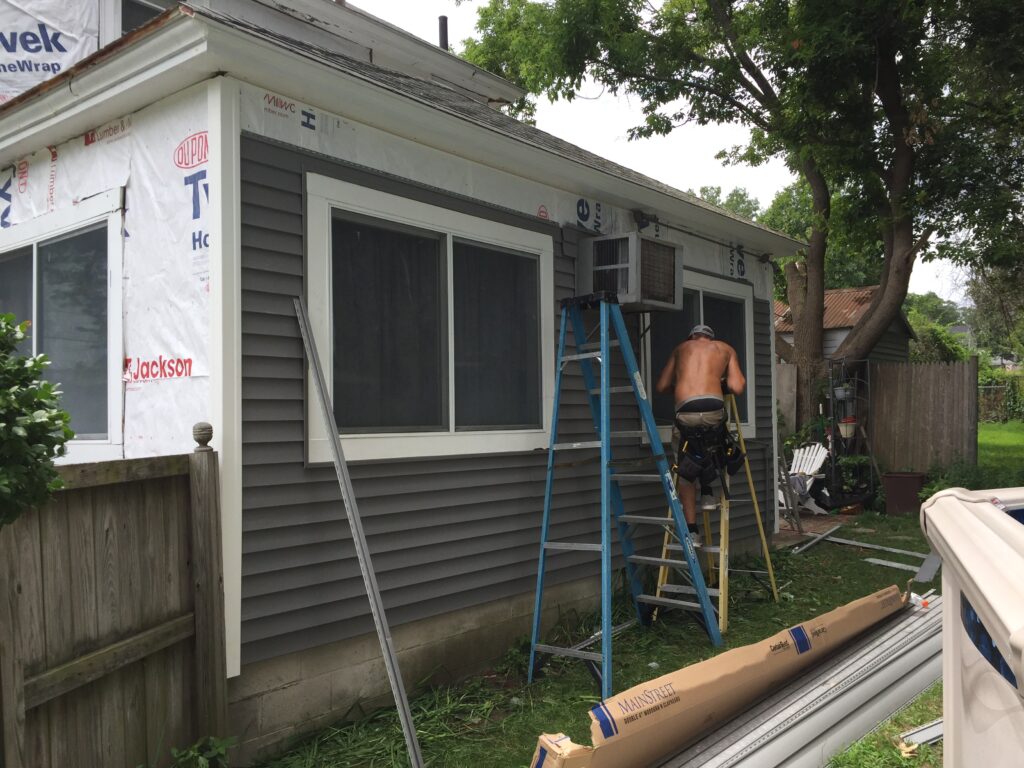
Salt air is the other factor that doesn’t show up on a spec sheet. It accelerates fastener corrosion and it bleaches cheaper vinyl faster than it bleaches better vinyl. On the older housing stock near the Rowley River and the farmhouses set back off Main Street, we also run into sheathing that’s original to the house – boards, not plywood – which changes how we fasten and how much furring we need before panels go on straight. Get that wrong and you’ll see wave patterns in the siding within a year, no matter how good the panel itself is.
How we assess it
Before we quote anything, Derek or a lead crew member walks the exterior and looks at what’s actually happening under the current siding, not just what it looks like from the driveway. That means pulling a few sections to check the sheathing, checking window and door flashing for water staining behind the trim, and looking at how the existing siding is fastened – too tight, too loose, wrong nail depth, all of it shows.
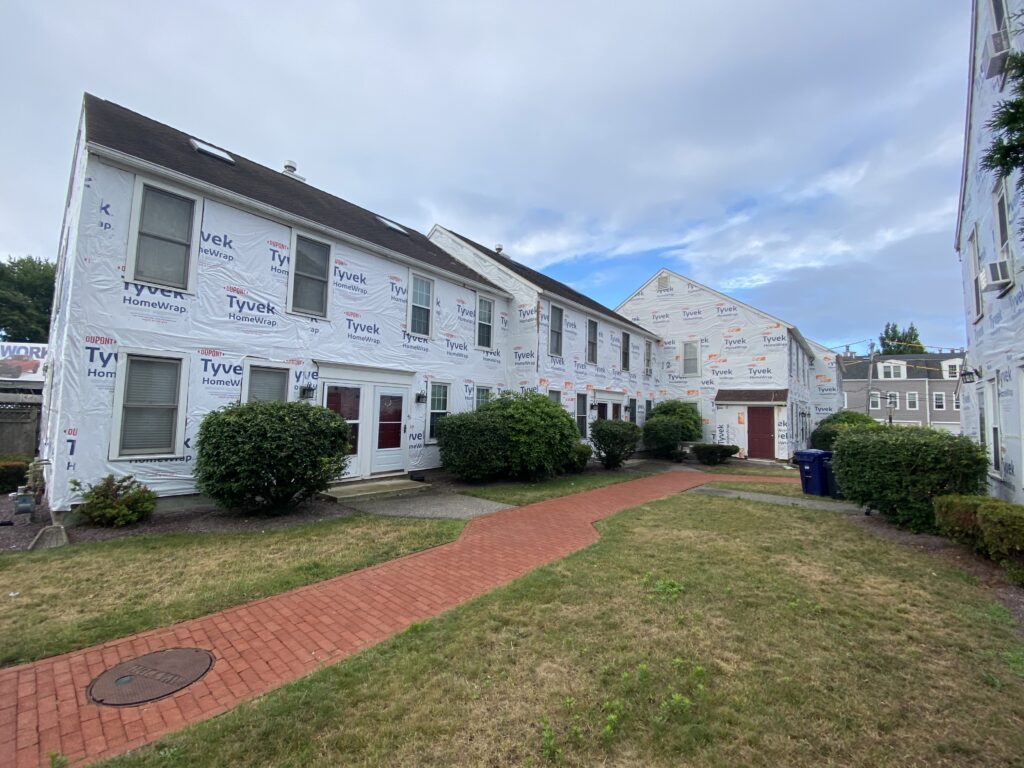
We also look at the wall assembly as a whole. Is there housewrap or building paper underneath? Is there any sign of moisture getting trapped behind the siding, which shows up as soft sheathing or staining once panels come off? A proper assessment happens before a recommendation, not after a contract is signed. If your existing siding still has life left and the problem is really just a handful of damaged panels, we’ll say so.
What the job involves
Replacement
We strip the shingles around the unit, pull the old skylight and flashing, repair the deck at the opening if it needs it, and set the new unit. Ice and water shield wraps up the sides and across the top, the step-flashing kit goes on, and we shingle back in. If the new unit matches the rough opening, the interior usually stays as it is. On a full roof replacement in Rowley, MA, all of this fits inside the reroof. The shingles are already off, the deck is exposed, and the new underlayment and flashing tie in as one system.
New cut-in
We lay out the opening from inside and out, cut the deck, and frame headers between the rafters. Ventilation gets rerouted so the bays above and below the opening still breathe. Then the unit, ice and water shield, flashing and shingles. Inside, a new opening means a light shaft through the attic, drywall and paint. That interior work is part of the conversation at the estimate, and we settle who handles what before anything is scheduled.
A full siding job starts with removing the old material down to the sheathing, or in some cases installing over sound existing siding with rigid furring if it tests out clean. Any soft or rotted sheathing gets cut out and replaced before anything else happens – that’s not an upsell, it’s the part of the job that determines whether the new siding lasts. We install housewrap where it’s missing or degraded, address flashing at every window, door, and roofline intersection, then run panels with the right expansion clearance so they don’t buckle in a July heat wave or pull loose in a January cold snap.
Trim work – corner posts, J-channel, window and door casing – takes as much time as the field panels on a lot of these older Rowley homes, especially ones with deep window returns or hand-built trim details original to the house. We match that detail rather than flattening it out with generic stock trim.
What it costs
Most full siding jobs in Rowley run {PRICE_LOW} to {PRICE_HIGH}. What moves that number: total square footage of wall area, how many stories, how much trim and how complex it is, whether we’re stripping multiple old layers, and what we find once the old siding is off. A house with sound sheathing and simple trim costs a lot less to side than one with rot at every window sill and elaborate original woodwork to match. We give you a number after we’ve looked, not before.
How long it takes
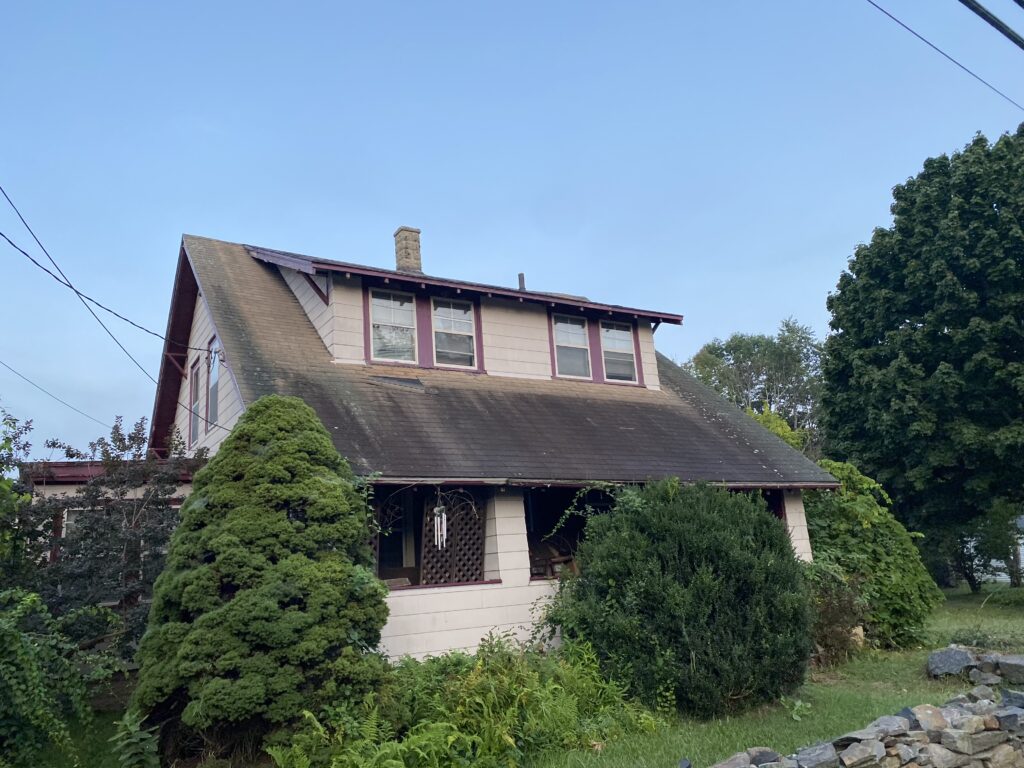
Most single-family homes in Rowley take three to six working days once material is on site and weather cooperates. Additions, dormers, complicated trim, and anything we find that needs repair before siding goes on all add time. We’ll give you an honest schedule up front and tell you as soon as anything changes it, rather than letting a job run long without saying anything.
Get an estimate
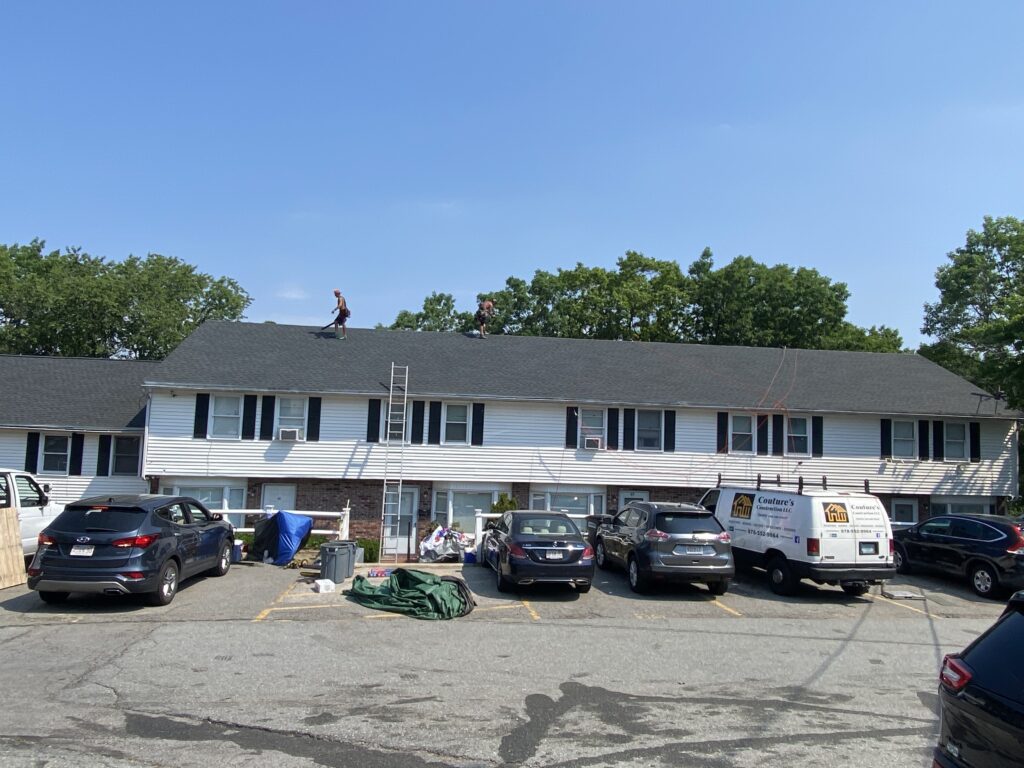
If you’re weighing siding on its own or thinking about pairing it with roof work, call Couture’s Construction at {PHONE}. We’re based in Methuen and we cover Rowley and the rest of the towns along this stretch of the coast. We’ll walk the house with you, tell you what we actually see, and put together a plan that fits the building, not a generic package.
Does vinyl siding hold up to wind off the water in Rowley?
Good vinyl does, if it's installed right. Look for panels rated for higher wind speeds and make sure the installer nails them correctly – not too tight, not too loose. A panel that's face-nailed too snug will buckle in a temperature swing, and one that's not fastened into solid sheathing will pull off in a nor'easter. We check both the product rating and the wall behind it before we install a single course.
Can siding go on over my existing clapboards or shingles?
Sometimes, but not always, and not if we find rot, soft sheathing, or a wall that's already out of plane. On a lot of Rowley's older homes we pull test sections first. If the sheathing underneath is sound, we can often install over it with proper furring. If it's not, that gets addressed before siding goes up, not covered up.
Should I do siding and roofing at the same time?
If both are due, yes, it saves money and disruption. Sharing one mobilization, one dumpster, one set of scaffolding or staging across two trades cuts real cost compared to two separate projects six months apart. We'll tell you honestly if your roof still has years left even if the siding doesn't.
What's the actual cost range for a house this size?
For most Rowley homes we're looking at {PRICE_LOW} to {PRICE_HIGH} for a full siding job, but that swings with square footage, trim complexity, how many stories, and what we find once the old siding comes off. We won't give you a real number until we've measured and looked at the walls.
How long will my house be under wrap?
Ready when you are
Give us a call to talk through your Rowley home’s siding needs. Let us know the age of your current siding, any problem areas you’ve noticed, and the look you’re after. We’ll schedule a visit to walk the exterior with you and cover the details before any work is scheduled.