
- Home
- Services
- Locations
Amesbury, MA
Boxford, MA
Chelmsford, MA
Danvers, MA
Dracut, MA
Essex, MA
Georgetown, MA
Groveland, MA
Hamilton, MA
Haverhill, MA
Ipswich, MA
Merrimac, MA
Methuen, MA
Middleton, MA
Newbury, MA
Newburyport, MA
North Andover, MA
North Reading, MA
Peabody, MA
Rowley, MA
Salem, MA
Salisbury, MA
Tewksbury, MA
Topsfield, MA
Topsfield, MA
West Newbury, MA
Atkinson, MA
Derry, NH
East Kingston, NH
Kensington, NH
Kingston, NH
Londonderry, NH
Plaistow, NH
Salem, NH
- Company
- Contact
- Home
- Services
- Locations
Amesbury, MA
Boxford, MA
Chelmsford, MA
Danvers, MA
Dracut, MA
Essex, MA
Georgetown, MA
Groveland, MA
Hamilton, MA
Haverhill, MA
Ipswich, MA
Merrimac, MA
Methuen, MA
Middleton, MA
Newbury, MA
Newburyport, MA
North Andover, MA
North Reading, MA
Peabody, MA
Rowley, MA
Salem, MA
Salisbury, MA
Tewksbury, MA
Topsfield, MA
Topsfield, MA
West Newbury, MA
Atkinson, MA
Derry, NH
East Kingston, NH
Kensington, NH
Kingston, NH
Londonderry, NH
Plaistow, NH
Salem, NH
- Company
- Contact
Roof Replacement in West Newbury, MA
Walk down Main Street or Pipestave Hill and you will see a lot of roofs that have been patched more than once. West Newbury’s housing stock skews old, a good share of it dating back to the 1700s and 1800s, mixed in with newer building on the outer roads toward Merrimac and Groveland. That mix means two very different roofing conversations on the same street: steep-pitched, multi-plane historic rooflines with additions bolted on over the decades, and simpler ranch and colonial roofs from more recent subdivisions that are just now hitting the age where the original shingles are giving out.
Roof Replacement in West Newbury
Not every bad-looking roof needs to come off. But there is a point where patching stops making financial sense, and most homeowners can spot the signs once someone points them out: shingles that are cupping or losing granules across the whole slope rather than in one spot, soft decking you can feel underfoot in the attic, daylight around a chimney or vent pipe, or a repair history that reads like a list rather than a one-time fix. If your roof is 18 to 25 years old and showing two or more of those signs, replacement is usually the honest answer, not the upsell. We will tell you straight if a repair buys you more years first.
When it is time to replace, the decision after that is material and system, not just color. We install architectural asphalt shingle systems rated for New England wind and snow loads, with ice and water shield carried well up from the eaves and into valleys, proper ridge and soffit ventilation, and flashing details at chimneys and sidewalls done in step and counter-flashing rather than caulked-over patches. That system is what actually keeps a West Newbury roof dry through a nor’easter, not the shingle brand alone.
What West Newbury roofs are up against
This town sits in the Merrimack River valley, and that geography shapes what fails first. Homes near the river and on the more open stretches out toward Route 113 catch real wind, and older roofs with worn or missing sealant strips are the ones that lose shingles first in a high-wind event. Heavy tree cover along Indian Hill and the back roads near the Common brings the opposite problem: valleys and roof-to-wall intersections pack up with leaves and pine needles every fall, and that debris holds moisture against the shingles and rots the decking underneath long before anyone sees a stain on the ceiling.
North-facing slopes on the older colonials and capes in the town center are the classic ice dam spot. Without a warm, well-ventilated attic and a continuous ice and water barrier at the eaves, meltwater backs up under the shingles every time we get a freeze-thaw cycle, which in this valley can happen half a dozen times in a bad winter. A lot of the additions and ells behind these older houses also carry low-slope roof sections, sometimes under 3:12 pitch, that were never detailed for that slope and need a different membrane approach than the steep-slope shingle roof out front. If your house has one of those flat-roofed additions, that section usually needs to be addressed separately from the main roof.
How we assess it
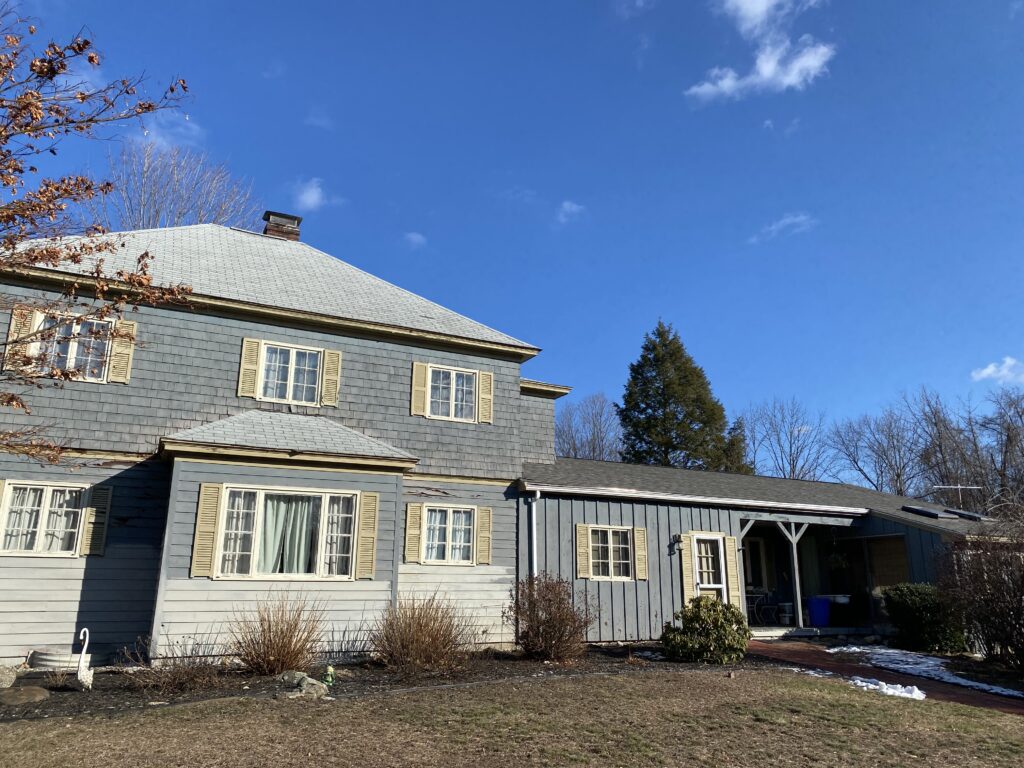
Derek walks the roof before he quotes anything. That means checking the shingle condition slope by slope, pulling back a section at the eave if there is any doubt about the decking, and looking at every flashing point around chimneys, skylights, and valleys up close instead of from the ground. Just as important is what happens in the attic: he checks for daylight, for moisture staining on the underside of the decking, for insulation that has been pushed against the soffit and choked off the ventilation path, and for signs of past ice damming along the eaves.
That full look tells us whether you are looking at a straightforward re-roof or whether there is rotted decking to replace, a ventilation problem to fix, or a chimney flashing detail that has been failing quietly for years. You get a recommendation after that inspection, not before it. On older West Newbury homes especially, we will not quote a roof sight unseen, because the surprises tend to be in the decking, not the shingles.
What the job involves
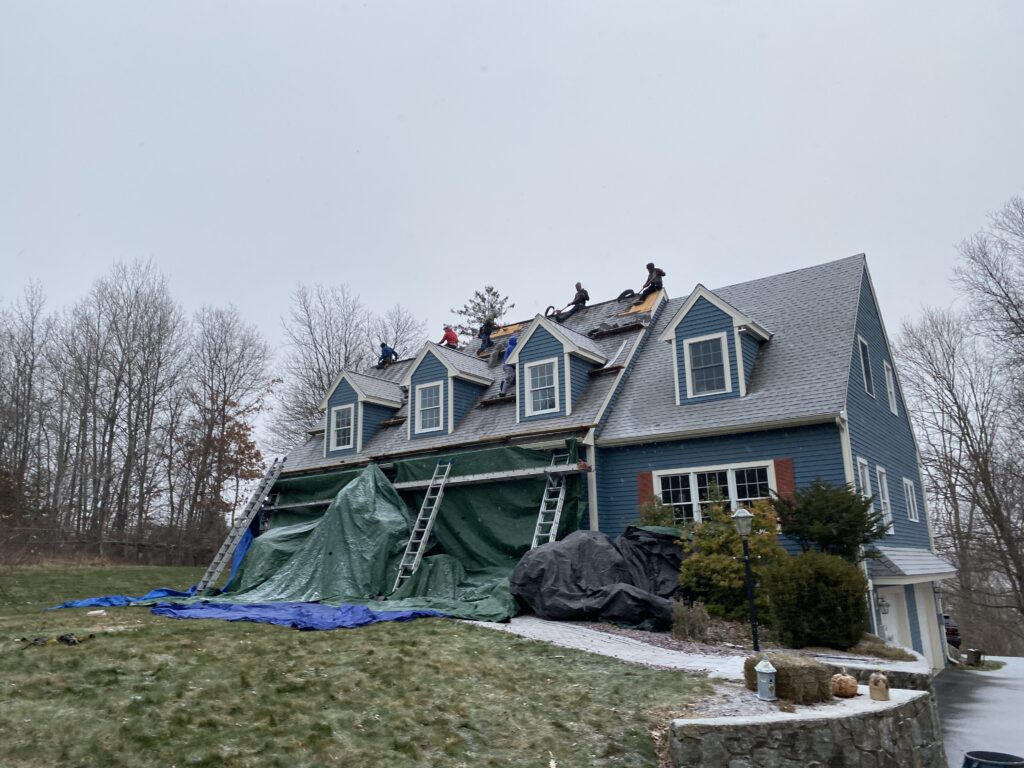
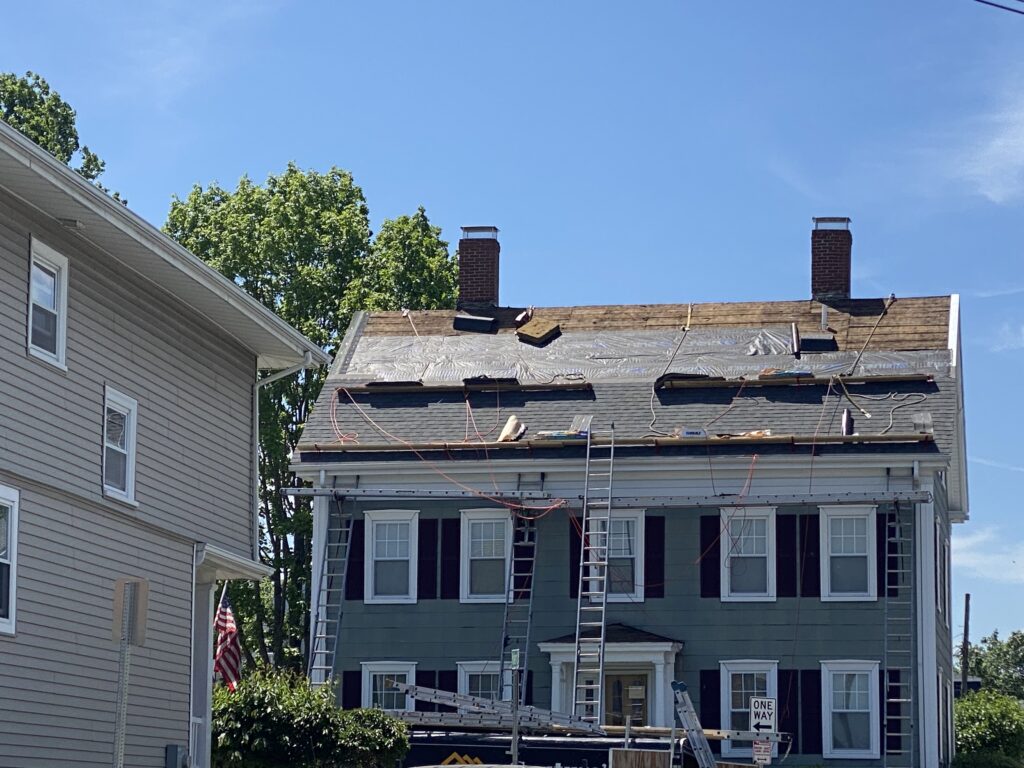
A full tear-off starts with stripping the existing roofing down to the decking, no shortcuts, no roofing over old layers. We check every sheet of decking as it is exposed and replace anything soft, delaminated, or damaged by past leaks before anything new goes down. From there it is ice and water shield at the eaves, valleys, and around all penetrations, synthetic underlayment across the field, new flashing at chimneys and walls, and the shingle system installed to the manufacturer’s wind-rated nailing pattern. We finish with ridge venting matched to your soffit intake so the attic actually breathes the way it is supposed to, which matters as much for summer heat as it does for winter ice.
On the older homes in the town center, that often includes matching roofline transitions where additions meet the original structure, and coordinating with any historic district guidance on visible materials if your property falls under it. Cleanup includes a magnetic nail sweep of the yard and driveway, not just the roof edge.
What it costs
Most full roof replacements in West Newbury run between {PRICE_LOW} and {PRICE_HIGH}, and where you land in that range depends on the specifics of your roof, not on a flat per-square rate someone quotes over the phone. Size and pitch matter first, a steep multi-gable colonial takes longer and costs more per square than a simple ranch. How many layers we are stripping off matters. Decking condition matters, and we will not know that number until the old roofing is off, though we flag likely problem areas during the assessment. Access matters too, a roof with tight setbacks or landscaping to protect around it takes more time to stage safely. We give you a written estimate with those variables spelled out, and we call out any decking allowance up front rather than surprising you with it mid-job.
How long it takes
A standard single-family tear-off and reroof in West Newbury typically takes one to two days once the crew is on site, weather permitting. Larger or more complex rooflines, additions with multiple pitch changes, or jobs that turn up significant decking replacement can run longer. We schedule around New England weather, not around it being convenient for us to push through rain, because a roof installed in the wrong conditions is a roof that fails early.
How do I know if I need a roof replacement or just a repair in West Newbury?
Age and pattern of failure tell the story. A single leak around one flashing point on a roof under 15 years old is usually a repair. Widespread granule loss, soft decking, or a repair history that keeps growing on a roof past 18 to 20 years is usually replacement. We will tell you honestly which one applies after we look.
Do older West Newbury homes need anything different for a roof replacement?
Often yes. Additions with low-slope rear roofs need a different membrane detail than the main steep-slope roof, and homes in or near the historic district may have guidance on visible roofing materials. We account for both during the assessment, not after materials are ordered.
What causes ice dams on West Newbury roofs?
North-facing slopes, poor attic ventilation, and repeated freeze-thaw cycles in the Merrimack Valley combine to push meltwater back under the shingles at the eaves. Proper ice and water shield plus balanced ridge and soffit ventilation are what actually stop it, not just adding more insulation.
Will you replace rotted decking as part of the job?
Yes, and it gets flagged as a separate line item since we cannot see the full extent of decking damage until the old roofing is stripped off. Any decking work is documented and shown to you before we close it up.
Do you handle the low-slope addition roofs common on older West Newbury houses?
Yes, those sections need a different roofing approach than the steep-slope shingle roof and we quote and install them accordingly, usually as part of the same project.
Get an estimate
If your roof is showing its age or you just want an honest read on what shape it is in, call Couture’s Construction at {PHONE}. We will get up on the roof, into the attic, and give you a straight answer about repair versus replacement before we talk numbers.