
- Home
- Services
- Locations
Amesbury, MA
Boxford, MA
Chelmsford, MA
Danvers, MA
Dracut, MA
Essex, MA
Georgetown, MA
Groveland, MA
Hamilton, MA
Haverhill, MA
Ipswich, MA
Merrimac, MA
Methuen, MA
Middleton, MA
Newbury, MA
Newburyport, MA
North Andover, MA
North Reading, MA
Peabody, MA
Rowley, MA
Salem, MA
Salisbury, MA
Tewksbury, MA
Topsfield, MA
Topsfield, MA
West Newbury, MA
Atkinson, MA
Derry, NH
East Kingston, NH
Kensington, NH
Kingston, NH
Londonderry, NH
Plaistow, NH
Salem, NH
- Company
- Contact
- Home
- Services
- Locations
Amesbury, MA
Boxford, MA
Chelmsford, MA
Danvers, MA
Dracut, MA
Essex, MA
Georgetown, MA
Groveland, MA
Hamilton, MA
Haverhill, MA
Ipswich, MA
Merrimac, MA
Methuen, MA
Middleton, MA
Newbury, MA
Newburyport, MA
North Andover, MA
North Reading, MA
Peabody, MA
Rowley, MA
Salem, MA
Salisbury, MA
Tewksbury, MA
Topsfield, MA
Topsfield, MA
West Newbury, MA
Atkinson, MA
Derry, NH
East Kingston, NH
Kensington, NH
Kingston, NH
Londonderry, NH
Plaistow, NH
Salem, NH
- Company
- Contact
Roof Replacement in Rowley, MA
Rowley sits close enough to the Parker River and the marshes off Route 1A that wind off open water is a real factor in what shingle a roof needs, not a sales point. A lot of the housing stock here is older farmhouses and capes on wooded lots, with steep main roofs and lower-pitched additions tacked on over the decades, and tree cover that drops needles and leaf litter straight into the valleys every fall. Those two things together, wind exposure and debris load, are what actually wear a Rowley roof out.
Roof Replacement in Rowley
Not every failing roof needs a full tear-off, and we will tell you that on the driveway, not just in this paragraph. A roof usually needs replacement rather than repair when the granule loss is widespread rather than isolated, when the decking has gone soft in more than one spot, when flashing has failed at multiple penetrations, or when the roof is old enough that patching one section just moves the next failure to a different spot next season. If a roof is 8 to 12 years old with one bad valley or a chimney flashing leak, that is a repair. If it is pushing 20 years, has curling shingles across multiple slopes, and you have already had two or three leak calls, replacement is the honest answer, and continuing to chase individual leaks is spending money that should go toward the new roof instead.
What Rowley roofs are up against
Being this close to the coast means wind uplift ratings matter here in a way they do not two towns inland. A standard three-tab shingle rated for 60 mph gusts is undersized for a lot of Rowley lots, especially anything with exposure toward the marsh or open fields. We spec architectural laminate shingles rated 110 to 130 mph for most replacements out here, sealed with the manufacturer’s high-wind nailing pattern, because the difference between a shingle that lifts in a nor’easter and one that does not is often the fastening schedule and the wind rating, not the price you paid per square.
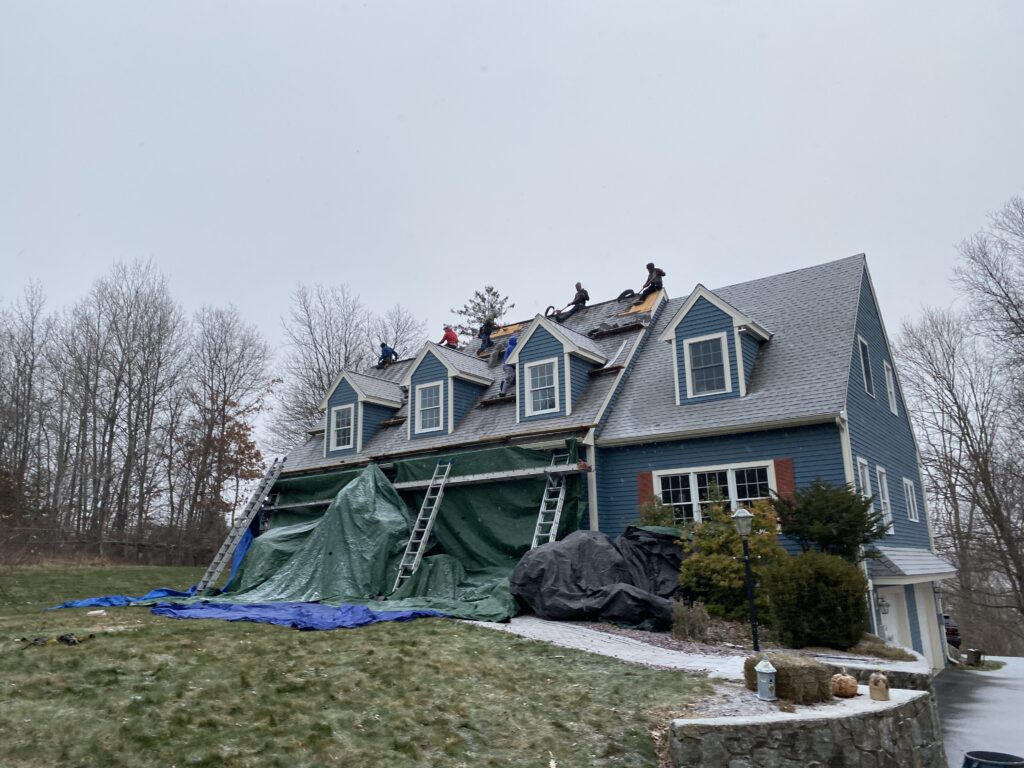
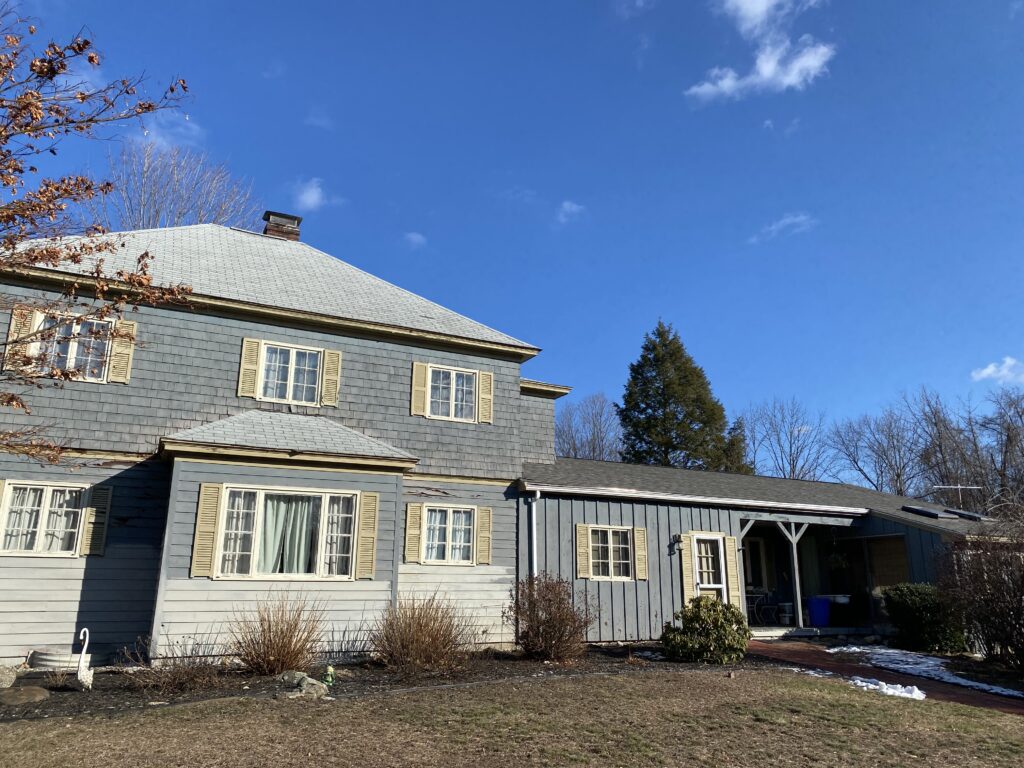
The other issue we see constantly in Rowley is debris-driven valley failure. Mature oak and pine cover over a lot of these lots means valleys fill with needles and leaves faster than open-lot homes nearby, and that trapped moisture rots the underlayment from underneath long before the shingles look bad from the ground. We also see genuine ice dam damage on the north-facing slopes of older capes and farmhouses where attic insulation was added over the decades without matching ventilation, which backs meltwater up under the shingle courses at the eave. Any of the older First Period or colonial-era homes scattered through town also tend to have roof framing that was never designed for a second or third layer of shingles, which is something we check before we ever talk material.
How we assess it
Derek walks the roof himself before we quote anything. That means checking the decking for soft spots underfoot, not just from a ladder, pulling back shingles at a chimney or valley to see what the flashing actually looks like rather than guessing from the eave, and getting into the attic to look at the underside of the decking for water staining, mold, and daylight coming through anywhere it should not. We also check ridge and soffit ventilation, because a roof that is not breathing correctly will cook the shingles from underneath and shorten the life of even a good material. You get a straight answer on whether this is a repair or a full replacement before we talk about product or price, and if it is a repair, we say so.
What the job involves
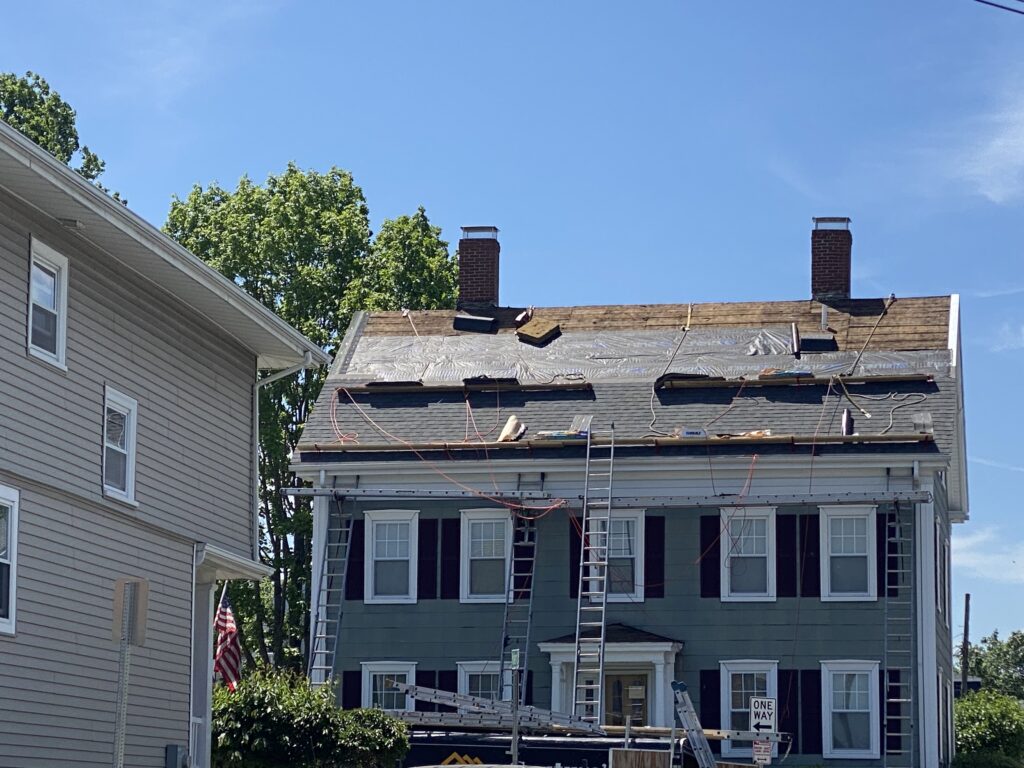
A full replacement starts with tear-off down to the decking on most Rowley homes, since a lot of the roofs out here are already on their second layer and code will not allow a third. Any decking that is soft, delaminated, or water-stained gets cut out and replaced with matched plywood, not skimmed over. We install ice and water shield along the eaves, valleys, and around every roof penetration, which matters more here than in towns further from the coast because of the wind-driven rain that comes with coastal storms. Flashing gets rebuilt at every chimney, sidewall, and valley rather than reused, ridge and soffit ventilation gets corrected if it is inadequate, and then the shingle goes down with the high-wind nailing pattern appropriate to the exposure of that specific lot. We clean up nail debris with a magnetic sweep and haul the old material off site the same day the tear-off happens whenever the schedule allows it.
What it costs
Most full roof replacements in Rowley run between {PRICE_LOW} and {PRICE_HIGH}, and where a specific job lands in that range depends on roof size, pitch, and how many layers we are stripping off. A steep, cut-up roof with three or four dormers costs more to strip and shingle than a simple gable roof of the same square footage, because the labor time is higher and material waste goes up on every cut. Decking surprises move the number too. We cannot know for certain what the plywood looks like underneath until tear-off starts, so we build a per-sheet replacement rate into the estimate rather than guessing at a flat number and hoping we are close. Access matters as well. A roof with easy driveway staging for a dumpster and material delivery costs less to work than a house tucked back on a wooded lot with a long, narrow drive, which is common on some of Rowley’s older lots.
How long it takes
A standard single-family roof replacement in Rowley typically takes one to two days from tear-off to final cleanup, weather permitting. Larger roofs, homes with multiple roof planes or additions at different pitches, or jobs where we find significant decking damage can run two to three days. We do not start a tear-off with rain in the forecast for that day, because an open roof deck overnight is not a risk we take with your house.
How do I know if my Rowley roof needs replacement instead of repair?
Widespread granule loss, soft decking in more than one location, or repeated leaks in different spots over a couple of seasons all point to replacement. A single isolated leak on a roof under 12 years old is usually a repair.
Why does wind rating matter for a roof in Rowley?
Rowley's proximity to open marsh and coastal exposure means gusts run higher than towns further inland. A shingle rated 110 to 130 mph with a high-wind nailing pattern holds up where a standard 60 mph three-tab will not.
Do you replace roof decking if it is damaged?
Yes. Any soft, delaminated, or water-stained decking found during tear-off gets cut out and replaced with matched plywood before new shingle goes down. We do not shingle over bad decking.
How long does a roof replacement take in Rowley?
Most single-family roofs take one to two days from tear-off to cleanup. Complex rooflines or hidden decking damage can extend that to two or three days.
What causes ice dams on older Rowley homes?
Insulation added over the years without matching ridge and soffit ventilation lets heat escape into the attic, which melts snow that then refreezes at the cold eave and backs water up under the shingles.
Get an estimate
If your roof is showing granule loss, a soft spot near a valley, or daylight in the attic where there should not be any, walk it with us before you decide anything. We will tell you plainly whether you are looking at a repair or a full replacement, what material makes sense for your exposure, and what it will cost, with no pressure to sign anything on the spot. Call Couture’s Construction at {PHONE} to schedule a look.