
- Home
- Services
- Locations
Amesbury, MA
Boxford, MA
Chelmsford, MA
Danvers, MA
Dracut, MA
Essex, MA
Georgetown, MA
Groveland, MA
Hamilton, MA
Haverhill, MA
Ipswich, MA
Merrimac, MA
Methuen, MA
Middleton, MA
Newbury, MA
Newburyport, MA
North Andover, MA
North Reading, MA
Peabody, MA
Rowley, MA
Salem, MA
Salisbury, MA
Tewksbury, MA
Topsfield, MA
Topsfield, MA
West Newbury, MA
Atkinson, MA
Derry, NH
East Kingston, NH
Kensington, NH
Kingston, NH
Londonderry, NH
Plaistow, NH
Salem, NH
- Company
- Contact
- Home
- Services
- Locations
Amesbury, MA
Boxford, MA
Chelmsford, MA
Danvers, MA
Dracut, MA
Essex, MA
Georgetown, MA
Groveland, MA
Hamilton, MA
Haverhill, MA
Ipswich, MA
Merrimac, MA
Methuen, MA
Middleton, MA
Newbury, MA
Newburyport, MA
North Andover, MA
North Reading, MA
Peabody, MA
Rowley, MA
Salem, MA
Salisbury, MA
Tewksbury, MA
Topsfield, MA
Topsfield, MA
West Newbury, MA
Atkinson, MA
Derry, NH
East Kingston, NH
Kensington, NH
Kingston, NH
Londonderry, NH
Plaistow, NH
Salem, NH
- Company
- Contact
Roof Replacement in Newburyport, MA
Walk through downtown Newburyport and you’ll see steep gable and gambrel roofs packed tight on narrow federal-era lots, most of them with almost no side yard for a lift or a dumpster. Out toward Plum Island Turnpike and the river, the exposure changes and wind becomes the bigger factor. Both ends of town put real demands on a roof that a lot of other places in the region simply don’t have.
Roof Replacement in Newburyport
Most homeowners don’t wake up planning a roof replacement. It usually starts with a stain on a ceiling, a shingle in the yard after a nor’easter, or a contractor doing gutter work who mentions the decking looks soft. The question we get asked on the driveway is almost always the same: is this a repair or do I need the whole thing done.
Here’s the honest answer. If the roof is losing granules across most of the field, if you’ve got two or three roof-repair visits in the last five years, if the shingles are curling or cupping on the south and west slopes, or if the decking has gone soft in more than one spot, you’re past the point where patching makes financial sense. If it’s one flashing detail leaking at a chimney or a single storm-damaged section, that’s a repair, and we’ll tell you that. A full tear-off and re-roof on a typical Newburyport home, from a modest cape near the high school to a three-story federal downtown, is a project we walk homeowners through step by step, and we don’t recommend it unless the roof actually needs it.
What Newburyport roofs are up against
Newburyport sits close enough to the Merrimack River mouth and the open Atlantic that wind uplift is not a theoretical concern here. Shingles rated for standard wind exposure can start lifting at the tabs after a few seasons of harbor-side gusts, especially on homes closer to the water or with less tree buffer. When we replace a roof in this town we’re looking hard at the wind rating on the shingle we spec, not just the color and the price point, because a shingle that’s fine forty miles inland can underperform two blocks from the river.
The other half of the equation is the housing stock itself. Newburyport’s downtown federal and colonial homes were built long before anyone thought about ridge or soffit ventilation, and a lot of them have had additions tacked onto the rear with low-slope roofs that don’t drain the way the original steep pitches do. Combine that with heavy tree cover on the inland side of town, and you get valley debris buildup that traps moisture against the decking all winter. On north-facing slopes that stay shaded most of the day, ice dams form fast once the temperature swings, and they back water up under shingles that were never installed with ice and water shield in the first place. Add in the Historic District’s restrictions on visible materials and rooflines, and access issues on lots where there’s barely room to walk around the house, and you’ve got a town where roof replacement takes more judgment than a standard suburban tear-off.
How we assess it
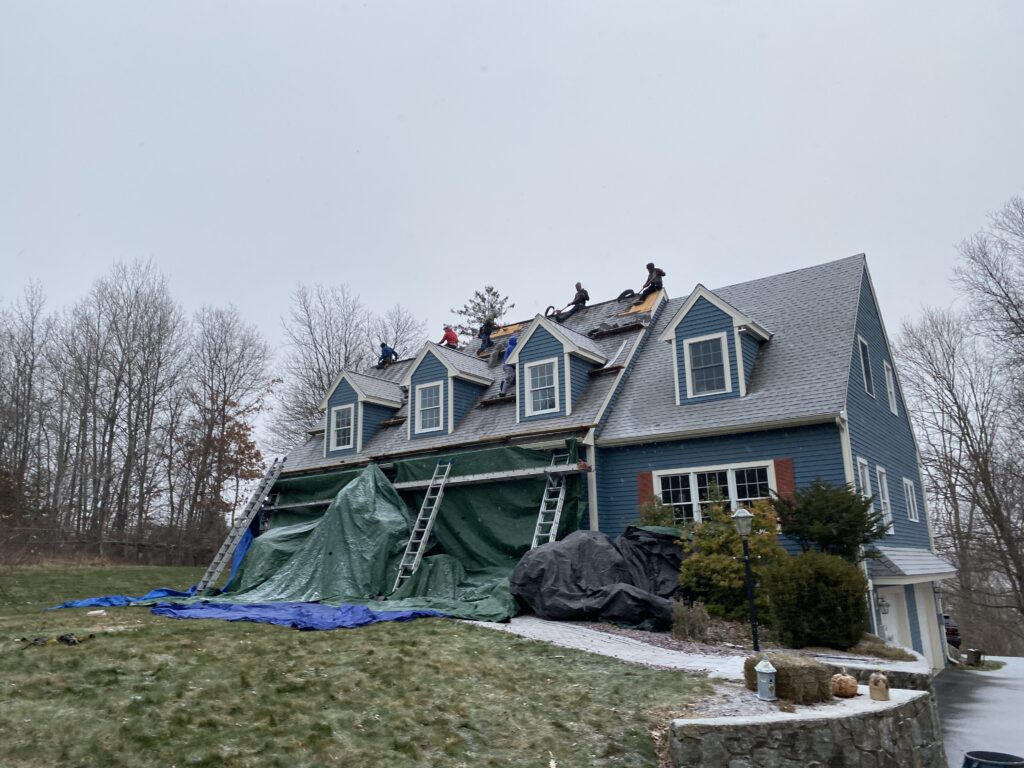
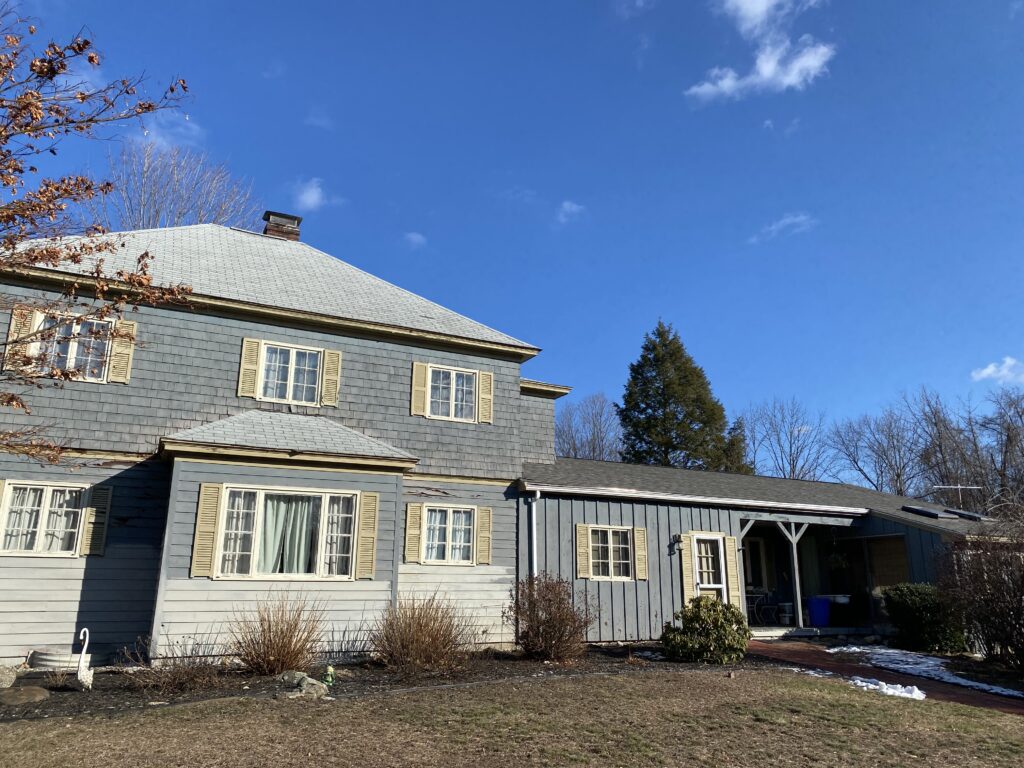
Derek doesn’t quote a roof replacement off a photo or a drive-by. Before we recommend anything we get up there and look at the decking directly, either by pulling a test section of shingles or checking from inside the attic where the sheathing is exposed. We check flashing at every chimney, wall intersection, and valley, because that’s where most leaks actually originate even when the shingles in the field still look fine. We check the ridge and soffit ventilation, or the lack of it, because a roof that can’t breathe cooks itself from underneath and voids a shingle warranty faster than weather does. And we look at the attic itself for moisture staining, mold, or daylight coming through anywhere it shouldn’t.
That assessment happens before we talk numbers. If the decking is solid and the problem is isolated, we say so and price a repair. If the roof is at the end of its life, we tell you why, specifically, not in general terms about age.
What the job involves
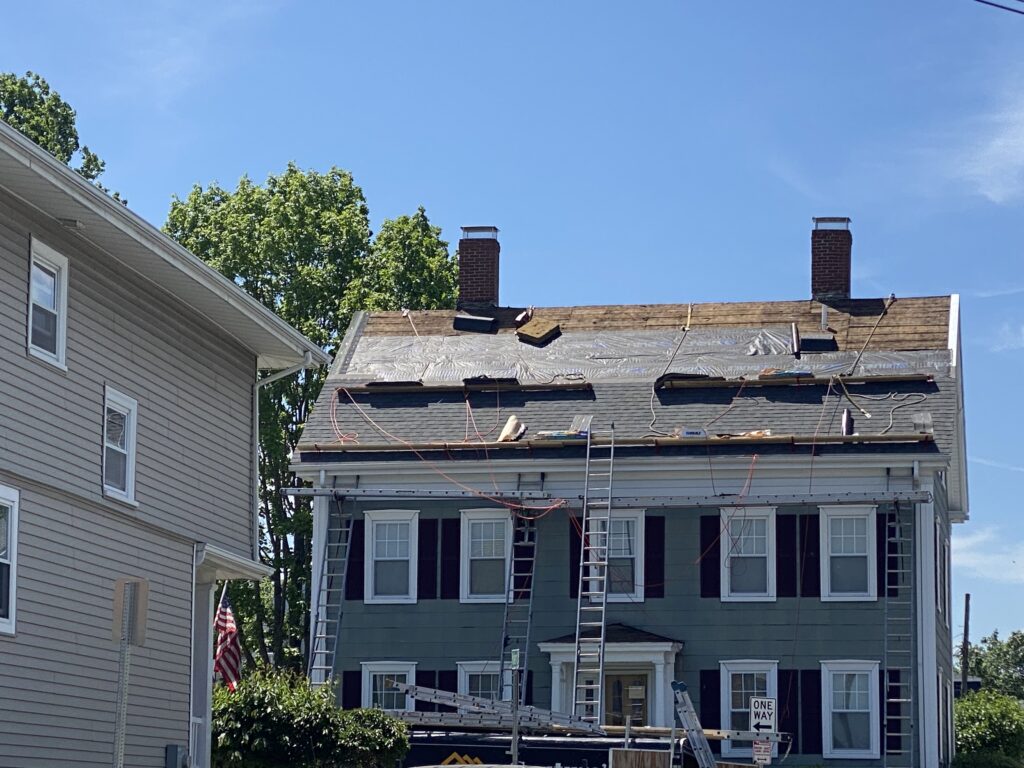
A full tear-off starts with stripping the existing roofing down to the decking, not laying new shingles over old ones. That lets us actually see and replace any rotted or delaminated sheathing before it gets covered up again. From there we install ice and water shield along the eaves, valleys, and around every penetration, which matters more in Newburyport than in most towns given the ice dam risk on shaded slopes. We install synthetic underlayment across the field, new flashing at chimneys, walls, and valleys, and a shingle rated for the wind exposure your specific lot sees, factoring in how close you are to open water and how much tree buffer you have. Ridge vents and soffit intake get corrected where the current setup is inadequate, which on older Newburyport homes is common. Downtown lots with tight access sometimes require hand-carrying materials rather than a standard boom lift, and Historic District properties may need specific shingle profiles or colors approved before we start.
What it costs
A straightforward roof replacement in Newburyport typically runs between {PRICE_LOW} and {PRICE_HIGH}, and where you land in that range depends on real variables, not guesswork. Roof size and the number of planes matter, as does pitch, since steep federal-era gables take longer and require more safety setup than a simple ranch roof. The number of existing layers to strip changes labor time. What we find once the decking is exposed can move the number too, since rotted sheathing has to be replaced and that’s not something we know until the old roofing is off. Access is its own factor in this town specifically, since a downtown lot with no side yard costs more to stage than a property with a driveway and open access on all sides. We give you a number after the assessment, not before, and we explain what’s driving it.
How long it takes
Most residential roof replacements in Newburyport take one to three days once we’re on site, weather permitting. Steeper or more complex rooflines, multi-layer tear-offs, and downtown properties with limited access on the longer end of that. We schedule around weather rather than pushing through a rain system, because a roof that’s opened up in bad weather is how you end up with an interior leak that didn’t exist before we started.
How do I know if I need a roof replacement or just a repair in Newburyport?
Look at how widespread the problem is. A single leak at a chimney or one storm-damaged section is usually a repair. Granule loss across most of the roof, repeated leaks in different spots, curling shingles, or soft decking in more than one area mean you're past the point where repair makes sense. We'll tell you honestly which one applies after we get up there.
Does Newburyport's Historic District affect roof replacement?
It can, particularly on downtown federal-era homes where roofline and visible material changes may need approval before work starts. We factor that into scheduling and material selection so there are no surprises partway through the job.
Why does wind rating matter more in Newburyport than inland towns?
Homes closer to the river mouth and the coastline see stronger and more frequent wind gusts. A shingle rated for standard exposure can lift at the tabs faster here than the same shingle would forty miles inland, so we spec wind rating based on your actual lot, not a generic default.
Can you replace a roof on a downtown lot with no side yard?
Yes, though tight lots without room for a lift often mean hand-carrying materials and staging debris removal differently. It takes more planning but it doesn't change the quality of the install, just the logistics.
Do you install ice and water shield on every replacement?
We install it along eaves, valleys, and penetrations on every roof we do in this region, because ice dams are a real risk here, especially on north-facing and shaded slopes common on Newburyport's tree-lined streets.
Request your estimate
Ready to see what a new roof would take for your Newburyport home? Couture’s Construction offers straightforward, no-pressure estimates so you know exactly what you’re working with before deciding on anything.
We’ll walk the roof, note the details that matter for coastal New England weather, and put together a written estimate you can review at your own pace.
- On-site inspection
- Clear, itemized pricing
- No obligation to move forward