
- Home
- Services
- Locations
Amesbury, MA
Boxford, MA
Chelmsford, MA
Danvers, MA
Dracut, MA
Essex, MA
Georgetown, MA
Groveland, MA
Hamilton, MA
Haverhill, MA
Ipswich, MA
Merrimac, MA
Methuen, MA
Middleton, MA
Newbury, MA
Newburyport, MA
North Andover, MA
North Reading, MA
Peabody, MA
Rowley, MA
Salem, MA
Salisbury, MA
Tewksbury, MA
Topsfield, MA
Topsfield, MA
West Newbury, MA
Atkinson, MA
Derry, NH
East Kingston, NH
Kensington, NH
Kingston, NH
Londonderry, NH
Plaistow, NH
Salem, NH
- Company
- Contact
- Home
- Services
- Locations
Amesbury, MA
Boxford, MA
Chelmsford, MA
Danvers, MA
Dracut, MA
Essex, MA
Georgetown, MA
Groveland, MA
Hamilton, MA
Haverhill, MA
Ipswich, MA
Merrimac, MA
Methuen, MA
Middleton, MA
Newbury, MA
Newburyport, MA
North Andover, MA
North Reading, MA
Peabody, MA
Rowley, MA
Salem, MA
Salisbury, MA
Tewksbury, MA
Topsfield, MA
Topsfield, MA
West Newbury, MA
Atkinson, MA
Derry, NH
East Kingston, NH
Kensington, NH
Kingston, NH
Londonderry, NH
Plaistow, NH
Salem, NH
- Company
- Contact
Roof Replacement in Merrimac, MA
Merrimac has a lot of roofs that were never designed for architectural shingles or modern ventilation, because the houses under them went up before either existed. Steep pitches near the town center, tree cover close to the roofline on the older lots, and additions tacked onto the back of farmhouses over the decades all change how a roof needs to be built today. If your roof is original to a house from that era, or close to it, you are probably not looking at a simple patch job anymore.
Roof Replacement in Merrimac
There is a point where a roof stops being repairable and starts being a liability, and most homeowners feel it before they can explain it. Shingles that are cupping or losing granules across the whole slope, not just one spot. Daylight in the attic. A soft spot underfoot near a valley or chimney. Ceiling stains that come back every winter no matter how many times you have had someone up there with a tube of caulk. Those are replacement signs, not repair signs, and on a roof that is fifteen, twenty, or thirty years old, they usually show up together, not one at a time.
The decision is not always obvious from the ground. A roof can look fine from the driveway and still have failed decking underneath, especially on houses in Merrimac where the original sheathing is old-growth board, not plywood. That is why we do not quote a replacement over the phone. We look at the roof first, tell you honestly whether it needs full replacement or just targeted repair, and go from there.
What Merrimac roofs are up against
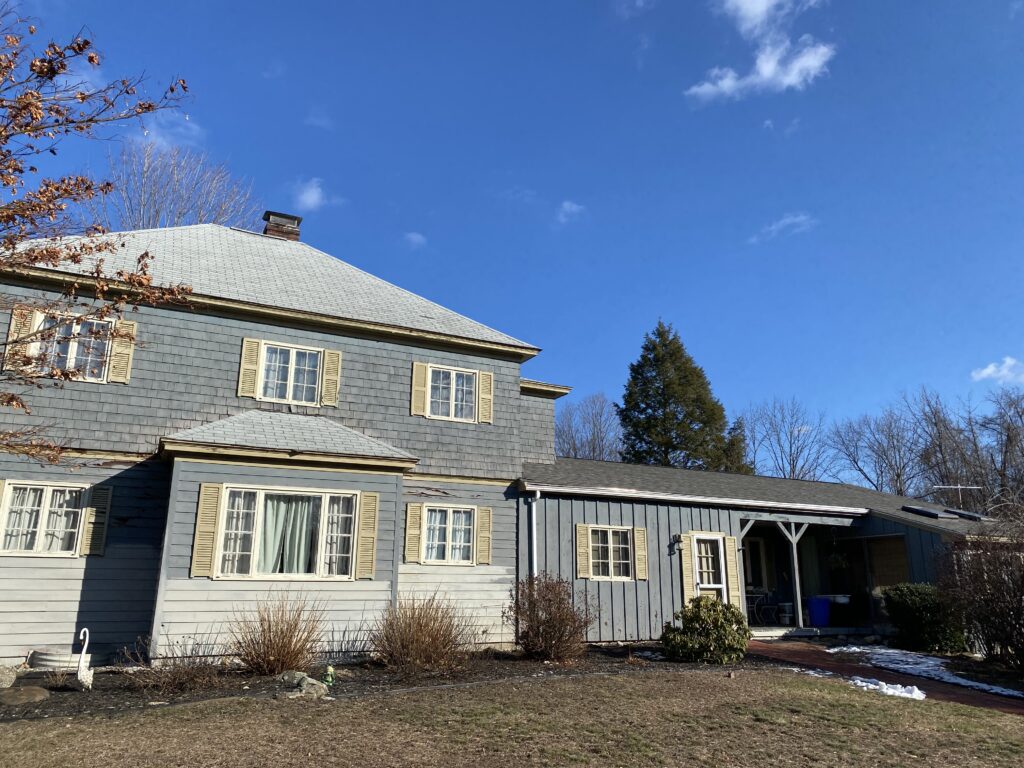
The housing stock in Merrimac splits pretty clearly into two groups. In the older sections near the town center and along the river, you have eighteenth and nineteenth century homes with steep roof pitches, multiple valleys, and additions built at different times with different roof lines meeting each other. Those intersections are where flashing fails first. Out toward the edges of town there is newer development from the last few decades, with simpler roof geometry but its own issues, mainly builder-grade shingles and minimal ventilation that were fine for a fifteen-year warranty period and are now aging out together across whole streets.
Tree cover is heavy in a lot of Merrimac’s older neighborhoods, and that means valleys and north-facing slopes hold moisture and debris longer than a roof out in the open would. Combine that with the ice dam pattern common across the Merrimack Valley, where heat escapes through under-insulated attics, melts snow on the upper roof, and refreezes at the cold eave, and you get water backing up under shingles that are otherwise in decent shape. On the older homes with low-slope rear additions, that same water has almost nowhere to shed, which is why those sections fail years before the main roof does.
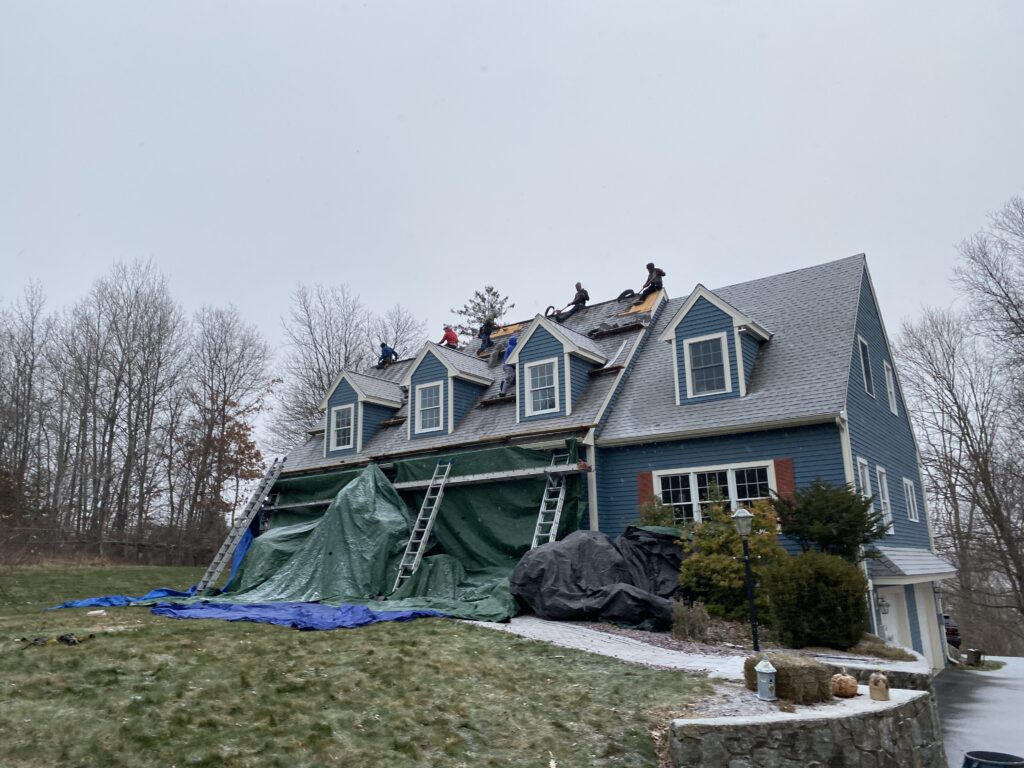
How we assess it
Derek gets on the roof and in the attic before anyone talks materials or numbers. That means checking the decking for soft spots and delamination, pulling back shingles at a valley or two to see how the underlayment held up, looking at flashing around chimneys and any roof-to-wall intersections, and checking whether the ridge and soffit vents are doing their job or whether they were never installed correctly to begin with. From inside the attic, he can see moisture staining, insulation that has been compressed or is missing where it matters, and daylight coming through anywhere it should not.
That assessment is what the recommendation is built on, not the other way around. If a roof needs a full tear-off, we will tell you why, specifically, based on what we found. If it does not, we will tell you that too, and what repair actually makes sense instead.
What the job involves
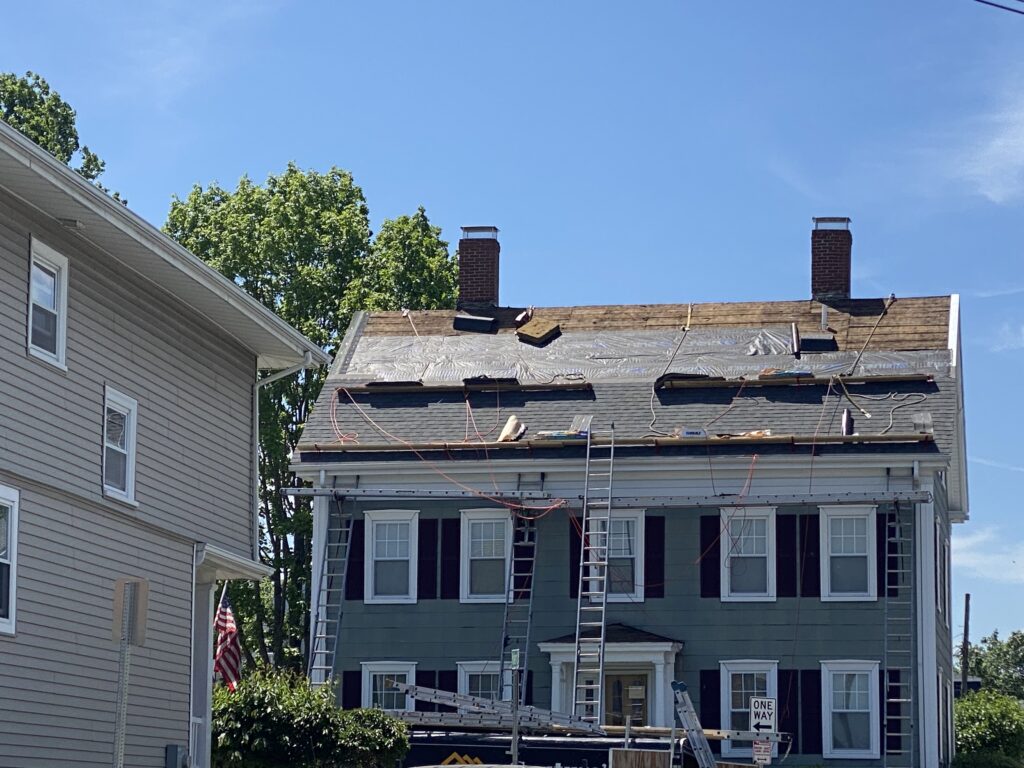
A full replacement starts with tear-off down to the decking, and that is the point where we find out what is really under the old roof. Any rotted or delaminated sheathing gets replaced before anything else goes down, no exceptions. From there it is ice and water shield along the eaves and in every valley, since that is standard practice for this region and non-negotiable on a roof with the ice dam exposure Merrimac homes see every winter. Synthetic underlayment covers the rest of the field. Shingles go down rated for the wind exposure the house actually gets, factoring in tree cover and how open the lot is. Flashing at chimneys, sidewalls, and valleys gets rebuilt, not just re-caulked over the old metal. Ridge venting goes in balanced against the soffit intake so the attic can actually breathe, which is the single biggest thing that extends a roof’s life past its warranty period.
What it costs
A straightforward roof replacement in Merrimac generally runs {PRICE_LOW} to {PRICE_HIGH}, and where a specific job falls in that range depends on a handful of things we can only pin down after looking at the roof. Total square footage and the number of roof planes matter. Pitch matters, since steep older roofs take longer and need more safety setup than a simple ranch. How many layers of old shingles have to come off matters. Decking condition matters more than any other single factor, because rotted sheathing found mid-tear-off adds material and labor that could not be priced in advance. Access matters too. Tight in-town lots with mature trees close to the house take more time to stage and protect than an open lot on the outskirts.
We give you a written number after the assessment, not a phone estimate, and we walk through what is driving that number line by line.
How long it takes
Most residential roof replacements in Merrimac take one to three days on site once material is on hand and weather cooperates. Steeper, more complex roofs with multiple valleys and dormers, common on the older homes near the town center, run toward the longer end. Simpler roofs on newer construction move faster. Weather is the real variable in this part of Massachusetts, and we will not shingle a roof in the rain or in high wind regardless of the schedule, because it is not worth doing the job twice.
How do I know if I need a full roof replacement or just a repair?
Isolated damage, like one storm-damaged section, a single leak around a pipe boot, or a small area of missing shingles, is usually a repair. Widespread granule loss, shingles curling or cupping across multiple slopes, recurring leaks in different spots, or soft decking are replacement signs. We will tell you honestly which one your roof needs after we look at it, not before.
Is ice damming really a bigger issue in Merrimac than elsewhere?
It is a Merrimack Valley-wide issue, but Merrimac's older homes with under-insulated attics and low-slope rear additions tend to see it worse than newer construction with modern insulation and ventilation. Ice and water shield at the eaves and proper attic ventilation are the fix, and both should be part of any replacement here.
What shingle wind rating makes sense for Merrimac?
It depends on the specific lot. A tree-sheltered older lot near the town center has different wind exposure than an open lot near the river or on higher ground toward the outskirts. We check the site and recommend a shingle rated appropriately rather than defaulting to one product for every job.
Do you handle the permit for a roof replacement in Merrimac?
Yes, we pull the required permit as part of the job. You can also look up Merrimac's building permit requirements directly through the town if you want to see them yourself before work starts.
How old does a roof have to be before replacement makes more sense than repair?
Age alone does not decide it, condition does. We have seen twelve-year-old roofs that need full replacement because of poor original ventilation, and thirty-year-old roofs still holding up fine on the field but needing flashing work. That is why the assessment comes before any recommendation.
Get an estimate
If your roof in Merrimac is showing granule loss, ice damming, or a soft spot you have been avoiding walking near, get it looked at before it turns into a decking repair on top of a roof replacement. Call {PHONE} and Derek will set up a time to get on the roof and give you a straight answer.