
- Home
- Services
- Locations
Amesbury, MA
Boxford, MA
Chelmsford, MA
Danvers, MA
Dracut, MA
Essex, MA
Georgetown, MA
Groveland, MA
Hamilton, MA
Haverhill, MA
Ipswich, MA
Merrimac, MA
Methuen, MA
Middleton, MA
Newbury, MA
Newburyport, MA
North Andover, MA
North Reading, MA
Peabody, MA
Rowley, MA
Salem, MA
Salisbury, MA
Tewksbury, MA
Topsfield, MA
Topsfield, MA
West Newbury, MA
Atkinson, MA
Derry, NH
East Kingston, NH
Kensington, NH
Kingston, NH
Londonderry, NH
Plaistow, NH
Salem, NH
- Company
- Contact
- Home
- Services
- Locations
Amesbury, MA
Boxford, MA
Chelmsford, MA
Danvers, MA
Dracut, MA
Essex, MA
Georgetown, MA
Groveland, MA
Hamilton, MA
Haverhill, MA
Ipswich, MA
Merrimac, MA
Methuen, MA
Middleton, MA
Newbury, MA
Newburyport, MA
North Andover, MA
North Reading, MA
Peabody, MA
Rowley, MA
Salem, MA
Salisbury, MA
Tewksbury, MA
Topsfield, MA
Topsfield, MA
West Newbury, MA
Atkinson, MA
Derry, NH
East Kingston, NH
Kensington, NH
Kingston, NH
Londonderry, NH
Plaistow, NH
Salem, NH
- Company
- Contact
Roof Replacement in Haverhill, MA
Walk down almost any street off Main Street or up toward Bradford and you’ll see two different roofs telling two different stories. The triple-deckers and converted mill housing have flat or low-slope rear additions that were patched more times than anyone can count. A few blocks over, the colonials and capes built during Haverhill’s 1990s and early 2000s growth spurt are all wearing the same architectural shingles they left the factory with, and those roofs are hitting twenty-plus years right around the same time. When a roof fails in this city, it usually fails for a reason we’ve already seen ten times this year.
Roof Replacement in Haverhill
Not every roof problem is a replacement problem, and we’re not going to tell you it is. A cracked pipe boot, a section of lifted shingles after a windstorm, a chimney flashing leak — those are repairs, and a straight answer costs you nothing. Replacement makes sense when the shingles are past their service life across the whole field, when granule loss is heavy and even, when there’s decking damage in more than one spot, or when the roof has already been repaired two or three times and the next fix is just delaying the same conversation. We’ll tell you which situation you’re in before we talk about product or price.
What Haverhill roofs are up against
The subdivision-age clustering is real. Neighborhoods built in the same five-year window went up with the same shingle package from the same builder, which means they’re all cashing in their warranty and their granules at the same time. If your street was developed in the late 90s or early 2000s, don’t be surprised if three of your neighbors are also fielding roofing quotes this season — it’s not a coincidence, it’s the shingle clock running out on schedule.
The older housing stock closer to downtown Haverhill and along the Merrimack carries a different problem: low-slope rear additions, porch roofs, and dormers that were never built to handle 25 years of New England weather the way the main roof was. These sections trap water, hold snow longer, and develop soft decking well before the primary roof shows any sign of trouble. Add in heavy tree cover in the older residential pockets, which loads valleys with leaves and pine needles every fall, and north-facing slopes that hold snow and set up ice dams every winter, and you’ve got a city where the roof rarely fails in the same place twice — it fails in the place nobody thought to check.
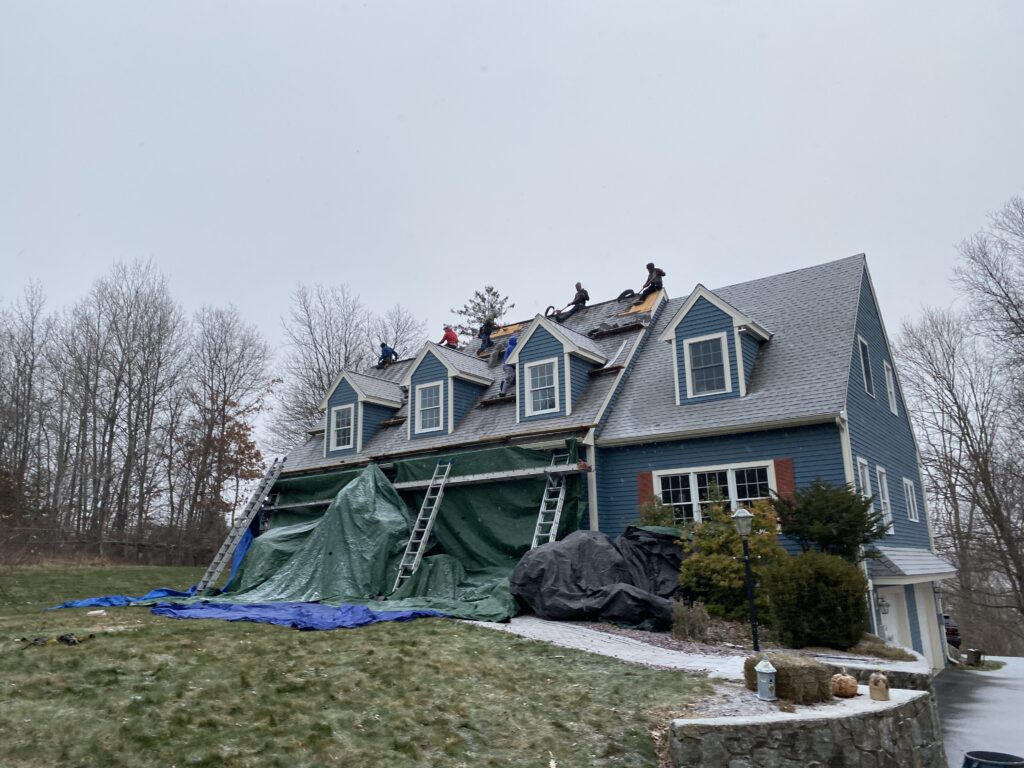
How we assess it
We don’t quote a roof from the driveway. Derek gets on the roof and checks the decking for soft spots, flex, and delamination, looks at flashing around every chimney, skylight, and valley, and checks the ridge and soffit ventilation to see if the attic is breathing the way it should. Then we go up into the attic itself, because that’s where you find the real story — water staining, dark or wet insulation, daylight where there shouldn’t be any. A roof can look fine from the street and still have decking that needs to be replaced, or look rough from the ground and turn out to be a straightforward reshingle. You get a recommendation after the assessment, not before it.
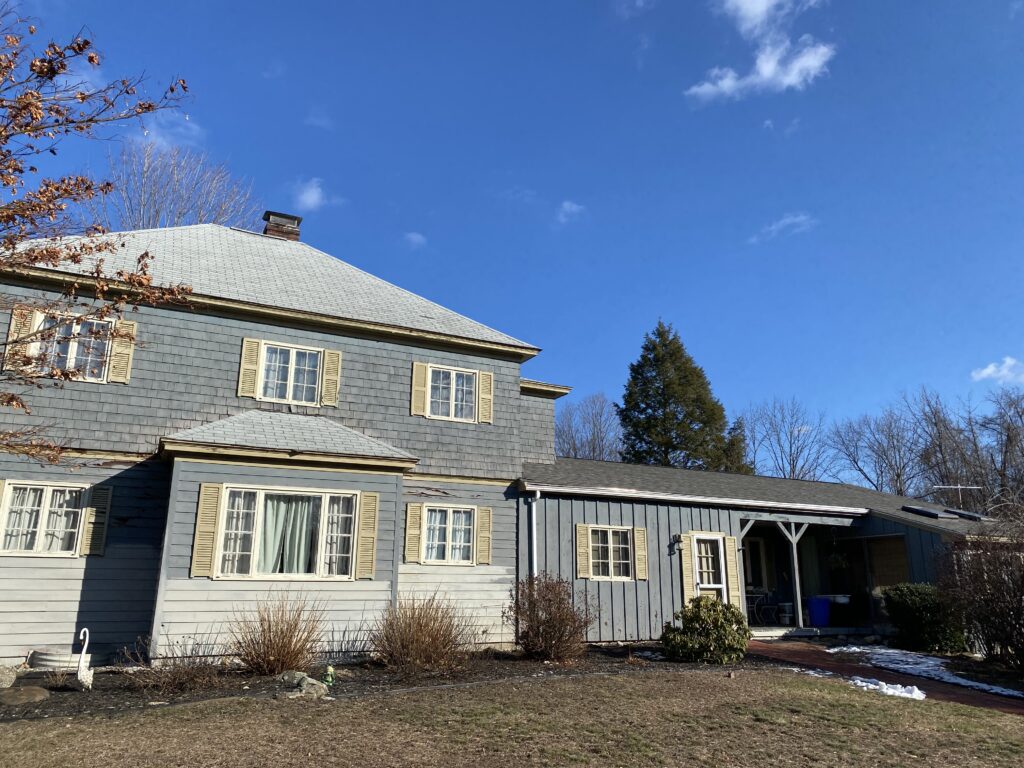
Complete Residential Roof Replacement in Haverhill
We install architectural asphalt shingles rated for high wind exposure, which matters here given the open stretches along the Merrimack and the exposed roof lines on some of the newer colonials in the outer neighborhoods. Every job gets ice and water shield along the eaves and in the valleys, which is non-negotiable in a city where ice dams form every winter on north-facing slopes and under tree cover. Flashing gets replaced at chimneys, skylights, and wall intersections rather than reused, and we correct ventilation where the ridge and soffit setup isn’t moving enough air, since poor ventilation is what cooks a new roof from underneath before its time.
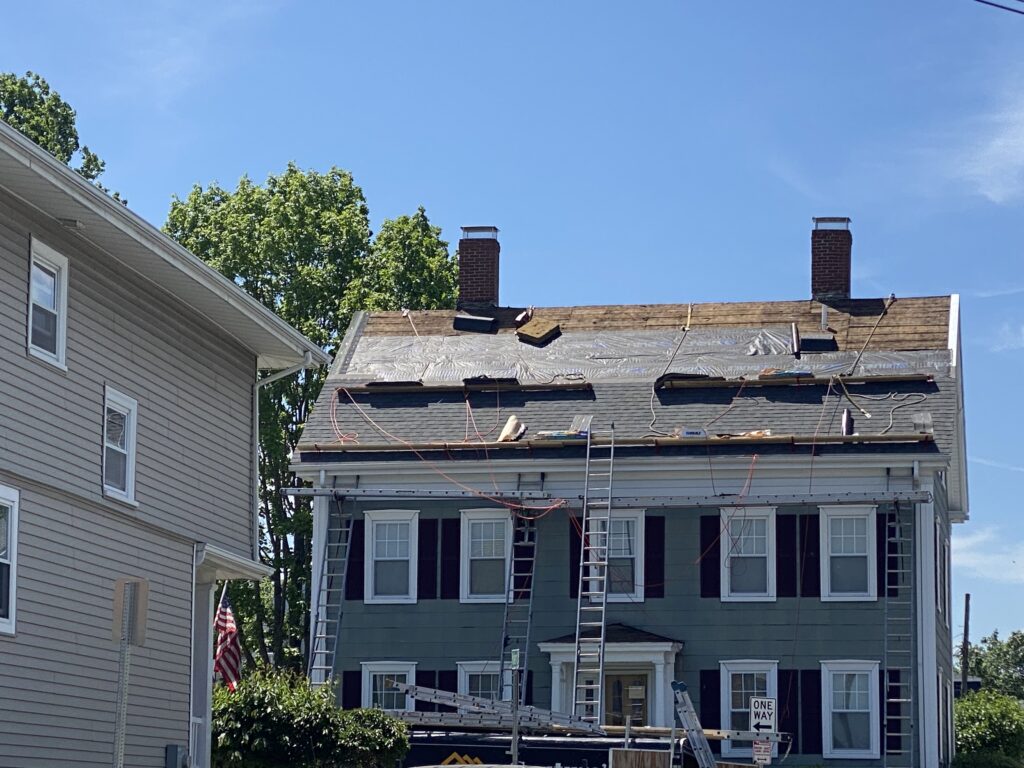
What the job involves
Tear-off comes first, down to the decking, so we can see exactly what’s underneath instead of guessing. Any rotted or delaminated plywood gets replaced board by board, not skimmed over. Then it’s ice and water shield at the eaves and valleys, synthetic underlayment across the field, new flashing at every penetration, the shingle install itself, and ridge venting to finish the ventilation loop. Your yard and driveway get protected during the tear-off, and we run magnetic sweeps for nails before we call the job done. Most homeowners are surprised how much of the job is prep and cleanup, not just shingles going down.
What it costs
Most full roof replacements in Haverhill land between {PRICE_LOW} and {PRICE_HIGH}, and the spread comes down to a handful of specifics: total square footage, roof pitch, how many layers of old shingles we’re stripping, whether the decking needs partial or full replacement once we open it up, and how much access the crew has for staging and disposal. A steep-pitch triple-decker roof with tight side-yard access costs more to work on than an open colonial roof with a walkable pitch, even if the square footage is similar. We’ll walk you through where your number lands and why before any contract gets signed. Nothing here is a flat rate.
How do I know if my Haverhill roof needs replacement or just a repair?
If the damage is isolated — a flashing leak, a section of wind-lifted shingles, a single soft spot — that's usually a repair. If granule loss is heavy across the whole roof, shingles are curling or cracking in multiple areas, or you've already had two or three repairs in as many years, you're looking at replacement. We'll tell you honestly which one you're dealing with after we've actually been on the roof.
Why are so many roofs in Haverhill failing around the same time?
A lot of the city's subdivisions went up in the same building boom in the late 1990s and early 2000s, all with similar architectural shingle packages. Those shingles are hitting the end of their service life together, which is why you'll see multiple roofing crews working the same street in a given season.
What about the flat roof over my rear addition?
Low-slope sections on older Haverhill housing fail earlier than the main roof, usually from ponding water or membrane wear rather than shingle wear. We assess these separately from the main roof, since the material and approach are different, and we'll tell you if it needs attention even when the main roof doesn't.
Do you handle ice dam damage from the winter before it becomes a bigger problem?
Yes. Ice and water shield at the eaves and in valleys is standard on every replacement we do, specifically because ice dams are a recurring issue on north-facing slopes and shaded roofs in this area. If you've had ice dam damage, we'll check the decking underneath for water intrusion before we do anything else.
Will you match my neighbor's shingle color or style?
We can, within what's currently available from the manufacturer. A lot of Haverhill's subdivision streets have a consistent look, and we'll talk through color and profile options that fit the neighborhood if that matters to you.
How long it takes
A standard single-family roof replacement in Haverhill usually runs one to two days once the crew is on site, weather permitting. Larger roofs, steeper pitches, or jobs that turn up decking damage once we open things up can push into a third day. Multi-family and triple-decker roofs with more complex geometry — dormers, multiple roof planes, low-slope sections — take longer than a straightforward gable roof of the same square footage. We’ll give you a realistic window before we start, not an optimistic one.