
- Home
- Services
- Locations
Amesbury, MA
Boxford, MA
Chelmsford, MA
Danvers, MA
Dracut, MA
Essex, MA
Georgetown, MA
Groveland, MA
Hamilton, MA
Haverhill, MA
Ipswich, MA
Merrimac, MA
Methuen, MA
Middleton, MA
Newbury, MA
Newburyport, MA
North Andover, MA
North Reading, MA
Peabody, MA
Rowley, MA
Salem, MA
Salisbury, MA
Tewksbury, MA
Topsfield, MA
Topsfield, MA
West Newbury, MA
Atkinson, MA
Derry, NH
East Kingston, NH
Kensington, NH
Kingston, NH
Londonderry, NH
Plaistow, NH
Salem, NH
- Company
- Contact
- Home
- Services
- Locations
Amesbury, MA
Boxford, MA
Chelmsford, MA
Danvers, MA
Dracut, MA
Essex, MA
Georgetown, MA
Groveland, MA
Hamilton, MA
Haverhill, MA
Ipswich, MA
Merrimac, MA
Methuen, MA
Middleton, MA
Newbury, MA
Newburyport, MA
North Andover, MA
North Reading, MA
Peabody, MA
Rowley, MA
Salem, MA
Salisbury, MA
Tewksbury, MA
Topsfield, MA
Topsfield, MA
West Newbury, MA
Atkinson, MA
Derry, NH
East Kingston, NH
Kensington, NH
Kingston, NH
Londonderry, NH
Plaistow, NH
Salem, NH
- Company
- Contact
Roof Replacement in Danvers, MA
Danvers has some of the most varied roofs on the North Shore. You’ve got Colonials off Hobart Street with steep original pitches, ranches and split-levels from the post-war boom on the Peabody line, and newer builds near the business park with low-slope rear sections and big open valleys. That mix means there’s no single answer to “what’s wrong with my roof” here. What’s consistent is the tree cover along the Ipswich River side of town and the wind that comes off the water near Crane Pond, and both of those factors show up in the calls we get.
Roof Replacement in Danvers
When a homeowner calls us about a roof in Danvers, the first question is always the same: is this a repair or does the whole thing need to come off. We answer that with a straight look at the roof, not a sales pitch. If you’ve got granule loss on a few courses, one or two flashing leaks, or a section of soffit rot from a clogged gutter, that’s often a repair, and we’ll say so. If you’re seeing curling or cupped shingles across multiple slopes, soft spots in the decking when we walk it, daylight through the ridge in the attic, or a roof that’s already had one layer added over the original, replacement is the honest recommendation. Age matters too. A roof pushing 20 to 25 years on standard three-tab shingles is at the point where one more hard winter is a real risk, not a maybe.
What Danvers roofs are up against
The tree canopy in the older neighborhoods near Sylvan Street and Hobart Street drops a lot of debris into valleys and behind chimneys every fall. That debris holds moisture, and moisture sitting in a valley all winter is how you get a slow leak that doesn’t show up inside the house until the drywall is already stained. We see this pattern more in Danvers than in some of the more open North Shore towns, simply because of how much mature tree cover is still standing over the roof lines here.
North-facing slopes on Colonials and capes are the other recurring issue. Heat leaks up from the living space, warms the roof deck unevenly, and melts snow that refreezes at the eave. That’s an ice dam, and it backs water up under the shingles at the exact spot where most of these older homes have the thinnest ice and water shield coverage, if they have any at all. Add in the low-slope rear additions that a lot of Danvers homes picked up during renovations over the decades, and you’ve got sections of roof that were never designed to shed water fast, which makes proper underlayment and flashing detail non-negotiable rather than optional.
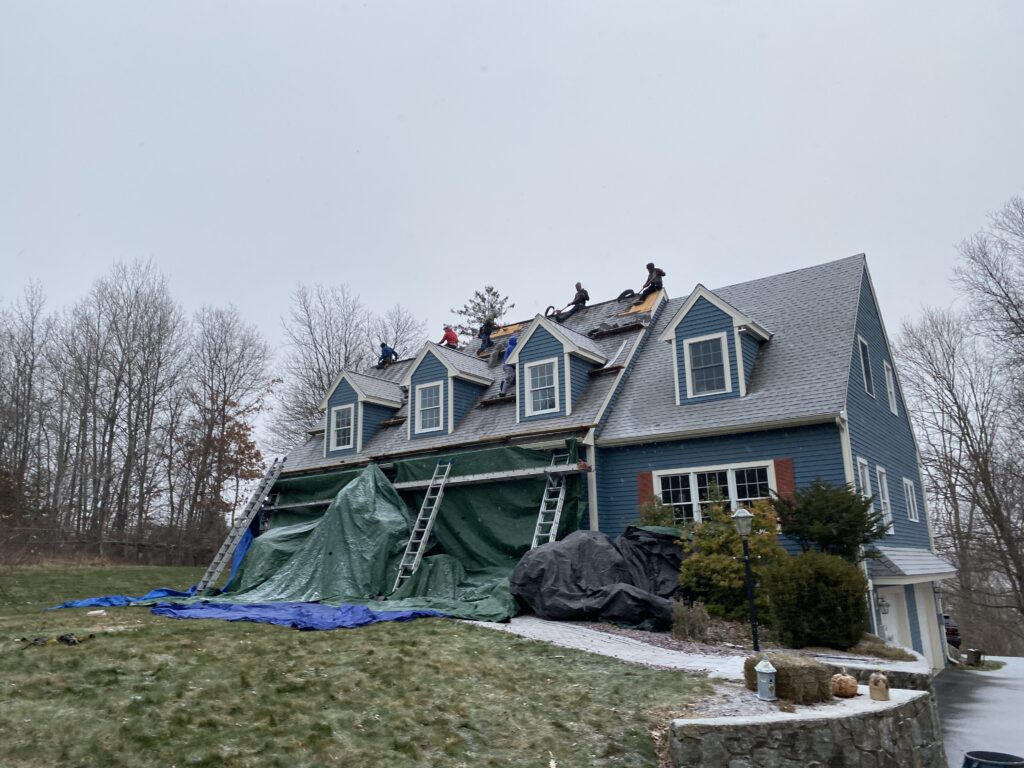
How we assess it
Derek walks the roof before anyone quotes a number. That means checking the decking for soft spots, pulling back a shingle or two near the eaves and valleys to see what’s actually happening underneath, and checking the flashing at every chimney, skylight, and sidewall. Then we go up into the attic, because that’s where you find the real story. A ridge vent that isn’t drawing air, insulation packed against the soffit blocking intake, dark staining on the rafters near the eaves, all of that tells us more than the shingles do from the ground. We don’t hand you a recommendation until we’ve done both halves of that inspection. A roof that looks rough from the driveway sometimes just needs a repair, and a roof that looks fine from the street sometimes has a decking problem you can’t see until you’re standing in the attic with a flashlight.
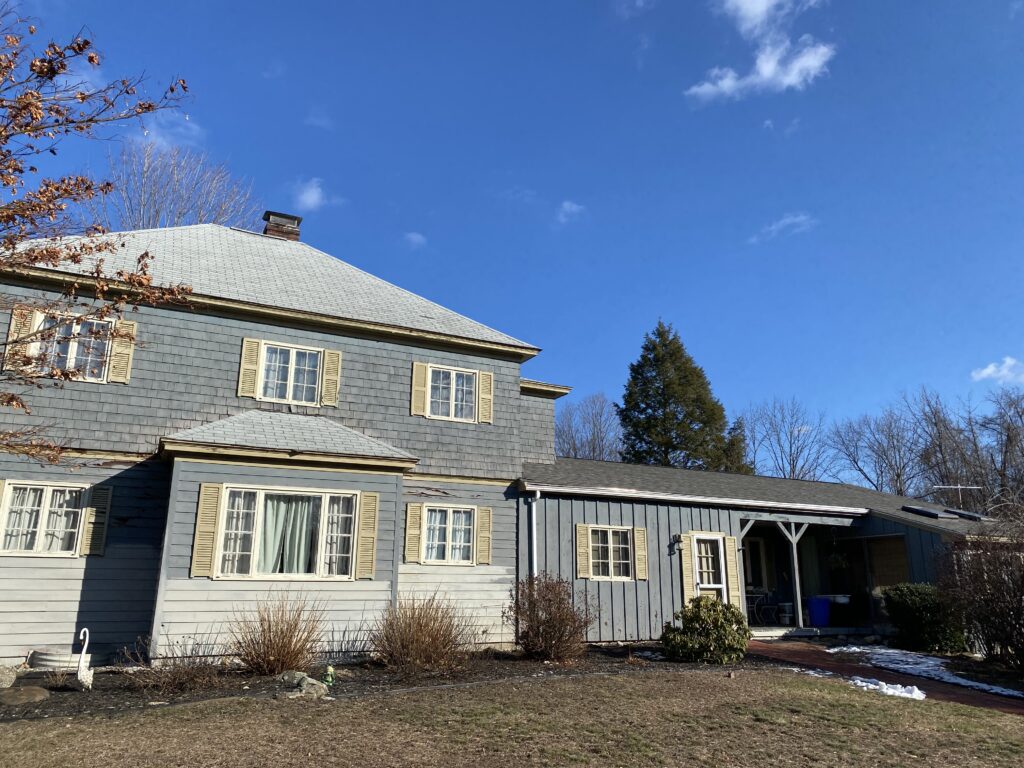
What the job involves
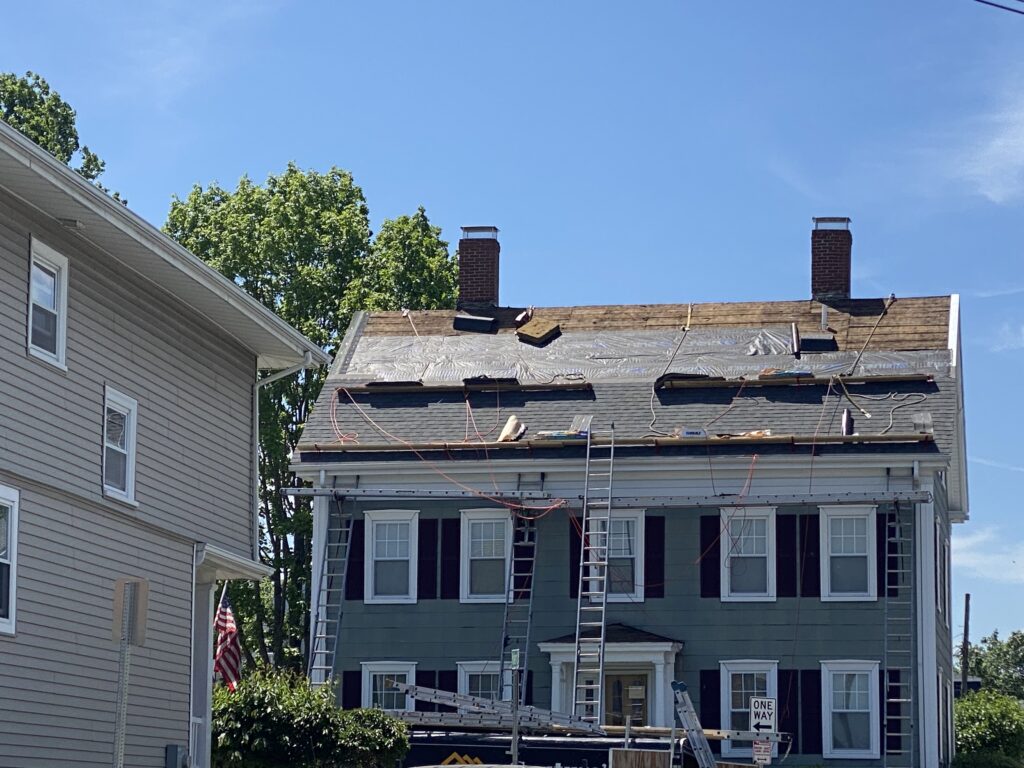
A full tear-off starts with stripping the existing roof down to the deck, not layering over it. We check every sheet of decking as we go, and any wood that’s soft, delaminated, or water-stained gets replaced before anything new goes down. Ice and water shield goes on at the eaves, valleys, and around every penetration, which matters more here than in towns without the same tree and shade coverage. Then synthetic underlayment across the field, new flashing at chimneys and sidewalls, architectural shingles rated for the wind exposure the property actually sees, and ridge venting paired with soffit intake so the attic can actually breathe. We clean the property as we go, magnet-sweep the yard for nails at the end of each day, and haul away the old material rather than leaving a dumpster sitting on your lawn for two weeks.
What it costs
Most full roof replacements in Danvers run {PRICE_LOW} to {PRICE_HIGH}, and where a job lands in that range depends on a handful of specifics. Square footage and pitch are the obvious ones, a steep original Colonial roofline takes longer and costs more to work safely than a simple ranch. How many layers we’re stripping matters, one layer versus two adds real labor time. Decking condition is the wildcard, we won’t know exactly how much plywood needs replacing until the old shingles are off, and we’ll show you what we find before we replace it, not after it’s on the invoice. Access plays a role too, a roof buried under mature trees or tight to a neighboring property takes longer to stage safely than one with a clear driveway and open yard.
How long it takes
Most Danvers homes are done in one to two days once we’re on site, weather permitting. A straightforward ranch with good decking can wrap up in a single day. A larger Colonial with multiple roof planes, a second layer to strip, or decking repairs will usually run two days. We don’t start a tear-off with rain in the forecast, an open roof deck overnight is not a risk we take with your house.
How do I know if my Danvers roof needs replacement instead of repair?
Look for shingle curling or cupping across more than one slope, soft spots in the decking, daylight visible through the roof boards in the attic, or a roof that already has two layers of shingles on it. Isolated leaks, a few damaged shingles, or flashing issues at one chimney are usually a repair. We'll tell you honestly which one you've got.
Do you handle the older homes near downtown Danvers with tighter roof access?
Yes. A lot of the housing near the center of town and along the older streets has tight lot lines and mature trees close to the roof. We stage material and set up safety equipment to work around that without damaging landscaping or neighboring property.
What shingle brands and wind ratings do you install?
We install architectural shingles rated for the wind exposure your property actually sees, which matters more for homes closer to open water or exposed lots. We'll walk you through the specific product options and their wind ratings during the estimate rather than quoting a generic spec sheet.
Will ice dams keep happening after a replacement?
Not if the roof is done right. Ice dams come from heat escaping into the attic and uneven melt at the eaves. A proper replacement includes ice and water shield at the eaves and valleys plus ridge and soffit ventilation that lets the attic breathe, which addresses the cause, not just the symptom.
Do I need a permit for a roof replacement in Danvers?
Yes, the town requires a building permit for roof replacement work. We handle the permit application as part of the job so you don't have to deal with the town's office directly.
Request your quote
Thinking about replacing your roof in Danvers? Couture’s Construction will walk your property, inspect the current roofing system, and put together a clear, itemized estimate before any work begins. No pressure, no guesswork — just an honest look at what your home needs.
Reach out to schedule your visit, and we’ll answer your questions and talk through material options that fit your Danvers home and budget.