
- Home
- Services
- Locations
Amesbury, MA
Boxford, MA
Chelmsford, MA
Danvers, MA
Dracut, MA
Essex, MA
Georgetown, MA
Groveland, MA
Hamilton, MA
Haverhill, MA
Ipswich, MA
Merrimac, MA
Methuen, MA
Middleton, MA
Newbury, MA
Newburyport, MA
North Andover, MA
North Reading, MA
Peabody, MA
Rowley, MA
Salem, MA
Salisbury, MA
Tewksbury, MA
Topsfield, MA
Topsfield, MA
West Newbury, MA
Atkinson, MA
Derry, NH
East Kingston, NH
Kensington, NH
Kingston, NH
Londonderry, NH
Plaistow, NH
Salem, NH
- Company
- Contact
- Home
- Services
- Locations
Amesbury, MA
Boxford, MA
Chelmsford, MA
Danvers, MA
Dracut, MA
Essex, MA
Georgetown, MA
Groveland, MA
Hamilton, MA
Haverhill, MA
Ipswich, MA
Merrimac, MA
Methuen, MA
Middleton, MA
Newbury, MA
Newburyport, MA
North Andover, MA
North Reading, MA
Peabody, MA
Rowley, MA
Salem, MA
Salisbury, MA
Tewksbury, MA
Topsfield, MA
Topsfield, MA
West Newbury, MA
Atkinson, MA
Derry, NH
East Kingston, NH
Kensington, NH
Kingston, NH
Londonderry, NH
Plaistow, NH
Salem, NH
- Company
- Contact
Roof Repair in Salisbury, MA
Roofs near Salisbury Beach and along the Merrimack take a different kind of beating than roofs ten miles inland. The wind comes off open water with nothing to slow it down, and salt air works on nail heads, flashing, and shingle granules faster than a typical New England winter alone would. If you’re calling about a leak, a lifted shingle, or a stain on a bedroom ceiling, there’s usually a specific reason, and it’s rarely the whole roof.
Roof Repair in Salisbury
We fix roofs in Salisbury the same way we’ve fixed roofs across the Merrimack Valley and the coast for years: find out exactly what’s wrong before anyone talks about what to do about it. Most repair calls here start with water showing up somewhere it shouldn’t – a ceiling stain after a nor’easter, a soft spot near a chimney, ice built up along an eave in February. We go up and look at the actual problem, not just quote a fix off a photo you texted us.
A lot of the work in this town is smaller than people expect. A ridge cap that lifted in a gust off the water. Flashing around a plumbing vent that dried out and cracked. A valley that’s been collecting pine needles for a few seasons and finally backed up water under the shingles. These are real repairs with real fixes, and we tell you straight when that’s what you’re looking at.
What Salisbury roofs are up against
Wind is the headline issue here. Salisbury sits close enough to open water that shingles rated for standard wind exposure can underperform, especially on roofs facing the beach or sitting up on a dune lot with nothing blocking the gusts. We see shingle tabs lift and crack in spots that would hold fine a few miles inland. When we’re repairing or replacing a section, we pay attention to what’s actually installed versus what the wind exposure calls for, because a patch with the wrong-rated shingle just fails again next winter.
Salt air is the quieter problem. It corrodes exposed fasteners, pits flashing, and shortens the working life of anything metal on the roof – drip edge, step flashing, vent caps. Combine that with the older seasonal-cottage-turned-year-round housing stock along the beach roads, where roofs were often built light for a summer place and never upgraded for winter loads, and you get roofs that look fine from the street but have flashing and decking issues underneath. Inland toward the marshes and the Route 1 corridor, tree cover brings its own version of the same problem: needle and leaf buildup in valleys that holds moisture against the shingles long after a storm has passed.
How we assess it
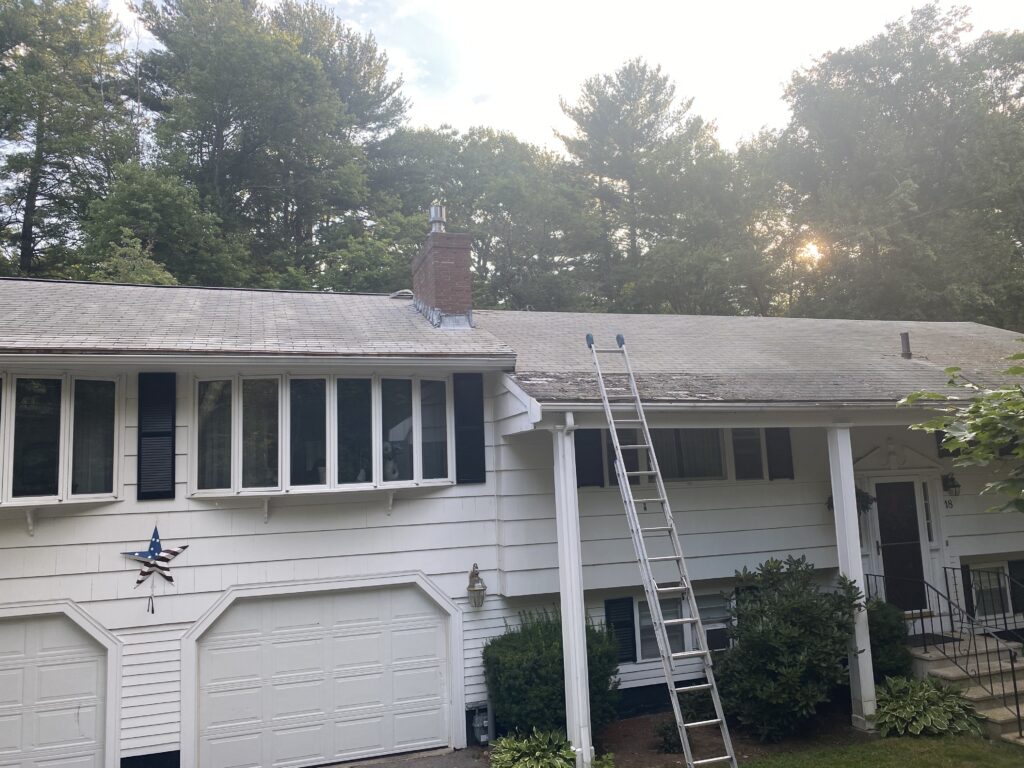
Before we recommend anything, we get on the roof. Derek walks the field, checks the ridge and hips, and looks closely at every flashing point – chimneys, sidewalls, valleys, plumbing vents. Flashing failure is behind more Salisbury leaks than worn-out shingle field, and it’s often missed because it doesn’t look dramatic from the ground.
We also get into the attic when access allows. That’s where you actually learn the truth about a roof: is the decking soft or delaminating, is there daylight at a flashing seam, is the ridge and soffit ventilation doing its job or is trapped moisture cooking the plywood from below. Ventilation problems show up as ice dams on north-facing slopes in January and as premature shingle aging in July, and you can’t diagnose either one standing in the driveway. A real assessment happens before a recommendation, not after we’ve already decided what we’re selling you.
What the job involves
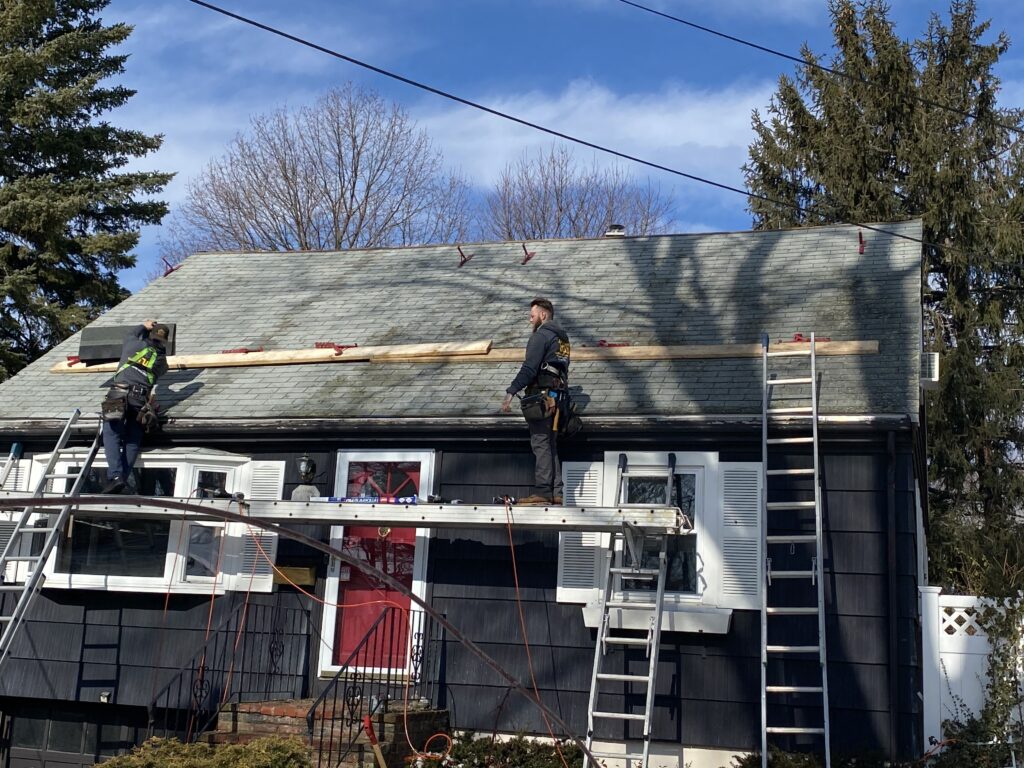
Once we know what’s actually failing, the fix matches the problem. A cracked pipe boot or a lifted section of ridge cap might be a half-day repair: strip the damaged shingles, check the decking underneath, replace flashing or boots as needed, re-lace new shingles into the existing pattern so it doesn’t look patched. A valley that’s failed from years of debris usually means pulling shingles back further, checking for rot in the decking, and installing new ice and water shield before anything goes back down.
If we find soft or delaminated decking, we replace only the sheets that need it – we don’t re-deck a whole roof because one section is bad. And if what looks like a simple leak turns out to be widespread flashing failure or shingles at the end of their service life across the whole field, we’ll tell you that plainly too. That’s a different conversation, and it’s one we have honestly, not one we back into.
What it costs
Most straightforward repairs in Salisbury run somewhere between {PRICE_LOW} and {PRICE_HIGH}, and where you land in that range depends on what we actually find. A single flashing repair or a small section of shingles is on the lower end. A valley rebuild, multiple decking sheets, or repair work on a steep or hard-to-access roof near the beach costs more. Roof size, pitch, how many layers of old shingles are already on there, and whether we can get a ladder or lift close to the house all move the number. We give you a firm price after the assessment, not a guess before we’ve been up there.
How long it takes
A single-area repair, like a flashing fix or a section of shingles, is typically a one-day job. Valley rebuilds or repairs involving decking replacement can run into a second day, especially if weather or access near the water slows things down. We’ll give you a realistic window before we start, and we won’t leave a roof open overnight without it being weathered in.
Can a leak in Salisbury usually be repaired instead of replacing the whole roof?
Often, yes. Most leaks come from a localized flashing or valley failure rather than the whole roof being worn out. We assess first and only recommend replacement when the shingles or decking are genuinely at the end of their life across the field, not just at one problem spot.
Why do roofs near Salisbury Beach seem to fail faster than roofs a few miles inland?
Wind exposure and salt air are the two big factors. Open water wind can exceed what standard-rated shingles handle well, and salt air corrodes fasteners and flashing faster than it does inland. Roofs on beach-facing lots need materials and details matched to that exposure.
Do you repair roofs on older seasonal cottages that are now year-round homes?
Yes, and we see this often in Salisbury. Roofs built for a summer place sometimes lack the ventilation or ice and water shield a year-round New England roof needs. We can repair what's failing now and flag anything that should be addressed before the next winter.
What causes ice dams on some Salisbury roofs and not others?
Ice dams usually come down to attic ventilation and insulation, not just weather. North-facing slopes and roofs with blocked soffit or ridge venting trap heat that melts snow unevenly, and the meltwater refreezes at the eave. We check the attic, not just the shingles, to find the real cause.
Do you handle emergency roof repairs after a nor'easter?
Yes. Coastal storms are a real driver of repair calls in Salisbury. Call us and we'll get out to assess active leaks and storm damage as quickly as our schedule allows.
Get an estimate
If you’ve got a leak, a stain, or a shingle that’s been flapping since the last coastal storm, call us before it turns into a bigger repair. We’ll come out, get on the roof, and tell you honestly what’s wrong and what it takes to fix it. Reach Couture’s Construction at {PHONE} for a Salisbury roof assessment.