
- Home
- Services
- Locations
Amesbury, MA
Boxford, MA
Chelmsford, MA
Danvers, MA
Dracut, MA
Essex, MA
Georgetown, MA
Groveland, MA
Hamilton, MA
Haverhill, MA
Ipswich, MA
Merrimac, MA
Methuen, MA
Middleton, MA
Newbury, MA
Newburyport, MA
North Andover, MA
North Reading, MA
Peabody, MA
Rowley, MA
Salem, MA
Salisbury, MA
Tewksbury, MA
Topsfield, MA
Topsfield, MA
West Newbury, MA
Atkinson, MA
Derry, NH
East Kingston, NH
Kensington, NH
Kingston, NH
Londonderry, NH
Plaistow, NH
Salem, NH
- Company
- Contact
- Home
- Services
- Locations
Amesbury, MA
Boxford, MA
Chelmsford, MA
Danvers, MA
Dracut, MA
Essex, MA
Georgetown, MA
Groveland, MA
Hamilton, MA
Haverhill, MA
Ipswich, MA
Merrimac, MA
Methuen, MA
Middleton, MA
Newbury, MA
Newburyport, MA
North Andover, MA
North Reading, MA
Peabody, MA
Rowley, MA
Salem, MA
Salisbury, MA
Tewksbury, MA
Topsfield, MA
Topsfield, MA
West Newbury, MA
Atkinson, MA
Derry, NH
East Kingston, NH
Kensington, NH
Kingston, NH
Londonderry, NH
Plaistow, NH
Salem, NH
- Company
- Contact
Roof Repair in Salem, MA
Salem, Massachusetts has some of the tightest roof geometry we work on anywhere north of Boston. Steep gables on Federal-era homes near the historic district, additions bolted onto the back of 1920s two-families in a dozen different pitches, and heavy tree canopy over streets like Lafayette and Federal that drop leaves and pine debris into valleys every fall. When a roof here starts leaking, it’s rarely one simple problem, and it’s almost never the whole roof.
Professional Roof Repair for Salem Homes
Most calls we get from Salem start the same way: a stain on a bedroom ceiling, a shingle in the yard after a windy night, or a leak that only shows up during a hard nor’easter. Homeowners want to know if it’s a patch job or something bigger, and that’s the right question to ask before anyone climbs a ladder.
We repair roofs in Salem the same way we’d want it done on our own house: figure out exactly what’s failing and why, fix that, and tell you straight if something bigger is coming down the road. If a repair holds up the roof for several more years, that’s what we recommend. We don’t pad a repair estimate to make replacement look like the only sensible option.
What Salem Roofs Are Up Against
Salem sits close enough to open water that wind uplift is a real factor, especially on roofs facing the harbor or exposed on a rise with no windbreak. We see shingles lifted at the eaves and rakes on homes that otherwise look fine from the street, because the wind gets under a tab that was never sealed right to begin with. Add in the density of the housing stock, where roofs sit closer to neighboring structures and chimneys, and flashing failures around those chimneys and at wall-roof intersections show up more often than on a standalone house in a more open town.
The historic district adds another layer most towns don’t have. If your roof is in that overlay, what you’re allowed to install is constrained by district guidelines, and that affects material choice, color, and sometimes even the repair method itself. Outside the district, Salem’s dense pockets of Peabody-adjacent and Beverly-border stock run from tightly packed post-war ranches to older triple-deckers with flat or low-slope rear additions, and those low-slope sections are where we find the most chronic, slow leaks. They don’t shed water the way a steep pitch does, and a lot of them were built with roofing that was never rated for standing water in the first place.
How We Assess It
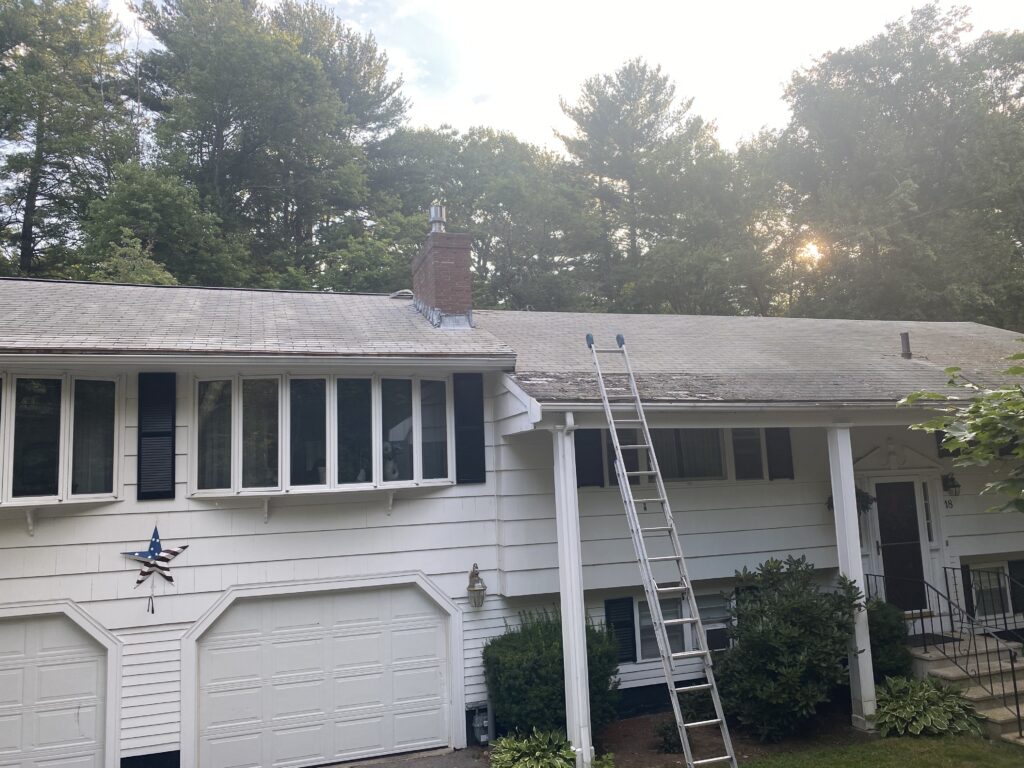
Derek doesn’t quote a repair off a photo you text him. Before we recommend anything, someone gets on the roof and checks the decking for soft spots, pulls back shingles at the leak point to see what’s actually happening underneath, checks the flashing at every chimney, skylight, and valley, and looks at ridge and soffit ventilation because a roof that can’t breathe cooks itself from the inside regardless of how good the shingles are. Then, if we can get into the attic, we look at the underside of the decking for daylight, staining, or rot, because that tells us things the surface never will.
Only after that walk-through do we tell you what we found and what it means. Sometimes that’s a $[PRICE_LOW] flashing repair. Sometimes it’s a section of decking that needs to come out. We’d rather tell you the second one up front than have you find out after a repair falls apart in eighteen months.
What the Job Involves
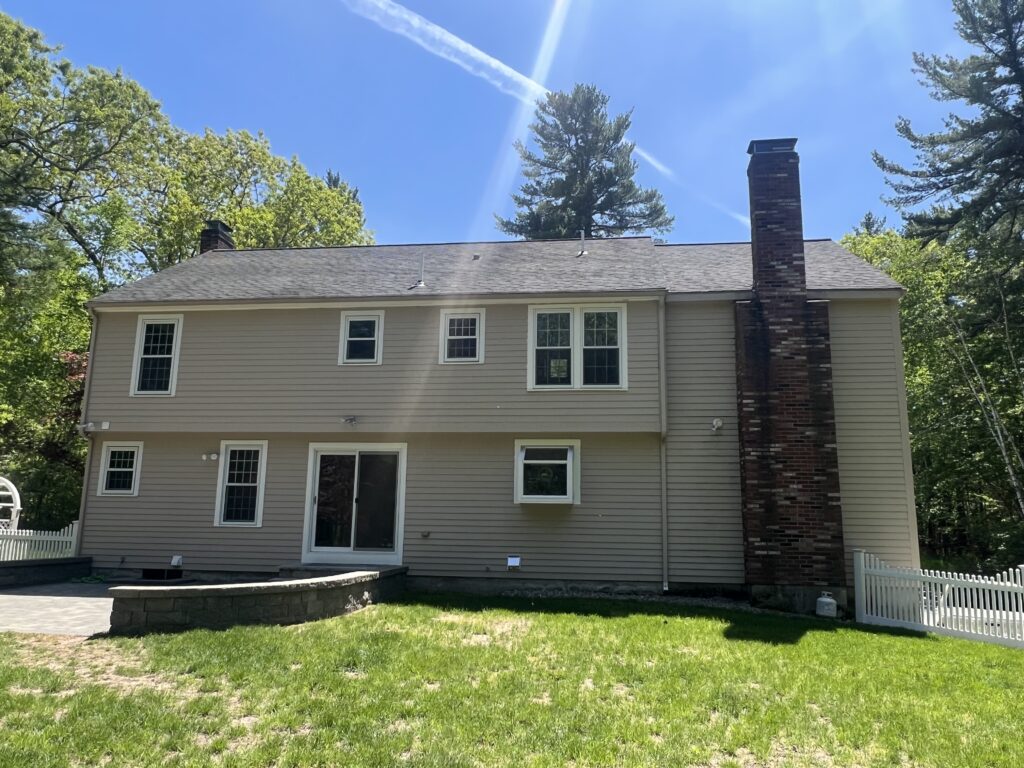
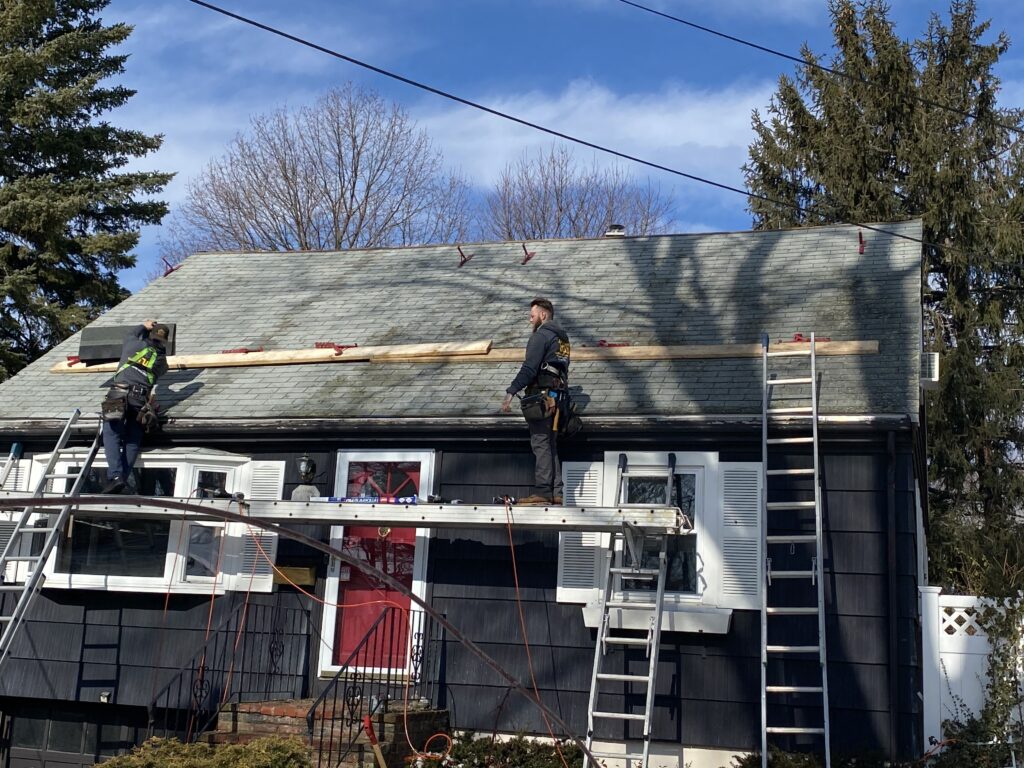
A straightforward repair, say a failed pipe boot or a cracked section of flashing, usually means pulling the affected shingles, replacing the underlayment and flashing in that section, and re-shingling to match as close as the existing material allows. If the leak traces back to a valley, we’re often stripping that whole valley down to decking and rebuilding it with new ice and water shield and valley metal, since a patched valley rarely holds through a second winter.
If we find soft or delaminated decking, and in older Salem homes with a history of ice dams that’s common, that section gets cut out and replaced with matching plywood before anything goes back down. We won’t shingle over bad decking. It doesn’t hold fasteners and it defeats the purpose of the repair. On homes in the historic district, we match material specs to whatever the district has approved for that structure, which sometimes means sourcing a specific shingle profile or color rather than whatever’s fastest to get.
What It Costs
Repairs in Salem typically run from about $[PRICE_LOW] for a contained fix, like a section of flashing or a handful of storm-damaged shingles, up to $[PRICE_HIGH] when a valley or larger decking section needs to be rebuilt. What moves the number is roof size and pitch, how many layers of old roofing are already down, whether the decking underneath is sound, and how hard the spot is to access, a rear low-slope addition tucked behind a two-family is a different job than an open front slope. We give you a number after the assessment, not before it, because a guess made from the driveway is exactly the kind of estimate that gets revised halfway through the job.
How Long It Takes
Most single-area repairs in Salem are a one-day job, start to finish, weather permitting. If we find decking damage or the repair grows into a full valley rebuild, plan on two days. Anything larger than that, we’ll tell you before we start, not after we’ve already opened up the roof.
Can my roof be repaired instead of replaced?
Often, yes. A single failed flashing point, a storm-damaged section, or an isolated valley leak can usually be repaired without touching the rest of the roof, as long as the decking underneath is sound and the shingles elsewhere aren't already at the end of their life. We tell you honestly which situation you're in after we've actually looked, not before.
How do I know if it's a repair or I need a whole new roof?
The deciding factors are decking condition, how widespread the shingle wear is, and whether the leak is isolated or showing up in multiple spots. One bad valley on an otherwise sound roof is a repair. Granule loss and curling shingles across the whole field, combined with soft decking in more than one area, usually means repair is a short-term fix at best.
Does homeowners insurance cover roof repair in Salem?
Sometimes, if the damage is from a specific storm event like wind or hail rather than gradual wear. We can document what we find during the assessment, which your insurer will typically ask for, but we're not the ones who decide what your policy covers.
What causes ice dams on Salem roofs?
Heat escaping from the attic melts snow on the upper roof, and that water refreezes at the cold eaves where it backs up under the shingles. It's a ventilation and insulation problem as much as a roofing one, which is why we check ridge and soffit venting as part of any repair assessment, especially on north-facing slopes that stay cold longest.
Can you repair a roof in Salem's historic district?
Yes, but material and sometimes method have to fit what the district has approved for that structure. We factor that into the assessment so you're not stuck ordering a shingle that isn't allowed on your street.
Get an Estimate
If you’ve got a leak, a missing shingle, or a soft spot you noticed from the attic, call {PHONE} and we’ll get someone out to look at it. Couture’s Construction is based in Methuen and works roofs across Salem and the rest of the North Shore. We’re BBB accredited with an A+ rating, and we’ll give you a straight answer on repair versus replacement before any work starts, not after.