
- Home
- Services
- Locations
Amesbury, MA
Boxford, MA
Chelmsford, MA
Danvers, MA
Dracut, MA
Essex, MA
Georgetown, MA
Groveland, MA
Hamilton, MA
Haverhill, MA
Ipswich, MA
Merrimac, MA
Methuen, MA
Middleton, MA
Newbury, MA
Newburyport, MA
North Andover, MA
North Reading, MA
Peabody, MA
Rowley, MA
Salem, MA
Salisbury, MA
Tewksbury, MA
Topsfield, MA
Topsfield, MA
West Newbury, MA
Atkinson, MA
Derry, NH
East Kingston, NH
Kensington, NH
Kingston, NH
Londonderry, NH
Plaistow, NH
Salem, NH
- Company
- Contact
- Home
- Services
- Locations
Amesbury, MA
Boxford, MA
Chelmsford, MA
Danvers, MA
Dracut, MA
Essex, MA
Georgetown, MA
Groveland, MA
Hamilton, MA
Haverhill, MA
Ipswich, MA
Merrimac, MA
Methuen, MA
Middleton, MA
Newbury, MA
Newburyport, MA
North Andover, MA
North Reading, MA
Peabody, MA
Rowley, MA
Salem, MA
Salisbury, MA
Tewksbury, MA
Topsfield, MA
Topsfield, MA
West Newbury, MA
Atkinson, MA
Derry, NH
East Kingston, NH
Kensington, NH
Kingston, NH
Londonderry, NH
Plaistow, NH
Salem, NH
- Company
- Contact
Roof Repair in Ipswich, MA
Ipswich has more First Period and early colonial houses than almost any town on the North Shore, and a lot of those roofs have been reframed, added onto, and reroofed more than once over two or three hundred years. Add in the wind coming off Plum Island Sound and the salt air working on flashing and fasteners, and you get roofs that fail in ways a inland ranch house never will.
Roof Repair in Ipswich
A repair call in Ipswich usually starts with a leak, a stain on a ceiling, or a shingle that showed up in the yard after a nor’easter. Sometimes it is a small, contained fix. Sometimes the leak is a symptom of something bigger under the shingles. We do not know which one it is until we get on the roof, and we will tell you straight which one it is once we do.
This page is not a setup to sell you a full replacement. Plenty of the roofs we look at in Ipswich need a flashing repair, a section of damaged decking, or a few courses of shingles replaced, and that is exactly the job we do. We only recommend replacement when the roof itself is telling us that is the honest answer.
What Ipswich Roofs Are Up Against
Proximity to open water matters here. Ipswich sits close enough to the coast that wind uplift is a real design factor, not a theoretical one. Standard three-tab shingles rated for 60 or 70 mph winds get outperformed fast by architectural shingles rated for 110 to 130 mph, and we see the difference in which roofs are missing shingles after a storm and which ones are not. Salt-laden air also accelerates corrosion on exposed nail heads and older galvanized flashing, which is a big reason chimney and valley flashing fails here before it does thirty miles inland.
The other factor is the age and shape of the housing stock. A lot of Ipswich’s First Period and colonial homes have complicated roof geometry, multiple additions, low-slope rear sections built onto a steep original roof, and dormers cut into places that were never meant to shed water efficiently. Valleys under heavy oak and maple canopy collect debris and hold moisture longer than they should, and north-facing slopes on these older homes build ice dams in a hard winter because the roof was framed before anyone thought about ventilation. Historic district guidelines in parts of town also affect what materials and colors are allowed, which we plan around before we ever price a job.
How We Assess It
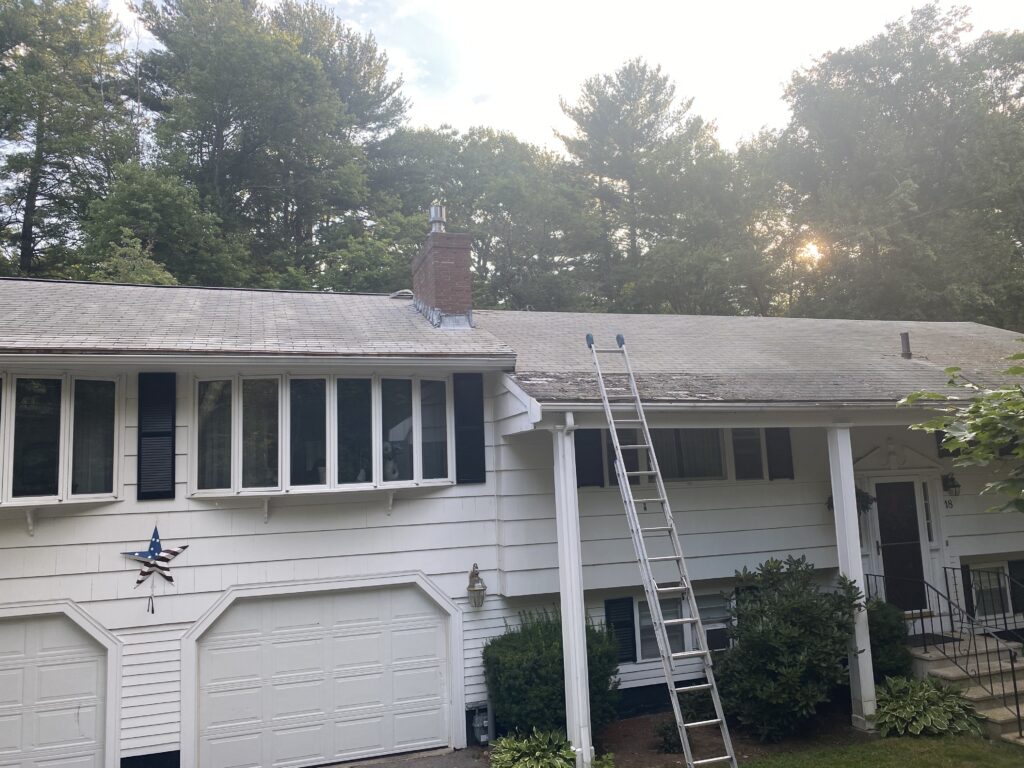
Derek gets on the roof himself before anything gets quoted. That means walking the field, checking the decking for soft spots underfoot, pulling back shingles at the suspect area to see what the underlayment and flashing actually look like, and checking valleys, chimney step flashing, and any skylight or vent penetrations. We also go into the attic when we can, because a flashlight under the roof deck tells you things a ladder from the ground never will. Stained sheathing, daylight coming through at a nail, rust trails, and inadequate ridge or soffit ventilation all show up from underneath before they show up as a ceiling stain.
Only after that walk-through do we tell you what is actually wrong, what your real options are, and what each one costs. If it is a contained repair, we say so. If the decking is soft in three spots and the shingles are cupping across the whole south slope, we say that too. Either way, you get the assessment before the recommendation, not the other way around.
What the Job Involves
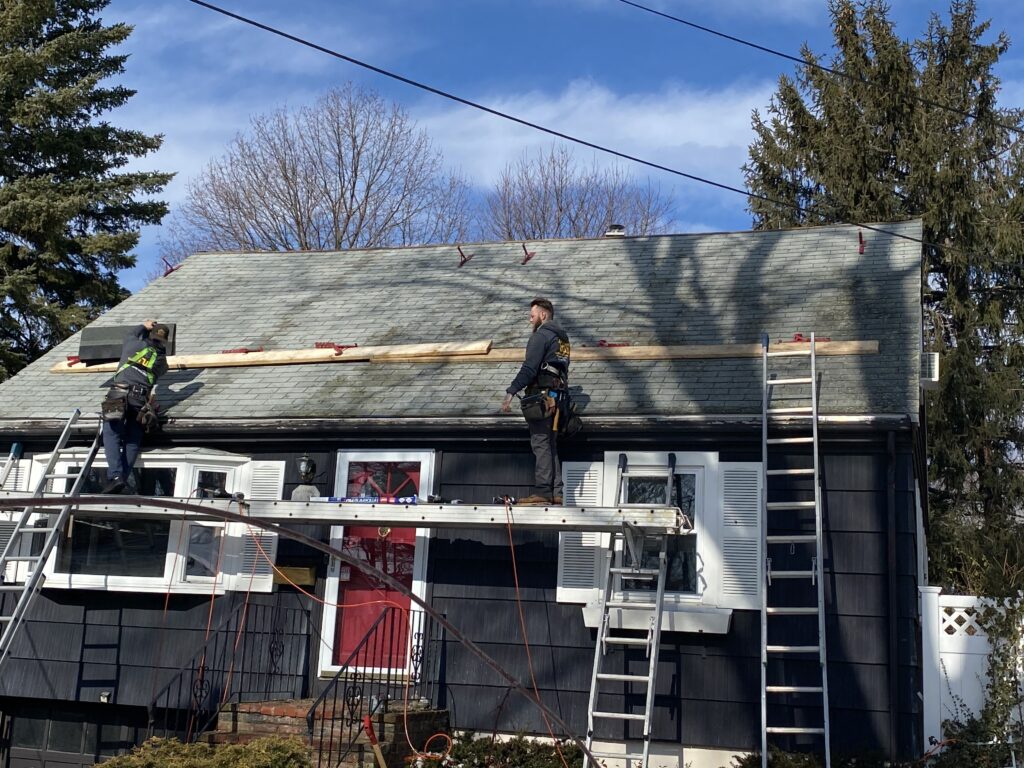
Most Ipswich repair jobs fall into a handful of categories. Flashing repair or replacement at chimneys, valleys, and skylights is common, especially on older homes where the original flashing was never properly step-flashed into the masonry. Localized shingle replacement after wind or ice damage is another frequent call, matching the existing shingle as closely as the manufacturer’s current line allows. Decking repair comes up when a leak has been running long enough to rot plywood or old board sheathing, and that section gets cut out and replaced before anything goes back over it. Ice and water shield gets added or extended along eaves and valleys on a lot of these older roofs, since many were built long before that product existed and it is one of the more effective upgrades you can make during a repair.
On roofs with ventilation problems, we sometimes recommend adding or improving ridge and soffit venting as part of the repair, since a roof that cannot breathe properly will keep producing ice dams and moisture problems no matter how many shingles you replace.
What It Costs
Repair costs in Ipswich generally run from {PRICE_LOW} to {PRICE_HIGH}, and where you land in that range depends on a few things: how much of the roof is affected, the pitch and how safely we can access it, whether there is one layer of shingles or two to work around, and whether we find sound decking or rotted sheathing once the shingles come off. A straightforward flashing repair on an accessible single-story section is a different job than a valley repair on a steep, three-story colonial with limited ladder access. We give you a number after the assessment, not before, because a number given before is a guess.
How Long It Takes
A contained flashing or shingle repair is usually a one-day job, sometimes finished in a few hours if the weather cooperates and access is straightforward. Repairs that involve decking replacement or work on multiple sections of an older, complex roof can run two to three days. We will give you a realistic window once we know what we are dealing with, and we do not schedule storm-damage repairs with the kind of urgency that skips the assessment step.
Can my Ipswich roof be repaired instead of replaced?
Often, yes. A lot of what we find in Ipswich is a contained problem, a failed flashing detail, a section of storm-damaged shingles, or a soft spot in the decking, that can be fixed without touching the rest of the roof. We only recommend full replacement when the roof's overall condition, age, or the extent of damage genuinely calls for it.
Why does wind rating matter for a roof this close to the water?
Ipswich is close enough to open water that sustained wind and gusts during coastal storms are stronger and more frequent than they are further inland. Standard shingles rated for lower wind speeds are more prone to blow-offs here, which is why we often recommend upgrading to a higher wind-rated architectural shingle during a repair or replacement.
Do historic district rules in Ipswich affect roof repairs?
In some parts of town, yes. Material and color choices can be restricted for homes in historic districts. We account for this before pricing a job so you are not surprised by a restriction after the fact.
What causes ice dams on older Ipswich homes?
A combination of inadequate attic insulation, poor ridge and soffit ventilation, and roof framing that predates modern building practices. Heat escapes into the attic, melts snow on the roof, and the meltwater refreezes at the cold eaves, backing up under the shingles. Adding ice and water shield and improving ventilation are the two most effective fixes.
How fast can you get to an active leak?
We prioritize active leaks over routine estimates. Call {PHONE} and we will get someone out to assess it as soon as we can, generally within a few days depending on weather and current jobs.
Get an Estimate
If you have a leak, a stain, or missing shingles anywhere on your Ipswich roof, call Couture’s Construction at {PHONE}. We will get on the roof, tell you what is actually going on, and give you a straight answer on whether repair is the right call or whether it is time to talk about replacement. Either way, you get the same honest look before we recommend anything.