
- Home
- Services
- Locations
Amesbury, MA
Boxford, MA
Chelmsford, MA
Danvers, MA
Dracut, MA
Essex, MA
Georgetown, MA
Groveland, MA
Hamilton, MA
Haverhill, MA
Ipswich, MA
Merrimac, MA
Methuen, MA
Middleton, MA
Newbury, MA
Newburyport, MA
North Andover, MA
North Reading, MA
Peabody, MA
Rowley, MA
Salem, MA
Salisbury, MA
Tewksbury, MA
Topsfield, MA
Topsfield, MA
West Newbury, MA
Atkinson, MA
Derry, NH
East Kingston, NH
Kensington, NH
Kingston, NH
Londonderry, NH
Plaistow, NH
Salem, NH
- Company
- Contact
- Home
- Services
- Locations
Amesbury, MA
Boxford, MA
Chelmsford, MA
Danvers, MA
Dracut, MA
Essex, MA
Georgetown, MA
Groveland, MA
Hamilton, MA
Haverhill, MA
Ipswich, MA
Merrimac, MA
Methuen, MA
Middleton, MA
Newbury, MA
Newburyport, MA
North Andover, MA
North Reading, MA
Peabody, MA
Rowley, MA
Salem, MA
Salisbury, MA
Tewksbury, MA
Topsfield, MA
Topsfield, MA
West Newbury, MA
Atkinson, MA
Derry, NH
East Kingston, NH
Kensington, NH
Kingston, NH
Londonderry, NH
Plaistow, NH
Salem, NH
- Company
- Contact
Roof Repair in Amesbury, MA
Walk through Amesbury’s Point neighborhood or up near the old mill district and you’ll see a lot of roofs that have been patched more than once, on houses built long before anyone thought about ice and water shield or ridge venting. Mix in the newer capes and colonials out toward Route 150, and you get two very different roof problems living in the same zip code.
Roof Repair in Amesbury
Most calls we get from Amesbury start the same way: a stain on a ceiling, a shingle in the yard after a windy night, or a leak that shows up every time it rains sideways out of the northeast. Before anyone talks about tearing a roof off, the question is simpler – can this be fixed, and if so, how long will the fix hold. That’s what a repair call is supposed to answer, and we treat it that way every time.
We’re not going to walk your roof and tell you it needs full replacement because that’s the easier sale. If a section of flashing failed and the decking underneath is dry, we’ll fix the flashing. If three shingles blew off in a March nor’easter and the rest of the field is sound, we’ll replace three shingles. Repair is the right answer more often than the roofing industry likes to admit.
What Amesbury roofs are up against
The older housing stock in and around Amesbury center – a lot of it dating back to the town’s carriage-making days in the 1800s – tends to have steep, complicated rooflines with multiple valleys, dormers, and additions tacked on over the decades. Every valley is a place where water concentrates, and every place two roof planes meet is a place flashing can fail. On a lot of these homes the original decking is full-thickness board sheathing, which holds up well structurally but doesn’t always play nice with modern ice and water membrane if it’s cupped or uneven.
Amesbury also sits close enough to the Merrimack and the coast that wind exposure matters more here than it does further inland. Homes on higher, more open lots – especially anything near the river or on a ridge without much tree cover – see more shingle lift and edge damage in a hard blow than a house tucked into a wooded lot in South Amesbury. On the flip side, heavy tree cover brings its own problem: valleys and gutters clog with leaves and pine debris, water backs up under the shingle courses, and that’s how a slow leak starts two winters before anyone notices the ceiling stain.
How we assess it
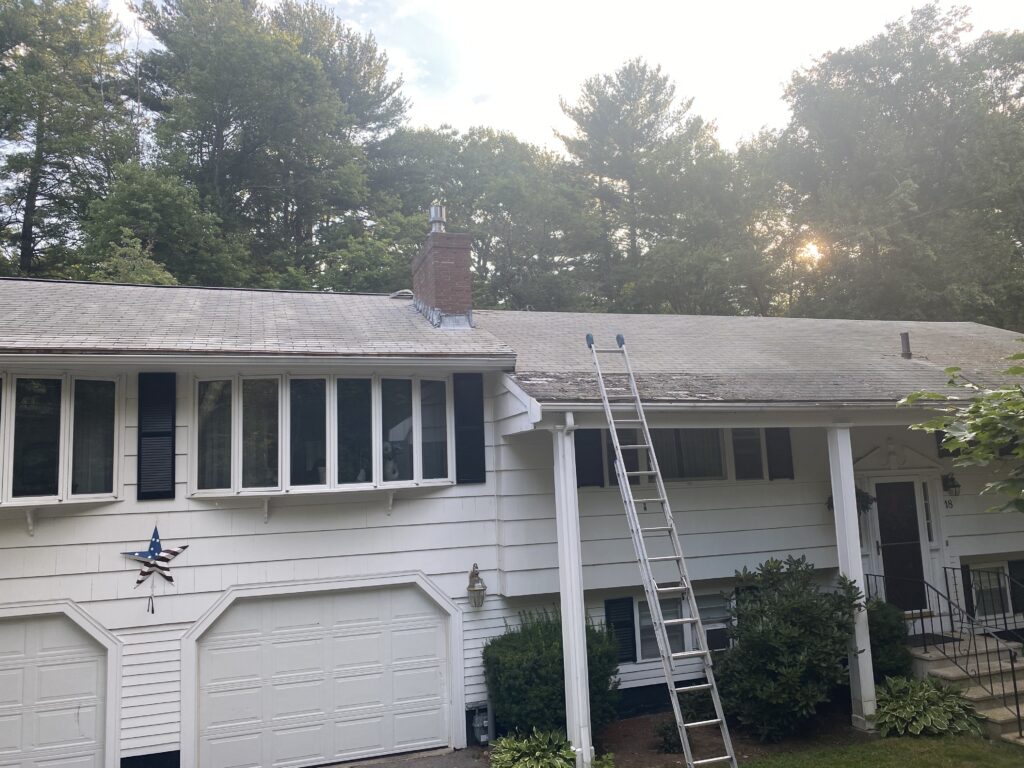
Before we tell you anything, we get on the roof. Derek or one of our lead guys will check the shingle field for granule loss and cracking, pull back the area around any suspected leak to look at the underlayment, and check every flashing point – chimney, sidewall, valley, any roof-to-wall transition. Then we go inside and look at the attic from underneath: is the decking stained, soft, or delaminating, is there enough soffit and ridge ventilation, is there daylight anywhere it shouldn’t be.
That’s the whole point of the assessment – we’re not guessing from the ground with binoculars. A roof can look fine from the driveway and have a rotted valley underneath, or look rough from the street and actually be structurally sound with a fixable flashing problem. We tell you what we actually find, including when the honest answer is that a patch will get you another few years and a full replacement isn’t necessary yet.
What the job involves
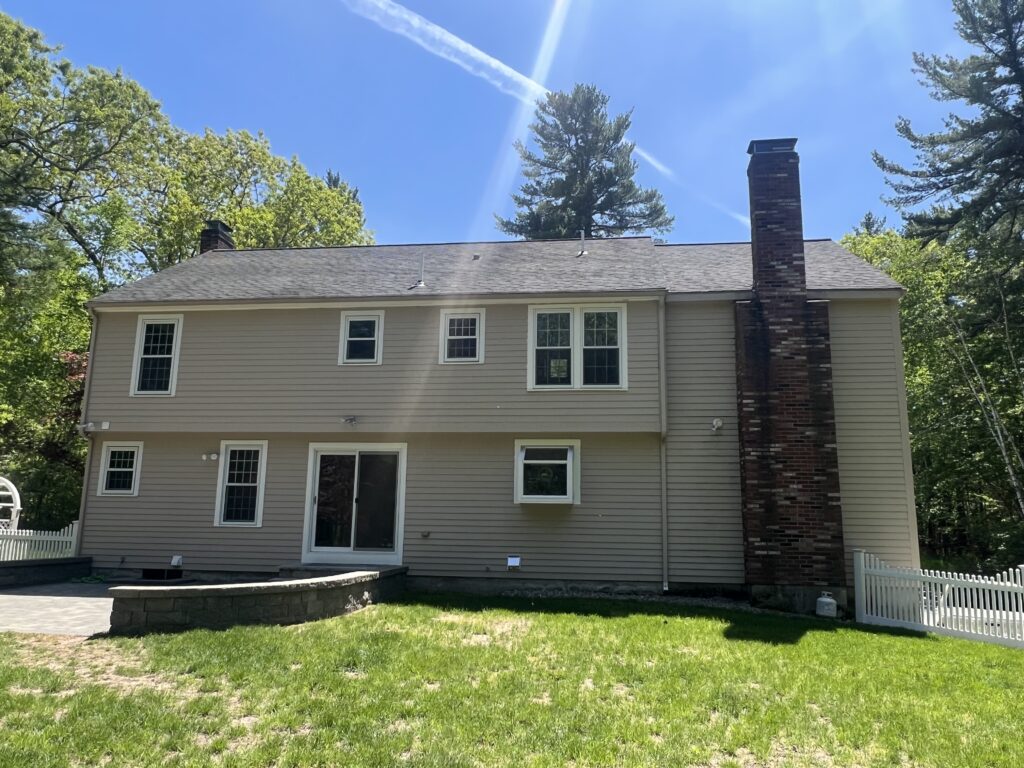
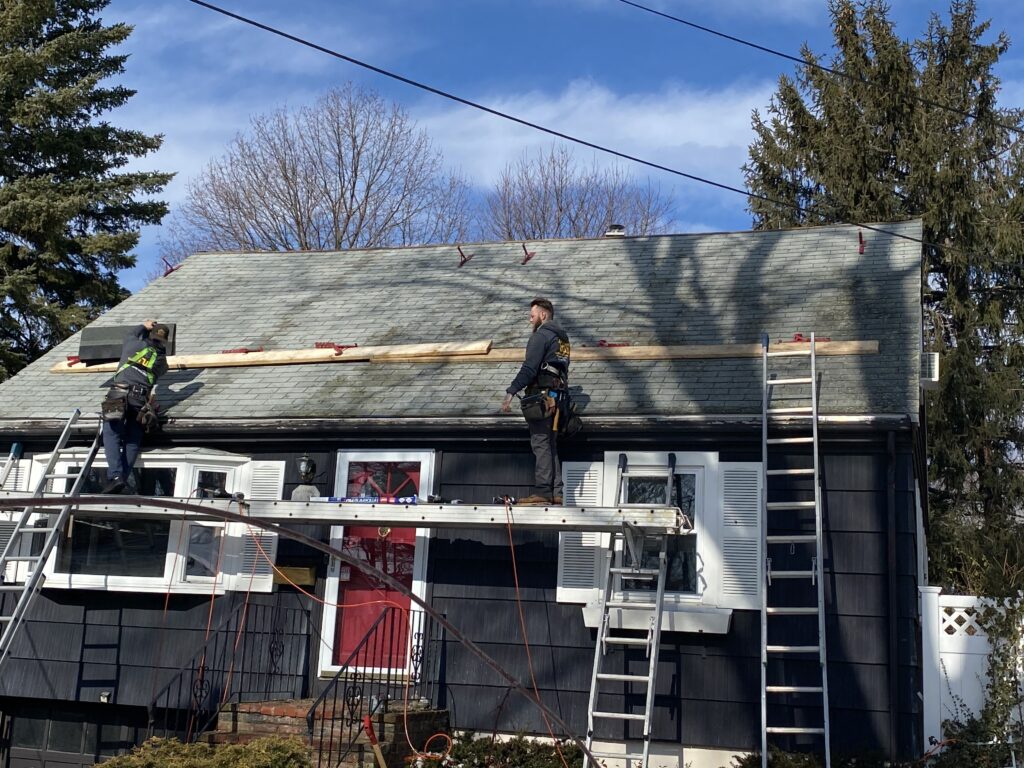
A repair job in Amesbury usually falls into one of a few categories. Flashing repair around a chimney or sidewall, where the old step flashing or counter-flashing has separated or rusted through. Shingle replacement in a section damaged by wind or falling limbs, matched as close as we can to the existing color and profile. Valley repair, which often means pulling the shingles back, installing proper ice and water shield, and rebuilding the valley metal correctly instead of just caulking over the problem. And ventilation fixes, since a lot of the ice dam damage we see in this town traces back to poor attic airflow rather than the shingles themselves.
Whatever the specific fix, we use materials that match what’s already on your roof where possible, and we don’t leave a job half-addressed. If we find the decking is soft in the repair area, we’ll tell you before we close it back up, not after.
What it costs
Most roof repairs we do in Amesbury run between {PRICE_LOW} and {PRICE_HIGH}, and where a job lands in that range depends on a handful of things: how much of the roof is affected, the pitch and how safely we can access it, whether we’re dealing with one layer of shingles or two, and whether the decking underneath is sound or needs to be opened up and replaced. A single flashing repair on an easy 6/12 pitch is a different job than a valley rebuild on a steep Victorian roofline with a chimney in the mix. We give you a number after we’ve actually seen the roof, not before.
How long it takes
Most straightforward repairs – a flashing fix, a section of shingles, a small valley section – get done in a single day, sometimes half a day depending on access. Bigger jobs, like a full valley rebuild or a repair that turns up rotted decking once we open it up, can run into a second day. Weather matters too. We’re not shingling in the rain, and in the winter months an ice dam repair sometimes has to wait for a thaw before we can safely and correctly seal it back up.
Can my roof actually be repaired, or does it need to be replaced?
It depends on what's actually wrong, not on how old the roof looks from the driveway. If the decking is dry and the damage is localized – a flashing failure, a section of wind-damaged shingles, a clogged valley – repair is usually the right call. Replacement makes sense when the decking has widespread rot, the shingles are failing across the whole field, or the roof has multiple past repairs stacking up. We'll tell you which situation you're in after we've actually looked.
How do I know if my leak is from the roof or from an ice dam?
Ice dams typically show up as staining near the eaves or in a corner of a ceiling right after a freeze-thaw cycle, not during a heavy rain. A roof leak from failed flashing or damaged shingles tends to show up during or right after a storm. Either way, the fix starts with getting into the attic to see where water is actually entering, since the stain on your ceiling isn't always directly under the source.
Do you match shingles on a repair or does the patch look different?
We do our best to match the existing shingle brand, color, and profile as closely as possible. Shingles fade with age and sun exposure, so on an older roof a patch may look slightly newer for a season or two until it weathers in. If the shingle is discontinued or the color is too far off, we'll tell you that upfront so there are no surprises.
Will you push me toward a full roof replacement even if I only need a repair?
No. We assess the roof, tell you what we found, and give you the honest options. If a repair solves the problem, that's what we recommend. Plenty of roofs we've walked in Amesbury needed nothing more than a flashing fix or a section of shingles.
How fast can you get out for a repair, especially if there's an active leak?
Call {PHONE} and describe what's happening. Active leaks get prioritized since water damage gets worse the longer it sits. We'll get someone out to assess it and, if it's a straightforward fix, often handle it same visit or within a day or two.
Get an estimate
If you’ve got a stain on the ceiling, a shingle in the yard, or you just want someone to look at a roof before winter instead of after, call {PHONE}. We’ll come out, get on the roof and in the attic, and tell you straight what we see and what it’ll take to fix it.