
- Home
- Services
- Locations
Amesbury, MA
Boxford, MA
Chelmsford, MA
Danvers, MA
Dracut, MA
Essex, MA
Georgetown, MA
Groveland, MA
Hamilton, MA
Haverhill, MA
Ipswich, MA
Merrimac, MA
Methuen, MA
Middleton, MA
Newbury, MA
Newburyport, MA
North Andover, MA
North Reading, MA
Peabody, MA
Rowley, MA
Salem, MA
Salisbury, MA
Tewksbury, MA
Topsfield, MA
Topsfield, MA
West Newbury, MA
Atkinson, MA
Derry, NH
East Kingston, NH
Kensington, NH
Kingston, NH
Londonderry, NH
Plaistow, NH
Salem, NH
- Company
- Contact
- Home
- Services
- Locations
Amesbury, MA
Boxford, MA
Chelmsford, MA
Danvers, MA
Dracut, MA
Essex, MA
Georgetown, MA
Groveland, MA
Hamilton, MA
Haverhill, MA
Ipswich, MA
Merrimac, MA
Methuen, MA
Middleton, MA
Newbury, MA
Newburyport, MA
North Andover, MA
North Reading, MA
Peabody, MA
Rowley, MA
Salem, MA
Salisbury, MA
Tewksbury, MA
Topsfield, MA
Topsfield, MA
West Newbury, MA
Atkinson, MA
Derry, NH
East Kingston, NH
Kensington, NH
Kingston, NH
Londonderry, NH
Plaistow, NH
Salem, NH
- Company
- Contact
Commercial Roofing in West Newbury, MA
West Newbury does not have a commercial strip. What it has is a scatter of small commercial and mixed-use buildings along Main Street and Route 113, a handful of municipal and church roofs, and a fair number of barns and outbuildings sitting on the larger parcels that make up most of the town. Most of those roofs are flat or low-slope sections tacked onto older buildings, or additions built out the back of a house that now runs a business out of the front rooms. That combination is what commercial roofing looks like here, and it is a different job than the pitched asphalt roofs on the houses around it.
Flat and Low-Slope Commercial Roofing Services in West Newbury
We install and repair EPDM rubber, TPO, and modified bitumen roofing on the low-slope buildings around West Newbury. That covers the flat roof over a converted barn now used as retail or storage, the rear addition on a Main Street building, a town or church building with a built-up roof that has been patched for decades, and any outbuilding on a farm property that has been reroofed with membrane instead of shingles.
Each of these systems has a different service life and a different failure pattern. EPDM is the most common and the most forgiving to repair. TPO handles heat and reflectivity better and is the right call on a roof with a lot of sun exposure. Modified bitumen is torch-down or cold-applied and tends to show up on older buildings that were re-covered rather than fully replaced. We tell you which one is already on your roof and whether it makes sense to repair it or replace it, not sell you whichever one we happen to be pushing that month.
What West Newbury roofs are up against
West Newbury’s building stock splits into two eras and that split matters for low-slope roofs. The older buildings in the town center and along the Merrimack date back to the eighteenth and nineteenth centuries, and any flat sections on them are almost always additions or infill built later, often with less attention to slope and drainage than the original structure got. Newer construction on the outskirts of town tends to have better-designed low-slope roofs, but those buildings are fewer and farther between out here than in denser towns nearby.
Tree cover is heavy in West Newbury and it is the single biggest factor on a flat roof here. Leaves and debris collect at drains and scuppers, ponding forms behind the blockage, and standing water is what shortens the life of any membrane roof faster than sun or cold ever will. On barns and outbuildings especially, we see roofs that were fine structurally but failed early because nobody was clearing the drains twice a year. Add in the open exposure some of these outbuilding roofs get near fields and river frontage, and wind uplift on membrane seams becomes a real concern too, not just a theoretical one.
How we assess it
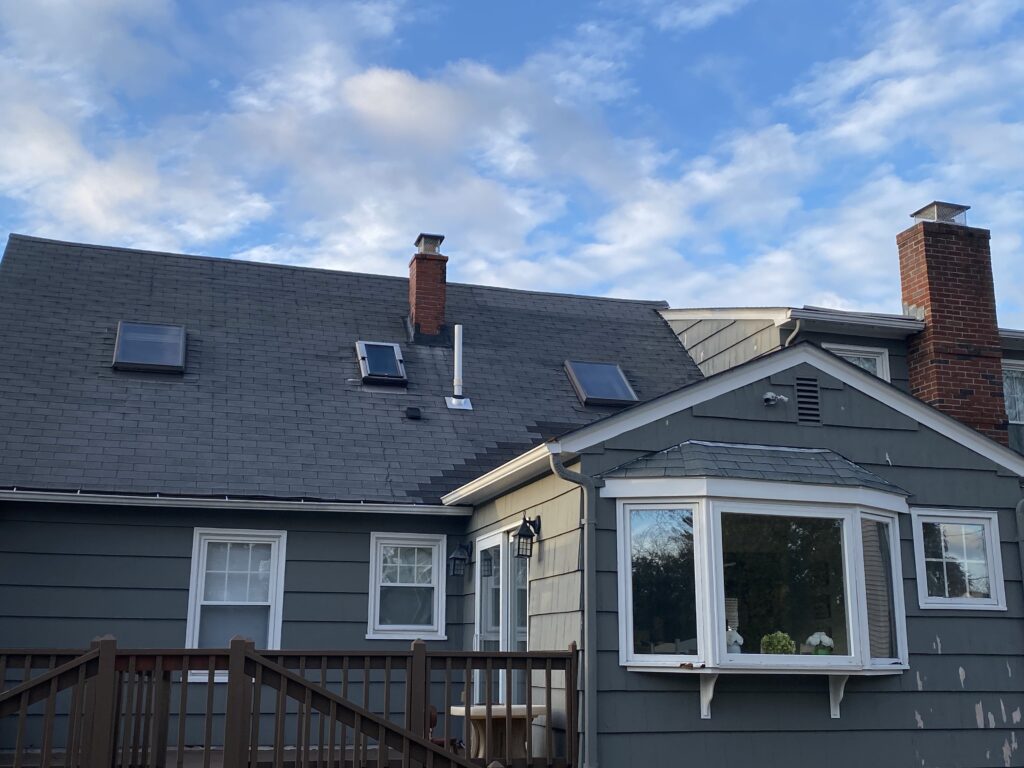
Derek walks the roof before he tells you anything. On a low-slope building that means checking the membrane for splits, blistering, and open seams, looking at every penetration and drain for separation, and checking where water is actually pooling versus where it is supposed to drain. If there is access from underneath, whether that is a barn interior or a drop ceiling, we look at the decking from below for staining and soft spots. We also check flashing at every wall termination and parapet, since that is where low-slope roofs leak more often than through the field of the membrane itself.
We do not quote a commercial roof over the phone or from a photo. A flat roof can look fine from the ground and still have soaked insulation underneath a membrane that is holding water in rather than shedding it out. You need someone on the roof to tell the difference, and that assessment happens before we talk about a fix or a number.
What the job involves
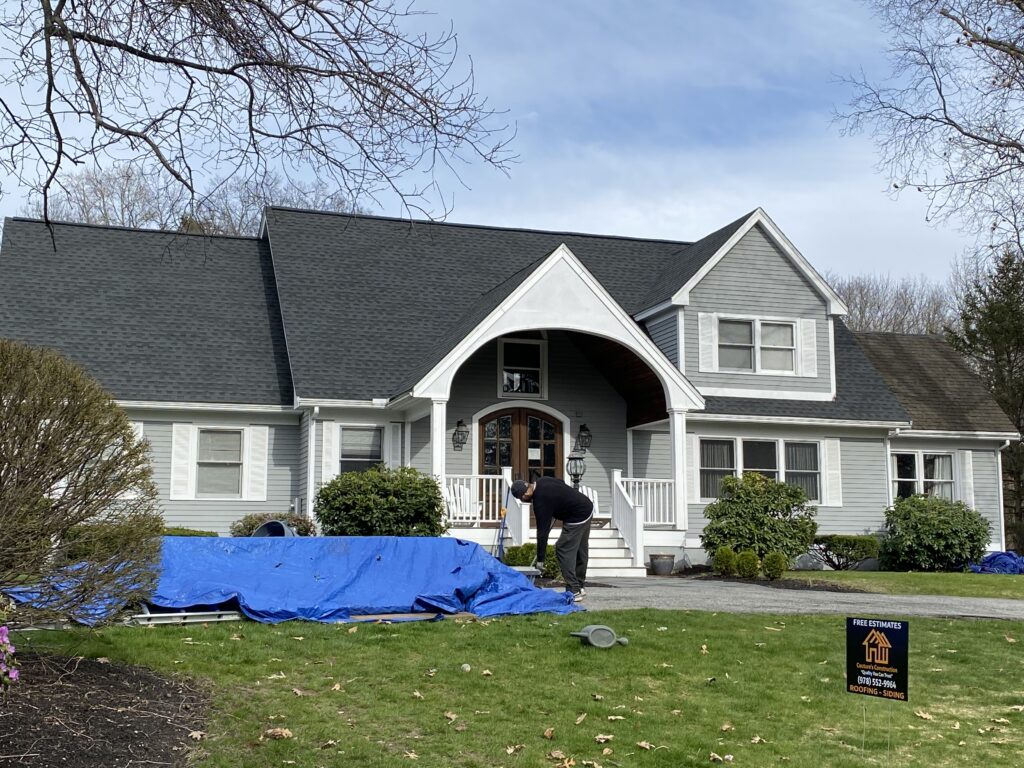
A repair on a low-slope roof usually means cutting out and patching a failed seam or section, resealing a penetration, or clearing and rebuilding a drain that has been ponding water. That is often the right call on a membrane roof that is otherwise sound, and we will tell you that plainly if it is what we find.
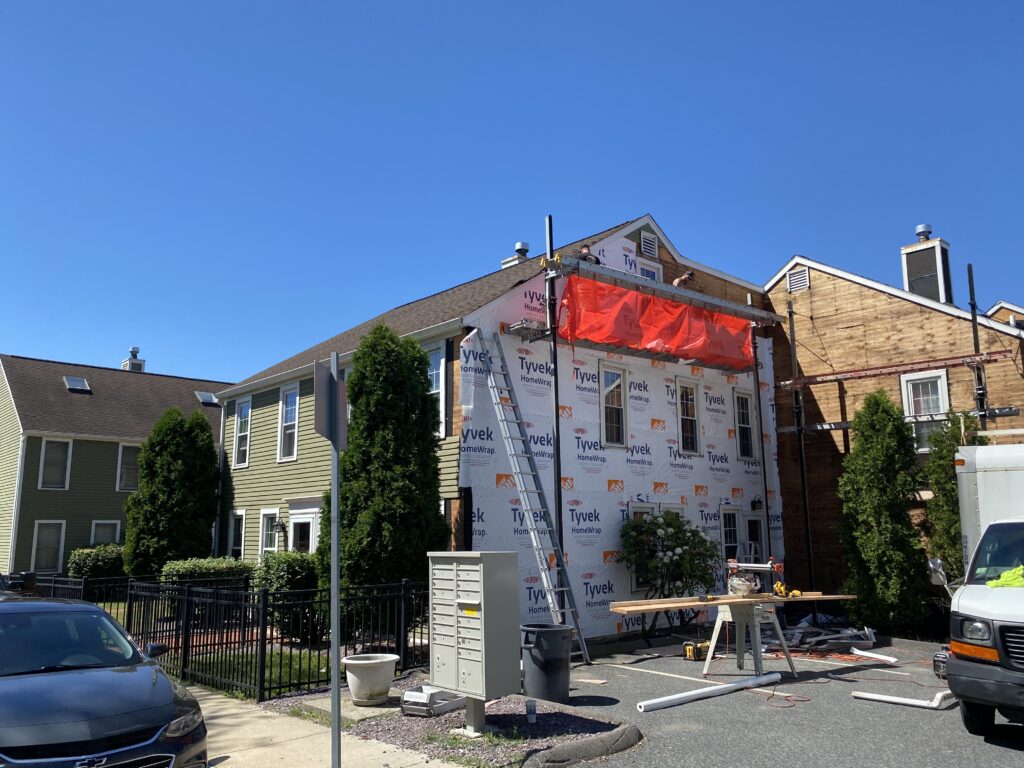
A full replacement means stripping the old membrane down to decking, checking that decking for rot or soft spots before anything new goes down, and installing new insulation board and membrane, whether that is fully adhered EPDM, mechanically fastened TPO, or a modified bitumen system torched or cold-applied in layers. Flashing at every wall, curb, and penetration gets rebuilt, not just resealed. On a building that stays open during the work, whether that is a small retail space or a working farm operation, we phase the job in sections so you are never fully exposed and never fully shut down.
What it costs
Commercial low-slope roofing in West Newbury generally runs between {PRICE_LOW} and {PRICE_HIGH}, and that range moves on a few specific things: the total square footage, how many layers of old roofing have to come off first, what condition the decking is in once we get down to it, and how the building is accessed for material and equipment. A barn roof with easy ground access costs less to work on than a rear addition roof you can only reach by hauling everything up and over an existing structure. We will not give you a number before we have seen the roof, and we will not pad the range to cover surprises we should have caught during the assessment.
How long it takes
A membrane repair or drain rebuild is usually a one-day job. A full low-slope replacement on a small commercial or outbuilding roof typically runs a few days to a week, weather dependent, since membrane installation needs dry conditions to bond and seal properly. If the building needs to stay operating, we schedule the tear-off and re-cover in sections rather than opening the whole roof at once, which adds some time but keeps you from having to close.
Do you work on barns and outbuildings, or only storefronts?
Both. A lot of the low-slope roofing work we do in West Newbury is on barns, garages, and outbuildings on larger properties, not just retail or office space. The membrane systems and the assessment process are the same either way.
Can you repair a flat roof instead of replacing it?
Often, yes. If the membrane is otherwise sound and the problem is a failed seam, a bad drain, or a damaged penetration, a targeted repair is the right and cheaper answer. We tell you honestly when a roof still has life left in it.
What membrane do you recommend for a sun-exposed low-slope roof?
TPO tends to perform better than EPDM on roofs with heavy sun exposure because of its reflectivity and heat resistance. On roofs with heavier tree cover, EPDM's easier field repairability often makes it the better long-term choice.
Can the work be phased so my business does not close?
Yes. We section the tear-off and re-cover so an operating business or an occupied building is never fully exposed to weather or fully shut down during the job.
How do you handle ponding water on an older flat roof?
Get an estimate
If you own or manage a commercial building, church, municipal property, or barn and outbuilding roof in West Newbury and something is leaking, ponding, or just old enough to worry about, call Couture’s Construction at {PHONE}. We will get up on the roof, tell you what is actually going on, and give you a straight answer on repair versus replacement before we talk about cost.