
- Home
- Services
- Locations
Amesbury, MA
Boxford, MA
Chelmsford, MA
Danvers, MA
Dracut, MA
Essex, MA
Georgetown, MA
Groveland, MA
Hamilton, MA
Haverhill, MA
Ipswich, MA
Merrimac, MA
Methuen, MA
Middleton, MA
Newbury, MA
Newburyport, MA
North Andover, MA
North Reading, MA
Peabody, MA
Rowley, MA
Salem, MA
Salisbury, MA
Tewksbury, MA
Topsfield, MA
Topsfield, MA
West Newbury, MA
Atkinson, MA
Derry, NH
East Kingston, NH
Kensington, NH
Kingston, NH
Londonderry, NH
Plaistow, NH
Salem, NH
- Company
- Contact
- Home
- Services
- Locations
Amesbury, MA
Boxford, MA
Chelmsford, MA
Danvers, MA
Dracut, MA
Essex, MA
Georgetown, MA
Groveland, MA
Hamilton, MA
Haverhill, MA
Ipswich, MA
Merrimac, MA
Methuen, MA
Middleton, MA
Newbury, MA
Newburyport, MA
North Andover, MA
North Reading, MA
Peabody, MA
Rowley, MA
Salem, MA
Salisbury, MA
Tewksbury, MA
Topsfield, MA
Topsfield, MA
West Newbury, MA
Atkinson, MA
Derry, NH
East Kingston, NH
Kensington, NH
Kingston, NH
Londonderry, NH
Plaistow, NH
Salem, NH
- Company
- Contact
Commercial Roofing in Merrimac, MA
Merrimac’s commercial buildings are mostly small and mostly old. A brick storefront with an apartment above it on Church Street, a converted mill outbuilding, a municipal roof that’s been patched more than once, a church hall with a flat rear addition off the back of a pitched roof. That’s the commercial roofing work in this town, and it’s a different job than the vinyl-sided colonials down the road.
None of those buildings can shut down for a week while a crew figures out the roof. That’s the whole game with commercial work here: get the flat or low-slope system right, and do it without shutting the tenant, the town office, or the congregation out of the building.
Flat and Low-Slope Commercial Roofing in Merrimac
Most of the commercial roofing we get called for in Merrimac isn’t a sprawling low-slope field like you’d find in an industrial park. It’s a rear addition on an older building, a flat roof over a retail space, or a low-pitch section tying into a steeper historic roofline. We work in EPDM (rubber membrane), TPO, and modified bitumen, and which one makes sense depends on the building, the slope, and what’s already up there.
EPDM is the workhorse for a lot of these older, smaller flat sections – it’s forgiving, it’s been around long enough that we know how it ages in a New England winter, and it’s usually the most cost-effective repair-and-replace option on a building that isn’t going anywhere. TPO gives you a reflective white membrane and a heat-welded seam, which matters more on a bigger open field than on a tight 800-square-foot roof, but it’s still worth pricing out. Modified bitumen is the right call on a lot of older mixed-use buildings where the roof has multiple layers of history baked into it and a torch-down or self-adhered mod-bit system is the cleanest way to get a durable, sealed surface without tearing everything down to the joists.
What Merrimac roofs are up against
Merrimac’s building stock runs old in the town center – plenty of eighteenth and nineteenth century construction along the river, with newer development further out toward the Amesbury and Newton, NH lines. On commercial and mixed-use buildings that means original framing carrying decades of roofing layers, low-slope additions bolted onto pitched main roofs, and flashing details that were never designed for the membrane systems we install today. Heavy tree cover along the Merrimack River valley adds another wrinkle – debris piles up in roof valleys and around rooftop drains faster than most owners realize, and a clogged drain on a flat roof is how ponding water turns into a leak that shows up two floors down.
Wind exposure is the other factor that’s easy to underestimate. Merrimac sits close enough to open river corridor and higher ground that a poorly-adhered membrane edge or loose flashing at a parapet can lift in a winter nor’easter the same way a shingle roof would. On the older mixed-use buildings especially, we see membrane that was installed correctly for its time but was never rated for the wind uplift standards used today, and the edge detail is usually where it starts to fail first.
How we assess it
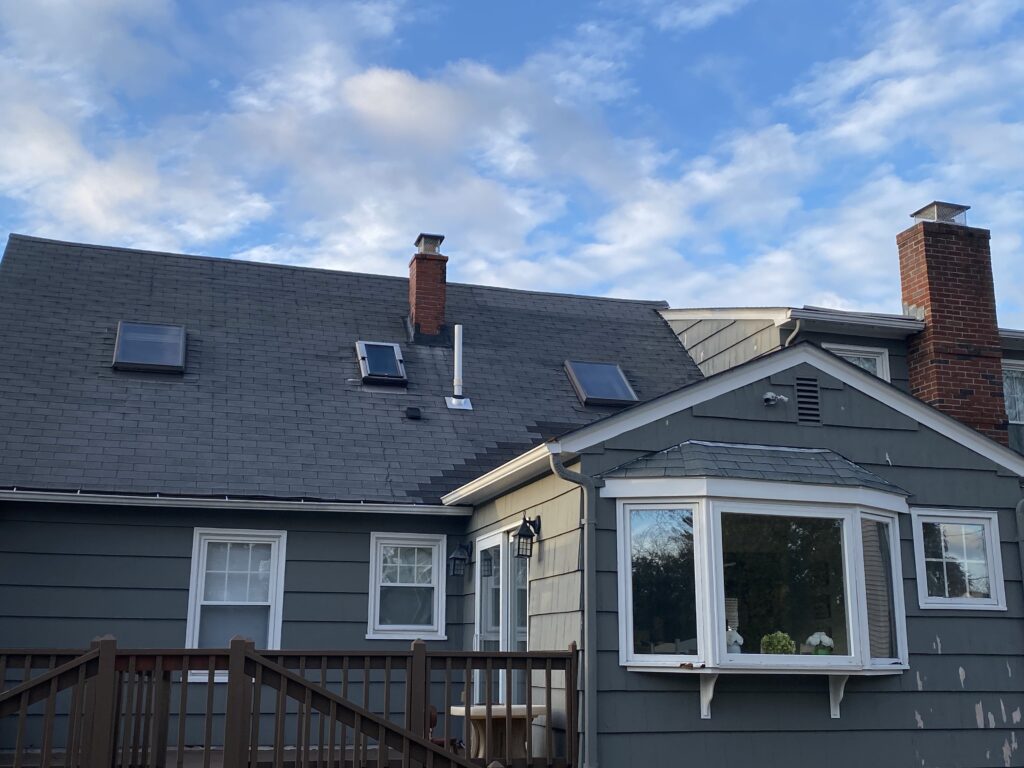
Derek walks the roof before anyone quotes a number. On a flat or low-slope commercial roof that means checking the membrane for splits, blisters, and shrinkage, checking every drain and scupper for standing water and debris, and pulling back flashing at parapets, curbs, and any rooftop equipment to see what condition the substrate is actually in underneath. If there’s attic or interior access below the roof deck, we’ll look at that too – staining, sagging, or soft spots tell you more about what’s really going on than the top surface does.
We’re not going to recommend a full tear-off on a roof that has ten good years left in it, and we’re not going to patch a membrane that’s past the point where patching makes sense. You get a straight answer on which one you’re looking at, and why, before we talk about cost.
What the job involves
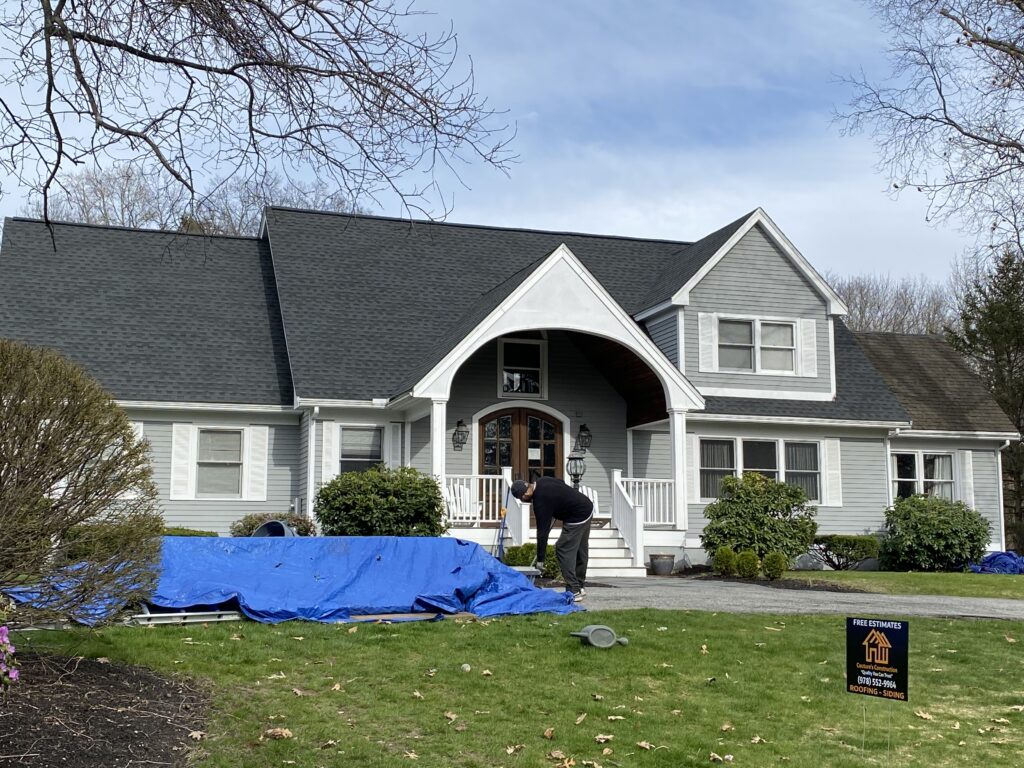
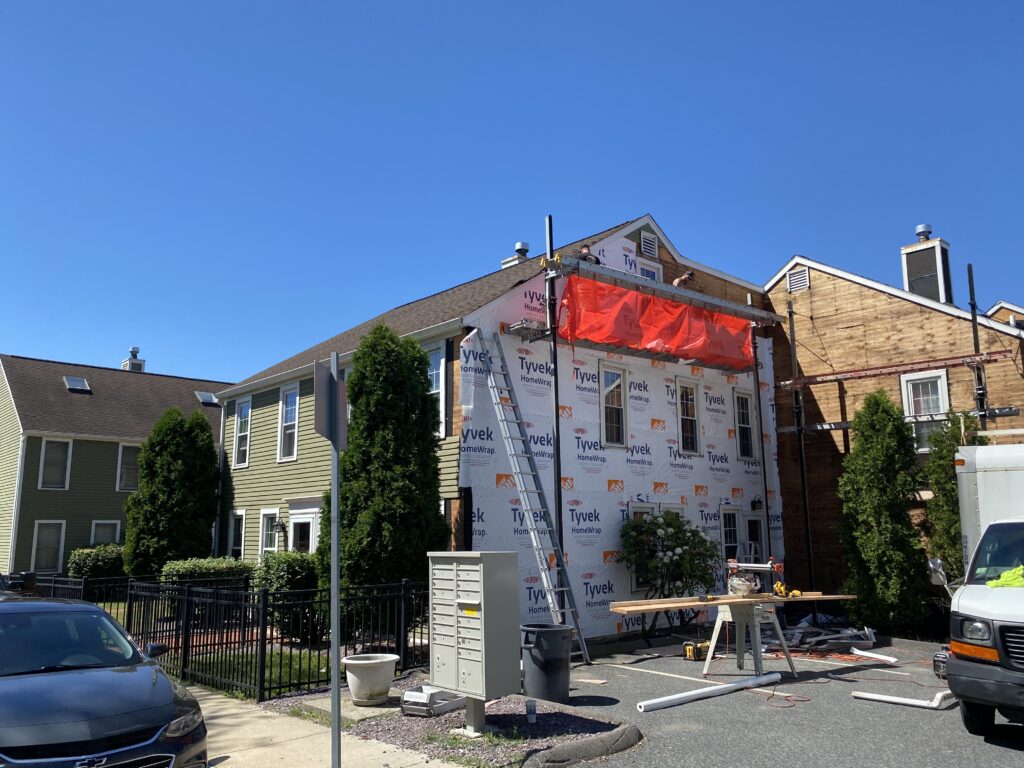
Commercial low-slope work in Merrimac is almost always a phased job because the building is occupied. That means we sequence the work in sections where possible, protect entrances and walkways, and coordinate with the owner or property manager on timing that doesn’t shut down a storefront or a town function. On a mixed-use building, that might mean working weekends or scheduling around a tenant’s hours. On a church or municipal building, it usually means working around scheduled events.
The work itself covers tear-off or overlay depending on what the deck can support, replacing rotted decking where we find it, new insulation where the R-value needs it, correct flashing at every penetration and parapet, and a membrane system installed to manufacturer spec so the warranty actually holds. We don’t cut corners on flashing details – that’s where almost every low-slope leak actually starts, not in the middle of the field.
What it costs
Commercial flat and low-slope roofing in Merrimac typically runs {PRICE_LOW} to {PRICE_HIGH}, and that range moves a lot based on square footage, how many layers need to come off, what we find once the old membrane is up, and how hard the roof is to access. A single-story mixed-use building with a small flat rear section costs a lot less to re-roof than a multi-story building where everything has to go up and down by hoist or crane. Rotted decking, once we open it up, is the other thing that changes the number – we won’t know that for certain until tear-off starts, and we’ll tell you the day we find it, not after the invoice.
How long it takes
A small commercial flat roof section in Merrimac, the kind we see most often here, usually runs a few days to a week depending on size and weather. Larger or phased jobs on occupied buildings take longer because we’re working around the tenant’s schedule, not because the roofing work itself is slow. We’ll give you a realistic timeline once we’ve seen the roof and talked through how the building needs to keep operating during the work.
Do you work on small commercial buildings, or only large ones?
Most of what we do in Merrimac is small commercial – a storefront with apartments above, a church addition, a municipal building, an outbuilding on a larger property. That's the building stock in this town, and it's the work we're set up for.
Can you replace a commercial roof without closing the business?
In most cases yes. We phase the work, protect entrances, and schedule around the tenant's or building's operating hours. We'll walk through the plan with you before work starts so there are no surprises.
What's the difference between EPDM, TPO, and modified bitumen?
EPDM is a rubber membrane that's held up well on smaller, older flat roofs for decades. TPO is a heat-welded reflective membrane that performs well on larger open low-slope fields. Modified bitumen is a layered, often torch-down or self-adhered system that works well on older buildings with complicated roof history. Which one fits your building depends on size, slope, and what's already there.
How do you know if a low-slope roof needs full replacement or just repair?
We check the membrane condition, the drains, the flashing, and the deck underneath before we say either way. If a roof has real life left in it, we'll tell you to repair it. If the membrane is past patching, we'll show you why.
Do you handle municipal or church roofing projects?
Get an estimate
If you manage or own a commercial or mixed-use building in Merrimac and the roof needs a real look, call Couture’s Construction at {PHONE}. We’re based in Methuen, BBB accredited with an A+ rating, and we’ll come look at the roof before we talk numbers. Same goes for outbuildings, church roofs, and municipal buildings – if it’s got a flat or low-slope section, we can assess it.