
- Home
- Services
- Locations
Amesbury, MA
Boxford, MA
Chelmsford, MA
Danvers, MA
Dracut, MA
Essex, MA
Georgetown, MA
Groveland, MA
Hamilton, MA
Haverhill, MA
Ipswich, MA
Merrimac, MA
Methuen, MA
Middleton, MA
Newbury, MA
Newburyport, MA
North Andover, MA
North Reading, MA
Peabody, MA
Rowley, MA
Salem, MA
Salisbury, MA
Tewksbury, MA
Topsfield, MA
Topsfield, MA
West Newbury, MA
Atkinson, MA
Derry, NH
East Kingston, NH
Kensington, NH
Kingston, NH
Londonderry, NH
Plaistow, NH
Salem, NH
- Company
- Contact
- Home
- Services
- Locations
Amesbury, MA
Boxford, MA
Chelmsford, MA
Danvers, MA
Dracut, MA
Essex, MA
Georgetown, MA
Groveland, MA
Hamilton, MA
Haverhill, MA
Ipswich, MA
Merrimac, MA
Methuen, MA
Middleton, MA
Newbury, MA
Newburyport, MA
North Andover, MA
North Reading, MA
Peabody, MA
Rowley, MA
Salem, MA
Salisbury, MA
Tewksbury, MA
Topsfield, MA
Topsfield, MA
West Newbury, MA
Atkinson, MA
Derry, NH
East Kingston, NH
Kensington, NH
Kingston, NH
Londonderry, NH
Plaistow, NH
Salem, NH
- Company
- Contact
Commercial Roofing in Essex, MA
Essex doesn’t have a business park or a strip of flat-roofed retail boxes. What it has is a handful of small commercial buildings along Main Street and Eastern Ave, a few mixed-use properties with an apartment or office over a storefront, the town’s own municipal buildings, church roofs, and a fair number of barns and outbuildings on the larger waterfront and marsh-side properties. That’s the commercial roofing reality here, and it’s worth saying plainly instead of pretending Essex is something it isn’t.
Flat and Low-Slope Commercial Roofing in Essex
Most of the commercial and mixed-use roofing we see in Essex is flat or low-slope, either because the building was built that way or because a rear addition or second-story dormer got tacked onto an older pitched-roof structure over the years. That means EPDM rubber, TPO membrane, or modified bitumen, not asphalt shingles.
EPDM is the workhorse for smaller commercial buildings and outbuildings around here. It’s a single-ply rubber membrane, it’s proven over decades, and it’s usually the more affordable option for a building owner who needs a roof that performs without a premium price tag. TPO is a heat-welded seam system, and on a building where you want a lighter reflective surface, or where the insurance or lending side wants a newer system on record, it’s often the better call. Modified bitumen still shows up on older mixed-use buildings and additions where a torch-down or self-adhered cap sheet was the original spec, and in some cases the right move is to repair or recoat that system rather than tear it off.
What Essex Roofs Are Up Against
Essex sits close enough to open water off the Essex Bay and the marsh system that wind is a real factor in any roofing decision here, commercial or residential. On a flat or low-slope commercial roof, wind uplift shows up at the perimeter and the corners first, where the membrane is most exposed to being lifted and worked loose. A roof system that wasn’t fastened or adhered to the right uplift rating for a coastal location will fail at the edges years before the field of the roof shows any wear. Salt air also shortens the life of exposed metal flashing, roof-mounted HVAC curbs, and any fasteners that aren’t rated for it.
The other issue we see on Essex’s older mixed-use buildings is ponding water. A lot of these flat roofs were built with minimal slope to begin with, and after a few decades of additions, HVAC units, and patch repairs, low spots develop where water sits instead of draining. Standing water accelerates membrane breakdown and is usually the first thing we point out on an assessment, because it’s often fixable with tapered insulation or better drainage before it becomes a full roof failure.
How We Assess It
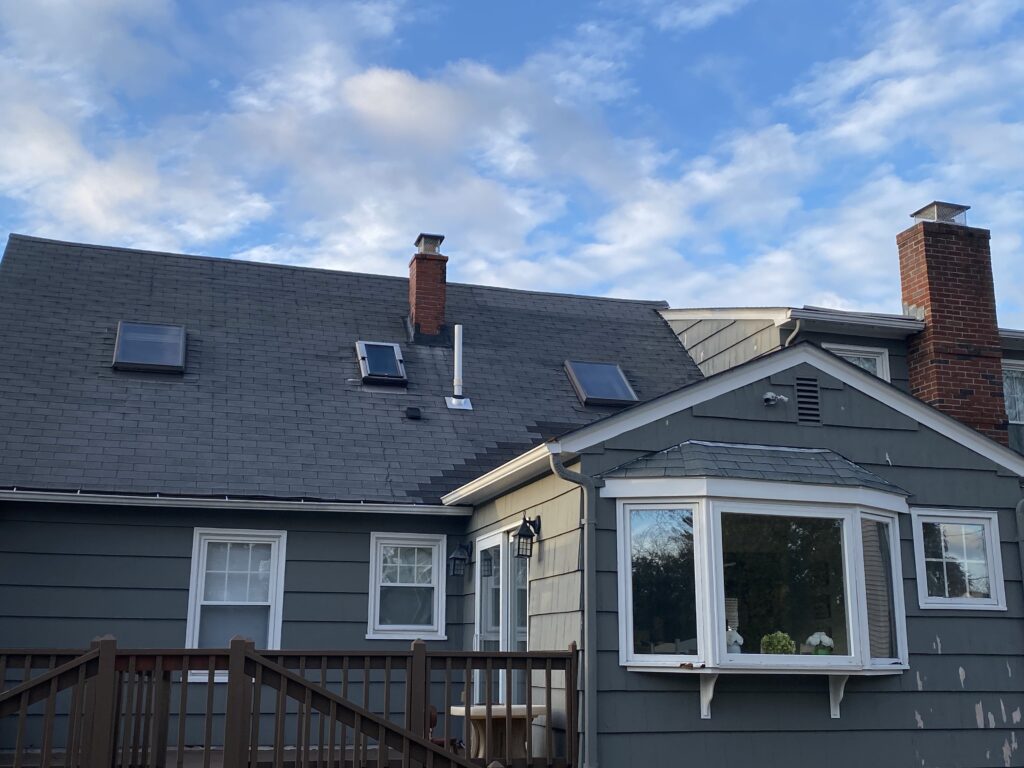
Before Derek recommends anything, he gets on the roof. On a flat or low-slope commercial building that means checking the membrane for splits, blistering, and open seams, checking every penetration, drain, and HVAC curb for failed flashing, and walking the perimeter for uplift damage or loose edge metal. If there’s an accessible ceiling or attic space below, he’ll check that too, because a stain on a ceiling tile or a damp spot on decking tells you more about where water is actually getting in than the roof surface alone does.
For municipal buildings, churches, and older mixed-use properties, we also look at what’s underneath the current membrane. A lot of these roofs have two or three layers of roofing built up over the decades, and knowing what’s actually there changes both the scope of the work and the cost. You get a straight answer about condition and options before any number gets discussed, not a sales pitch built around a worst-case scare.
What the Job Involves
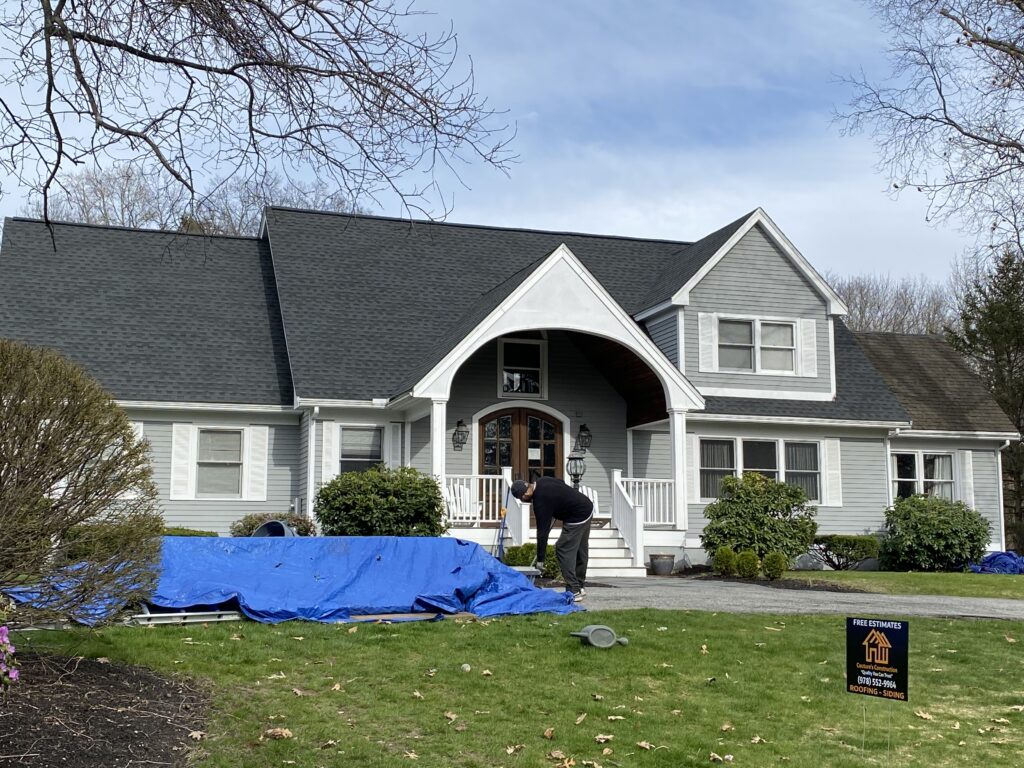
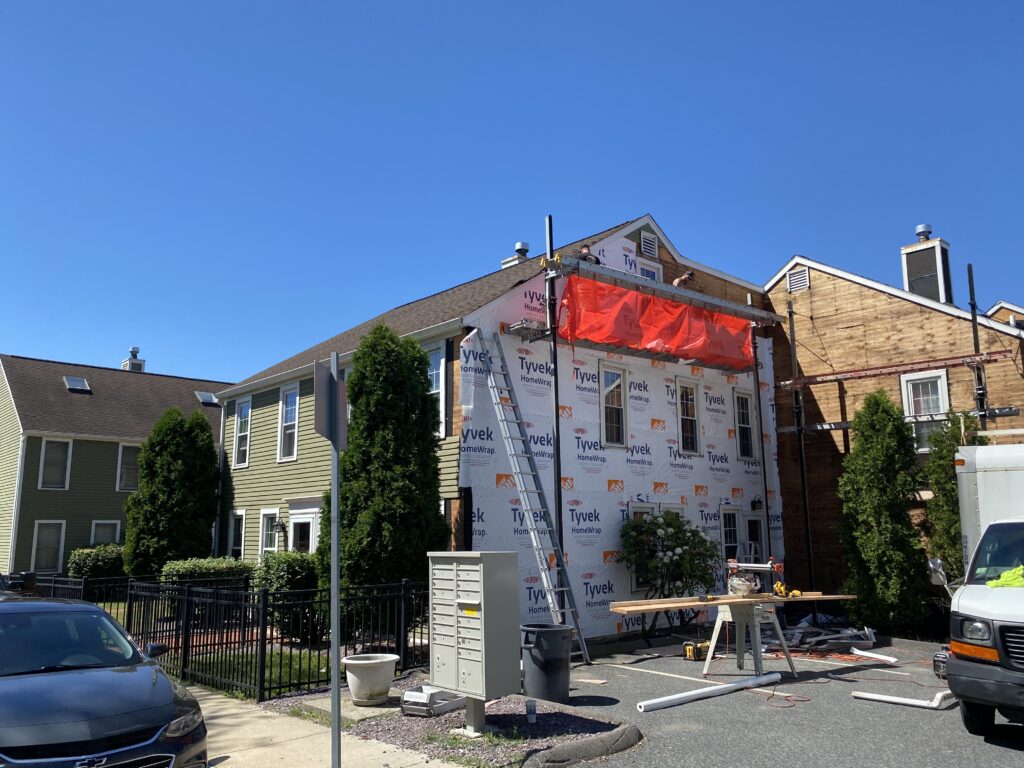
A commercial roofing job on a working building in Essex is planned around the building staying operational. If it’s a mixed-use property with a tenant below, or a municipal building that can’t shut down, we phase the work and manage material staging and access so the business or use underneath isn’t disrupted more than necessary. That usually means sectioning the roof, coordinating delivery and disposal timing, and being upfront about noise and access days in advance.
The work itself typically includes removing or preparing the existing membrane, addressing any wet or deteriorated decking or insulation found underneath, correcting drainage or low spots where they exist, installing new flashing at all penetrations and edges, and setting the new membrane system, EPDM, TPO, or modified bitumen, to the wind uplift standard the building’s location and height call for. On outbuildings and barns, the scope is often simpler, but the same attention to flashing and drainage still applies.
What It Costs
Commercial roofing in Essex runs roughly {PRICE_LOW} to {PRICE_HIGH}, and the range is wide because the buildings themselves are so different from each other, a small outbuilding is nothing like a mixed-use building with rooftop HVAC and multiple penetrations. What actually moves the number is total square footage, how many layers need to come off, the condition of the decking once we open it up, how many drains and penetrations need new flashing, and how difficult the roof is to access with equipment. We don’t quote a flat price off a phone call. We quote off what we find on the roof.
How Long It Takes
A small outbuilding or barn roof can often be done in a day or two. A mixed-use commercial building with a full tear-off, deck repair, and a new membrane system typically runs several days to a week or more depending on size and weather. Phasing to keep a building operational during the work can add time compared to a vacant building, but it’s usually worth it to avoid shutting a tenant or a municipal function down entirely.
Does Couture's Construction handle small commercial and municipal roofs, not just big buildings?
Yes. Most of the commercial roofing work in Essex is small in scale, mixed-use buildings, church and municipal roofs, and barns or outbuildings on larger properties. That's the majority of what we do here and we treat it with the same attention as a larger job.
What roofing system is best for a flat commercial roof in Essex?
It depends on the building. EPDM rubber is a proven, cost-effective choice for smaller commercial buildings and outbuildings. TPO offers a heat-welded seam and a reflective surface that some owners prefer. Modified bitumen is still a good fit for certain older mixed-use buildings. We'll tell you which one fits your building and budget after we've seen the roof.
Can you re-roof a commercial building without shutting the business down?
In most cases, yes. We phase the work, section the roof, and schedule deliveries and disposal to keep disruption to tenants or building use to a minimum. We'll walk through the plan with you before work starts.
Is wind rating actually different for a building this close to the water?
Yes. Essex is close enough to open water and the marsh system that wind uplift at roof edges and corners is a genuine concern, more than it would be further inland. We factor that into the fastening pattern and membrane system we recommend.
What if the roof has standing water in some spots?
Get an Estimate
If you own or manage a commercial, mixed-use, or municipal building in Essex, or you’ve got a barn or outbuilding roof that needs a real look, Derek will come out, get on the roof, and give you a straight assessment. Call {PHONE} to set it up.